

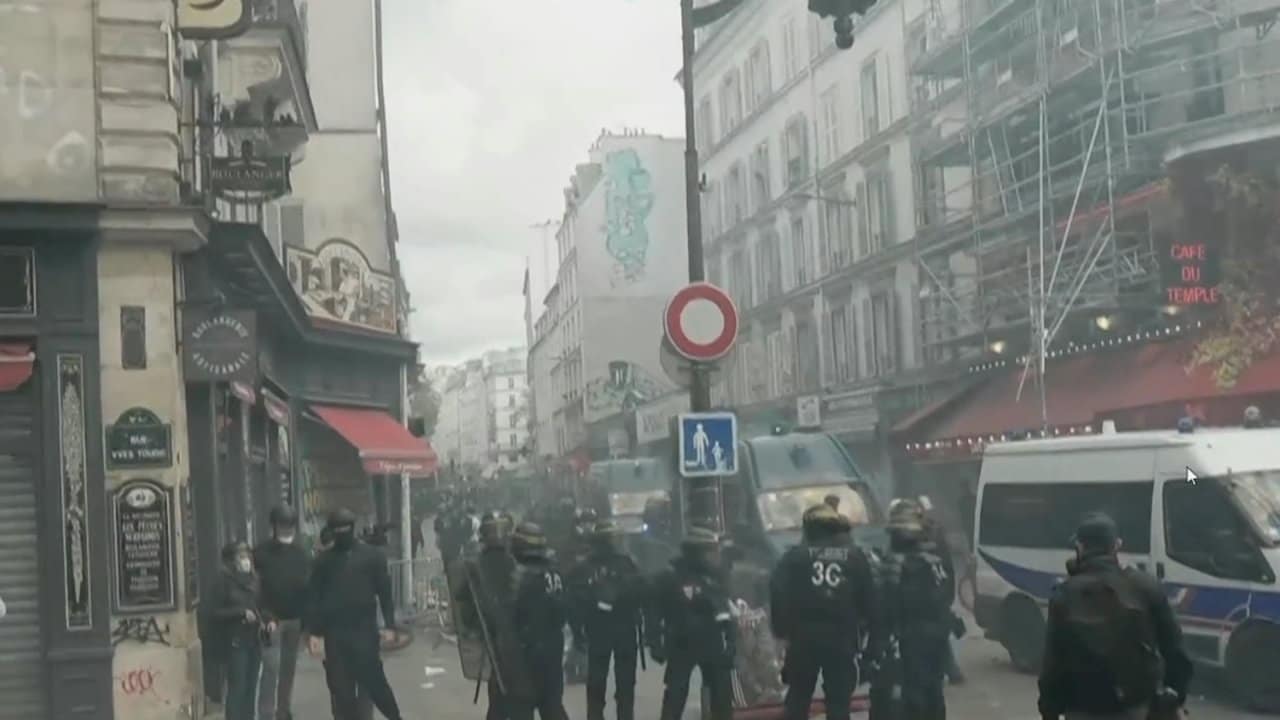
At least 166 people were detained across France on Saturday (17) as security forces deployed tear gas and water cannons to disperse nationwide demonstrations against inflation, high fuel prices and deteriorating public services. Government figures recorded 32,800 demonstrators in the streets during the morning mobilizations, which brought together high school students, Yellow Vest activists and labor unions in Paris and major regional cities.
By noon local time, the French Interior Ministry had counted 140 separate rallies outside the Paris metropolitan area, while authorities had not yet released a consolidated final tally of injuries for the day. The demonstrations united high school students with members of the Yellow Vests — a grassroots movement named after the high-visibility safety jackets worn by motorists — and major labor organizations such as the General Confederation of Labor (CGT), one of the largest trade union federations in France. Participants demanded higher wages and pensions, government price controls and increased funding for public schools.

At the Place de la République in Paris, hooded demonstrators threw fireworks and projectiles at riot police. The office of Interior Minister Laurent Nuñez reported attempted looting, burning street furniture and attacks targeting public buildings, police officers and journalists across Paris, Marseille, Rennes, Toulouse and Angers. In the French capital, objects thrown during the marches shattered windows at the offices of broadcasters CNews and Europe 1, while early morning demonstrators in Rennes set up burning barricades that disrupted traffic on the city ring road.
In Paris, 19-year-old protester Lola criticized the police response to the rallies. “We are fighting because the cost of living is too harsh, because fuel prices are too high, because high school students are being violently attacked and injured across the country just for trying to protest and ask for more teachers and decent learning conditions,” she said.
Marseille city hall breach and security zones in Paris
To contain the marches in Paris, police established a central security perimeter that excluded the Champs-Élysées avenue and the Arc de Triomphe from the two authorized protest routes. Commuters, residents and tourists in the capital also faced travel disruptions after authorities closed several metro stations along the demonstration paths.
In the southern port city of Marseille, a masked group used metal security barriers to force open the entrance and break into the lobby of the city hall, located in the Vieux-Port district. The intruders chanted “We are taking the Bastille,” spray-painted an anarchist symbol on the wall and set trash bins on fire in the surrounding streets before police arrived. In downtown Marseille, demonstrators also targeted a police station on the Canebière avenue, breaking windows and throwing smoke grenades inside. Following the attack on the municipal headquarters, Marseille Mayor Benoît Payan spoke with French Prime Minister Sébastien Lecornu and Interior Minister Laurent Nuñez, prompting the national government to dispatch police reinforcements to the city.
French authorities convened a new crisis unit meeting for 6 p.m. local time at the Interior Ministry in Paris to evaluate the unrest and coordinate security measures. The meeting brings together the chief of staff to Prime Minister Sébastien Lecornu, Interior Minister Laurent Nuñez and Justice Minister Gérald Darmanin.
The French government blamed the clashes on “ultra-left” groups and accused the left-wing party France Unbowed (La France Insoumise) of inciting the disturbances, an allegation the party denied. According to Prime Minister Sébastien Lecornu, more than 900 police officers have been injured since the current wave of protests began. Meanwhile, the internal police oversight agency is investigating at least 24 complaints of excessive force by officers following earlier rallies that left demonstrators injured, including a teenager who lost a hand after picking up a stun grenade.
Key dates of the social unrest and student blockades in France
The rallies on October 17, 2026, take place during the final stretch of President Emmanuel Macron‘s term, ahead of the French presidential election scheduled for the spring of 2027. The social tensions coincide with a period in which the borrowing costs to finance France’s public debt have reached their highest levels in more than two decades. The current mobilization builds on years of recurring street protests and a month of escalating youth demonstrations across the country:
- 2018: The Yellow Vest movement emerges across France in response to fuel tax hikes during President Emmanuel Macron’s previous term.
- September 2026: High school students launch blockades at schools in the northern suburbs of Paris to protest teacher shortages and decaying campus infrastructure.
- October 15, 2026: Prime Minister Sébastien Lecornu warns that security officials anticipate violent disturbances during the rallies called for the weekend.
- October 16, 2026: President Emmanuel Macron calls for calm and respect for property, while Interior Minister Laurent Nuñez authorizes police to resume the use of stun grenades in the event of clashes.
- October 17, 2026: Nationwide demonstrations draw 32,800 people in the morning, resulting in clashes with riot police, the breach of Marseille city hall and at least 166 arrests across France.


