
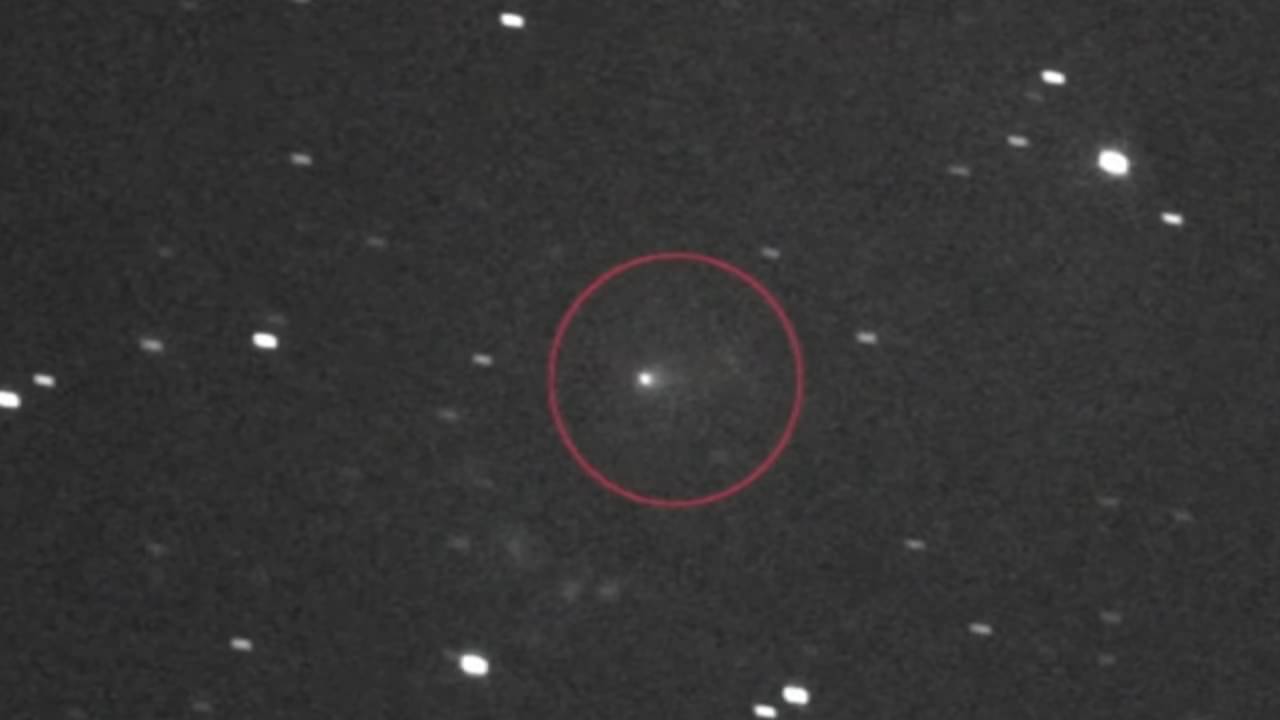
China’s Tianwen-1 spacecraft documented the passage of interstellar comet 3I/ATLAS as the object crossed near Mars, capturing visual records from an orbital distance of approximately 30 million kilometers. The operation marks the first time an artificial probe stationed at another planet tracked a celestial body originating beyond the solar system, providing astronomers with an unprecedented viewing angle outside Earth’s orbital plane.
The Asteroid Terrestrial-impact Last Alert System survey station in Chile originally detected the object on July 1, 2025. Designated as the third confirmed interstellar visitor following 1I/’Oumuamua in 2017 and 2I/Borisov in 2019, 3I/ATLAS follows an unbound hyperbolic trajectory that confirms it formed outside the gravitational reach of the Sun.

Flight controllers prepared the Martian orbiter weeks prior to perihelion, which occurred when the comet made its closest solar approach on October 29, 2025. Repurposing a planetary surveillance platform into a deep-space observatory demonstrated the technical adaptability of long-duration interplanetary probes.
High-resolution optical adjustments track fast-moving targets across deep space
Imaging the dim celestial target required reconfiguring the High-Resolution Imaging Camera, known as HiRIC, aboard the Chinese probe. While the optical system was built to record stationary geological formations on the Martian crust, ground teams uploaded dedicated software commands to identify and follow an object traveling through deep shadow.
Moving at an estimated speed of 58 kilometers per second relative to the Sun, the icy body presented acute challenges for exposure timing. Engineers ran orbital simulations to calibrate short-shutter settings that prevented optical blur, subsequently transmitting raw frames to control facilities in Beijing to produce 30-second video sequences.
Maintaining optical alignment across roughly 29 million kilometers demanded continuous stability and thermal regulation from the spacecraft. The resulting picture sequences recorded the solid central core alongside its surrounding gas cloud against background star fields, yielding precision tracking data to evaluate non-gravitational acceleration along its escape path.
Spectral data uncover frozen chemical signatures within the traveling visitor
Photographic sets released by the China National Space Administration display a compact core surrounded by a vast coma of dust and evaporating volatiles. This envelope measured thousands of kilometers across, driven by solar heating as the visitor approached the inner planetary zone.
Estimates place the central nucleus at up to 5.6 kilometers across, flanked by a dust tail that developed substantially as radiation pressure pushed particulate matter away from the Sun. Ground records documented an initial faint feature in August 2025 that lengthened into a structure measuring 56,000 kilometers by late autumn.
Spectroscopic surveys registered clear signatures of frozen water and carbon dioxide, alongside smaller readings of carbon monoxide. The volatile mixture suggests the object condensed in an ultra-cold protoplanetary disc, consistent with conditions in the deep galactic interior before dynamic events ejected it into interstellar space.
Check out: Interstellar comet 3I/ATLAS reveals origins below 30 Kelvin in outer reaches of another star
- Central nucleus: Rocky and icy mass showing reddish surface coloration linked to organic compounds.
- Surrounding coma: Expanding gas cloud produced by surface sublimation under direct solar illumination.
- Streamer tail: Ejected dust stream spanning roughly 30 arcseconds on astronomical detector arrays.
- Non-gravitational acceleration: Measurable orbital deviation driven by asymmetric outgassing jets.
Global space agencies synchronize planetary probes for unified observation
The trajectory of 3I/ATLAS mobilized international observation teams operating across the Martian orbital environment. The European Space Agency and NASA temporarily reoriented orbiting sensors to coordinate measurements alongside ground tracking, generating multi-angle datasets to refine the visitor’s flight path.
Synchronizing instruments with divergent focal lengths and spectral bands expanded observational coverage beyond what single-point terrestrial telescopes could achieve. Each planetary craft provided distinct measurements regarding coma density, velocity, and core structure.
- Mars Express: Recorded molecular emissions and volatile distribution within the expanding coma.
- Mars Reconnaissance Orbiter: Deployed its HiRISE optical suite to monitor core activity and fragmentation risks.
- Perseverance: Attempted skyward imaging sequences directly from the surface inside Jezero Crater.
- Hope Probe: Monitored atmospheric conditions and interplanetary dust interactions throughout closest approach.
Technological milestones pave the path toward future asteroid exploration
The Tianwen-1 mission departed Earth in July 2020 and achieved Mars orbit in February 2021. The flight architecture achieved global attention when the Zhurong rover touched down in Utopia Planitia in May 2021, conducting geological surveys across the Martian lowlands for an entire terrestrial year.
While surface operations ceased, the orbiter remains functional, surveying polar ice reserves and seasonal atmospheric dust cycles. Redirecting its tracking software to capture interstellar targets confirmed the operational longevity and sensor flexibility of the orbiter.
Flight techniques refined during the observation of 3I/ATLAS provide baseline data for China’s Tianwen-2 mission, which launched toward deep space in May 2025. Tianwen-2 is designed to retrieve physical surface samples from near-Earth asteroid 2016 HO3 before redirecting toward main-belt comet 311P/PANSTARRS, utilizing autonomous navigation algorithms tested during recent tracking campaigns.
Studying primordial bodies that predate the current planetary configuration gives astrophysicists direct access to unaltered materials from distant stellar nurseries. The combined observational data from 3I/ATLAS continue to inform models detailing how primitive planetesimals disperse across the galaxy.





