3I/ATLAS exposes water, methanol and hydrogen cyanide after 20-meter crust breaks By Luís Henrique Costa
4 min read
 |
The heat of the Sun cracked the crust of the interstellar comet 3I/ATLAS, exposing prebiotic compounds as it crossed the Solar System. The breach allowed direct detection of water, methanol, carbon and hydrogen cyanide, substances tied to the formation of biological molecules.
The most notable moment of the visit came during a close flyby of Jupiter, when the comet briefly entered the planet’s Hill sphere, the zone where Jupiter’s gravity outweighs the Sun’s. Its speed, estimated at about 68 kilometers per second relative to the Sun, ruled out permanent capture by Jupiter and any collision with a planet.
Dates and orbital data that traced the comet’s route
- Discovery: 1 July 2025, by the ATLAS survey system at Río Hurtado, Chile
- Perihelion, the closest point to the Sun: 29 October 2025, at 1.36 astronomical units (AU)
- Closest approach to Earth: 19 December 2025, at 1.8 AU
- Closest approach to Jupiter: 16 March 2026, at 0.358 AU
- Speed relative to the Sun: about 68 kilometers per second
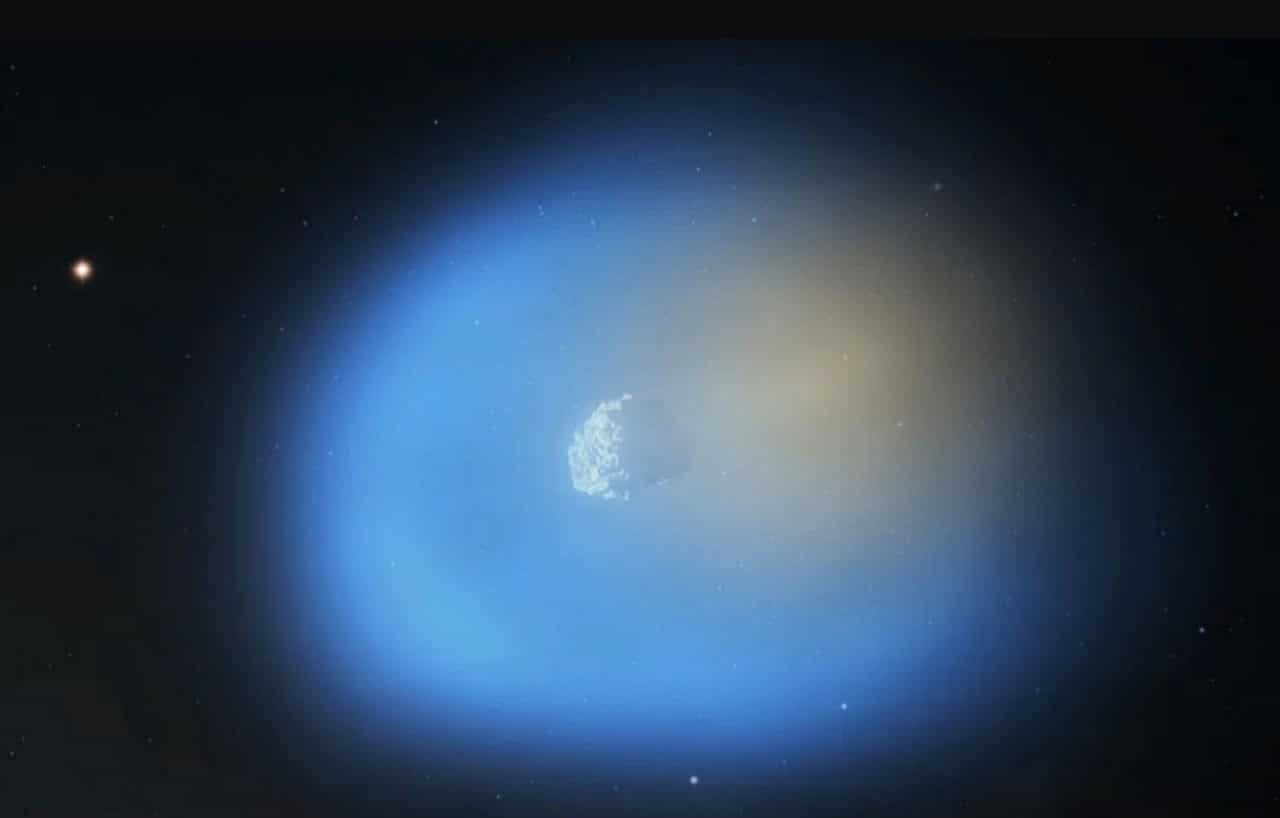
Before the surface broke, the object traveled for ages inside a shell 15 to 20 meters thick. Cosmic rays gradually compacted and chemically altered that layer during its journey through interstellar space. Romain Maggiolo, a researcher at the Royal Belgian Institute for Space Aeronomy who led a study on the crust, said the process is very slow but, over billions of years, has a strong effect. The hardened shell acted as a thermal and mechanical barrier, keeping trapped ice and gases from turning into vapor before perihelion.
What escaped once the outer layer gave way
Before the crust broke, astronomers noticed unusual emissions from the object. It released carbon monoxide, carbon dioxide and methanol, but only small amounts of water vapor. That contrasts with comets formed inside the Solar System, where water ice is usually the dominant ice, so the heat at perihelion had to strip the armored layer before deeper reserves could escape.
Check out: James Webb Space Telescope detects methane gas on interstellar comet 3I/ATLAS for the first time
Space instruments confirmed methanol, hydrogen cyanide, water and carbon, along with carbonyl sulfide, ionized nickel, silicate dust and complex organic molecules. Carbon makes up the largest share of the object’s mass, mostly as carbon dioxide. A 2026 study that used the ALMA telescope in Chile, led by Nathan Roth, measured methanol levels above those of most comets in the Solar System.
Scientists watch methanol and hydrogen cyanide closely because both help build amino acids, sugars and nucleotide bases, the parts needed to assemble DNA and RNA. Cyrielle Opitom, an astronomer at the University of Edinburgh, described the material as a kind of fossil from planet formation that took place far away and can now be studied up close. A separate Webb study published on 23 October 2026 in Nature Astronomy measured methane with a deuterium ratio of about 3.33 percent, higher than the value found in comet 67P.
Age and physical traits of the third known interstellar object
3I/ATLAS is the third interstellar object catalogued, after 1I/’Oumuamua, recorded in 2017, and 2I/Borisov, identified in 2019. Its age remains disputed. Galactic evolution models place it between 10 and 12 billion years old, which would make it older than the Solar System, dated at 4.6 billion years. Models based on saturation by cosmic rays suggest a figure close to 7 billion years.
Follow: Cosmic rays build 20-meter shell on interstellar comet 3I/Atlas
Estimates of the nucleus size also vary. Hubble measurements and calculations based on non-gravitational accelerations put the diameter between 440 meters and 5.6 kilometers, and some theoretical estimates start near 320 meters. During its approach the comet showed color changes, a large coma, two distinct tails and a visible antitail. Webb observations of its ice, published in The Astrophysical Journal Letters, found tiny grains mixed with a large amount of dust, which resemble icy bodies beyond Neptune.
Exit route beyond the Solar System and the artificial origin claims
Despite speculation in public debates about an artificial origin, space agencies and the scientific community ruled out any sign of extraterrestrial technology and confirmed the object as natural. Researchers have not yet determined whether solar heat removed the shield down to the untouched primordial nucleus, or whether the activity came only from irradiated intermediate layers. The comet now follows a hyperbolic escape path toward deep interstellar space, with no chance of returning gravitationally to the Sun.