James Webb Space Telescope detects methane gas on interstellar comet 3I/ATLAS for the first time By Janderson Luiz
3 min read
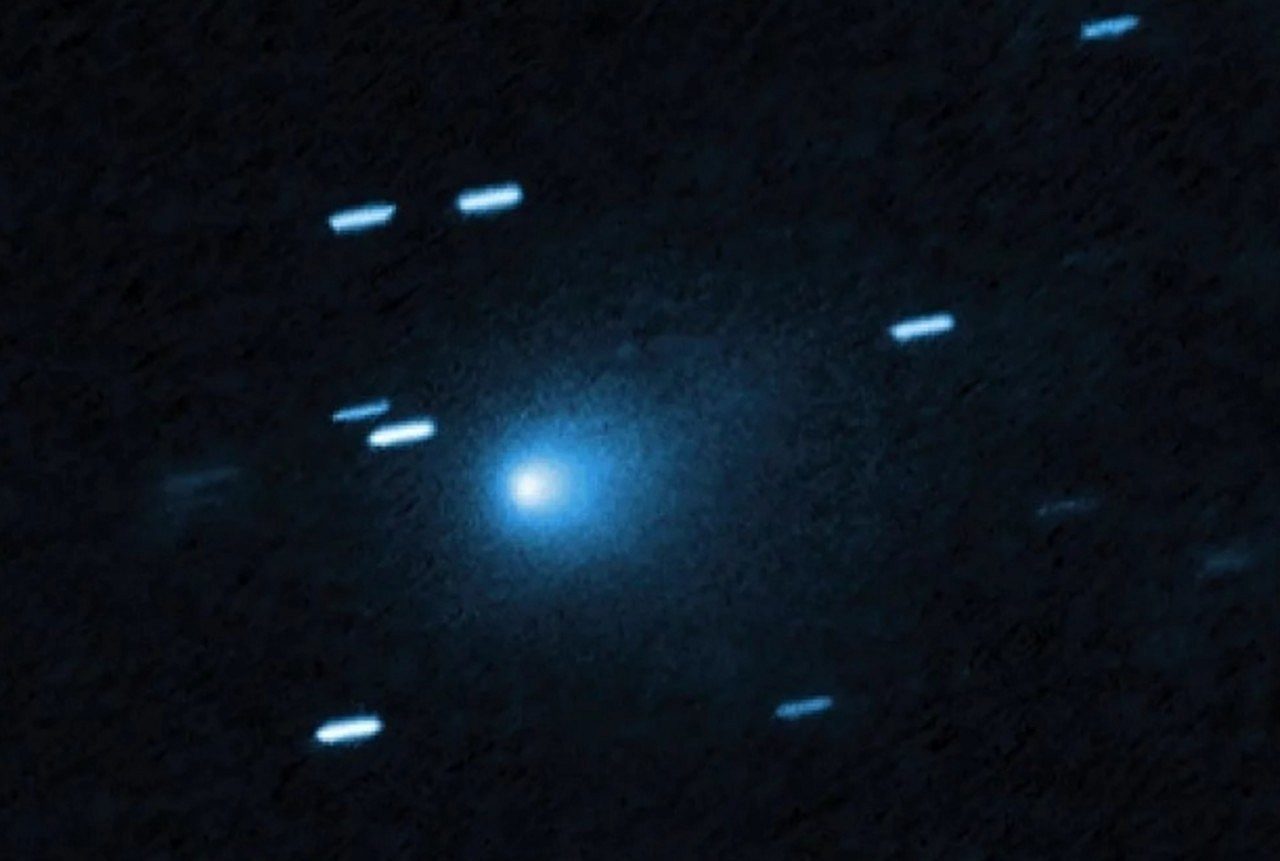 |
Astronomers using the James Webb Space Telescope identified direct traces of methane gas on the interstellar comet 3I/ATLAS, marking the first time the chemical compound has been directly confirmed on a body originating outside the Solar System. The measurements were captured by the observatory’s Mid-Infrared Instrument (MIRI) following the celestial body’s closest approach to the Sun. The findings, detailed in Pasadena, California, reveal a volatile chemistry distinct from comets formed locally.
The discovery indicates that methane remained shielded beneath an icy crust until intense solar radiation penetrated the interior. Matthew Belyakov, a graduate student researcher at the California Institute of Technology (Caltech) and lead author of the study, noted the rare chance to examine the traveler: “It’s a very interesting object. It has been traveling through the galaxy for at least a billion years. The high speed at which it flew past us gave just a narrow window to study it.”
Spectroscopic analysis reveals buried icy reservoirs
The Mid-Infrared Instrument collected the first mid-infrared chemical fingerprint of an interstellar visitor by deploying its Medium Resolution Spectrometer. This integral field unit decomposes infrared light into distinct wavelengths and captures a spectrum across a specific patch of sky, enabling researchers to map chemical species and analyze their distribution surrounding the nucleus. Because methane sublimates easily from solid ice into gas, researchers did not identify it prior to perihelion. The delayed release indicates that the gas resided beneath the comet’s outer surface layer, vaporizing only after solar thermal energy penetrated into deeper subsurface strata.
Observations track changing emissions across millions of kilometers
Measurements occurred during two distinct sessions separated by a 12-day interval as the comet traveled outward toward deep space.
The initial observation took place on December 15 and 16, 2025, when 3I/ATLAS was located 329 million kilometers (205 million miles) from the Sun. A subsequent observation followed on December 27, 2025, at a distance of 379 million kilometers (236 million miles). Between these two sessions, the observatory recorded a sharp drop in overall gas production as surface temperatures dropped. Water vapor production declined most drastically because water is less volatile than carbon dioxide or methane, causing its release to shut off more rapidly as solar heating diminished.
Chemical ratios separate visitor from native comets
Analysis showed that 3I/ATLAS contains unusually elevated levels of carbon dioxide and methane relative to water. The ratios of carbon dioxide to water and methane to water exceed those found in the vast majority of Solar System comets, indicating that 3I/ATLAS formed under chemical and environmental conditions foreign to our planetary system. The research team included coauthors Ian Wong, an astronomer at the Space Telescope Science Institute, and Michael E. Brown, a professor of planetary astronomy at Caltech.
Timeline of observations and discovery
- July 1, 2025 — The ATLAS survey telescope in Chile discovers the interstellar comet 3I/ATLAS.
- October 30, 2025 — The comet reaches perihelion, its closest approach to the Sun at 1.4 astronomical units (approximately 210 million kilometers).
- December 15, 2025 — The James Webb Space Telescope initiates its first post-perihelion mid-infrared observations of 3I/ATLAS.
- December 27, 2025 — Scientists conduct the second round of observations with the Mid-Infrared Instrument across 379 million kilometers.
- April 8, 2026 — The Astrophysical Journal Letters publishes the peer-reviewed study documenting the chemical measurements.
- June 1, 2026 — NASA and the European Space Agency release detailed disclosures confirming the detection of methane.
Context among confirmed interstellar visitors
Astronomers have confirmed only 3 interstellar objects passing through the Solar System to date. The first, 1I/’Oumuamua, was identified in 2017 and displayed no substantial cometary outgassing. The second visitor, 2I/Borisov, was discovered in 2019 but appeared relatively faint during its flyby. In contrast, 3I/ATLAS exhibited pronounced brightness and active coma development, allowing the telescope to carry out direct spatial mapping of volatile gases before the object continued its trajectory beyond the planetary boundary.