Cachoeira da Fumaça: 340-meter drop where wind lifts the waterBy Luís Henrique Costa
3 min read
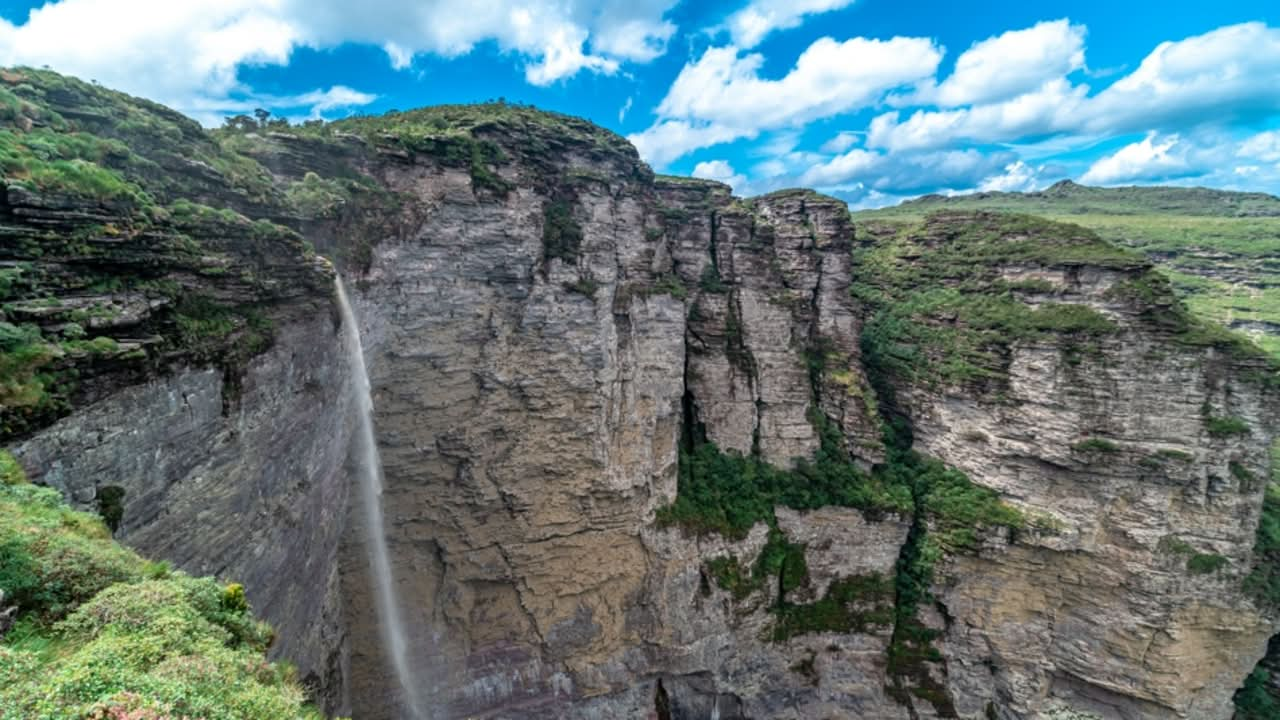 |
In the Cachoeira da Fumaça, in Bahia, wind pushes the water back up the cliff instead of letting it fall to the valley floor. The attraction sits in the Chapada Diamantina National Park, where the water drops from the rock in thin streams. Strong updrafts along the canyon break the flow into tiny droplets before it can reach the ground.
The phenomenon gave the attraction its name, since the rising mist looks like smoke from the lookout points. The water leaves the top of a 340-meter drop and meets air currents rising through the canyon. On days of strong wind, the mist is pushed back toward the upper edge of the cliff.
How the wind sends the falling water back upward
The change from liquid water into dense vapor follows basic laws of thermodynamics and fluid mechanics. Water arrives from the high plateaus in a relatively small volume for most of the year. As it falls from such a height, air resistance splits the stream into very small particles, which have little mass and a large surface area in contact with the air.
The deep gorges of the range work like ducts that speed up warm air and valley winds moving upward. When these vertical currents hit the falling droplets, the upward force of the wind overcomes the pull of gravity on the dispersed water. The liquid then reverses direction, gains altitude and wets the rocky vegetation on top of the cliff.
Learn more: Why a cabeça d'água can raise Rolândia creeks without rain at the spot
Official height and how visitors reach the falls
- Official free fall: 340 meters, measured by the Cachoeiras Gigantes project
- Total height difference to the valley floor: 380 to 400 meters
- Location: Vale do Capão, in the municipality of Palmeiras, Bahia
- Protected area: Chapada Diamantina National Park, with 152,000 hectares
- Trail length: 12 kilometers round trip
The difference between the figures comes from how each survey measures the drop. Some publications count the whole slope down to the bottom of the valley. The official survey by the Cachoeiras Gigantes project, however, standardizes the continuous fall at 340 meters.
The water flow depends heavily on the season. Annual rainfall ranges from 830 mm to 1,192 mm, and most of it falls between mid-November and February. During the dry period, from September to December, surface water drops off and can briefly interrupt the falling curtain.
See also: Atlético trails Barcelona by two points as Simeone defends Lee Kang-in
The Instituto Chico Mendes de Conservação da Biodiversidade is responsible for protecting the area around the waterfall. The Chapada Diamantina National Park was created by federal Decree No. 91.655 of September 17, 1985. Its restricted access rules limit human traffic on the plateaus and help keep the cliff edges safe.