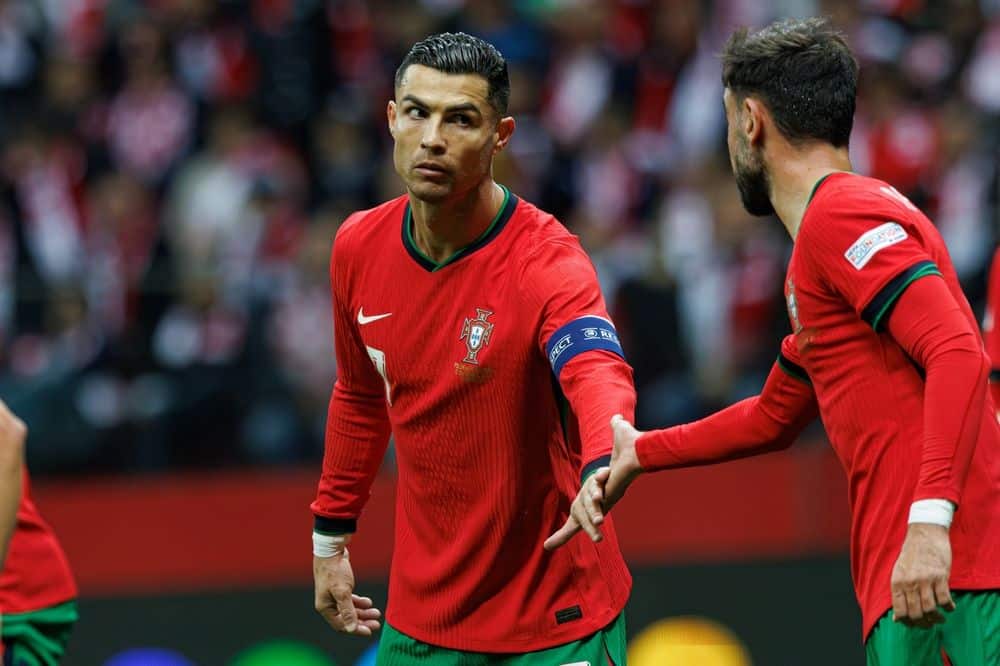
Cristiano Ronaldo, one of the greatest icons in world football and a five-time winner of the FIFA World Player of the Year award, has once again chosen not to participate directly in the voting process for the FIFA The Best award. For the third consecutive year, the Portuguese forward, long-standing captain of the national team, delegated his voting rights, passing the responsibility to Bernardo Silva, midfielder and national team colleague.
The decision not to vote: a statement or indifference?
Cristiano Ronaldo’s absence from The Best voting in 2024 raises questions about his relationship with individual awards in football. Since 2022, the player has opted out of exercising his right as captain of the Portuguese national team, a role that places him among those responsible for selecting the world’s best players. This year, Bernardo Silva represented Portugal and chose to vote for Rodri, from Manchester City, as the best player in the world, followed by Vinícius Júnior and Erling Haaland. The choice reflected the dominance of European football and recognition of talents in top clubs.
Ronaldo’s attitude has fueled speculation about his motivation. For some, the gesture symbolizes a possible critique of the voting system, while others believe it may reflect personal disinterest due to changing priorities throughout his career.
Bernardo Silva and the role of representation
Bernardo Silva, known for his tactical intelligence and vision on the field, responsibly took on the task of voting on behalf of the Portuguese national team. His first-place pick, Rodri, came as no surprise given the Spaniard’s influence in Manchester City’s midfield and his contributions to the club’s title victories. Including Vinícius Júnior in second place also highlights the global impact of Brazilian football, while Haaland in third reflects the Norwegian’s rise as one of the world’s top strikers.
Over the past few years, Pepe has also taken on this role, showing that Ronaldo’s delegation is not an isolated incident but part of a consistent strategy. However, the official captain’s absence from a high-profile event like The Best still sparks debates about leadership and representation in national teams.
Congrats Vinicius! ???????????? pic.twitter.com/feeYKiKeTH
— Cristiano Ronaldo (@Cr7Fran4ever) December 17, 2024
Ronaldo’s history with The Best
Cristiano Ronaldo won the FIFA The Best award five times (2008, 2013, 2014, 2016, and 2017), cementing his place as one of football’s all-time greats. During these years, his individual performances and team achievements justified global recognition. However, since 2022, the forward, who now plays for Al-Nassr in Saudi Arabia, has chosen not to participate in the voting process, leaving the decision-making to other players.
While his absence from The Best is noteworthy, Ronaldo remains a central figure in world football. His impact transcends individual awards, with achievements including UEFA Champions League titles, the Euro 2016 championship, and records such as being the highest goal scorer in international football.
The context of abstentions and their implications
Cristiano Ronaldo’s stance on The Best reflects a shift in how he views individual accolades. His criticisms of the voting system, often described as influenced by campaigns and external narratives, may explain his decision to step back. Additionally, his abstention can be seen as an attempt to prioritize the collective spirit of the sport over individualism.
Ronaldo’s absence also raises questions about Portugal’s representation in these awards. As one of the most influential players in history, his participation could further spotlight Portuguese talent on the global stage. However, delegating the role to players like Bernardo Silva and Pepe underscores Ronaldo’s trust in his teammates and their ability to represent the nation.
The symbolism of The Best in modern football
The FIFA The Best award is one of the most prestigious in football, combining votes from captains, coaches, journalists, and fans to select the world’s best players. While the focus of the award is on individual recognition, it also celebrates collective excellence, highlighting performances that contribute to team success.
For Cristiano Ronaldo, however, the value of individual awards seems to have diminished over time. While many players see The Best as an opportunity to solidify their careers, Ronaldo appears to be in a phase where his priorities extend beyond personal recognition.
Ronaldo’s influence on the awards debate
Even absent from the voting, Cristiano Ronaldo remains an influential figure in world football. His critical stance on The Best and other individual awards inspires discussions about the transparency and criteria used to determine winners. Moreover, his decision to delegate the vote can be seen as a call for greater representation and fairness in the process.
With his long history of achievements and leadership, Ronaldo has the power to shape how awards are perceived in the sport. His absence from The Best does not diminish his relevance but instead reinforces his role as a critical and influential voice in football.
The future of awards and Ronaldo’s stance
Cristiano Ronaldo’s attitude toward The Best reflects both his personal perspective and a broader trend of questioning individual awards in football. His decision to abstain for the third consecutive year may be interpreted as a call for deeper reflection on the relevance of these ceremonies in a sport that values teamwork above all else.
As the years pass, Ronaldo remains a central figure in football, even as he distances himself from certain traditions. His influence and legacy remain unshakable, standing out as one of the sport’s greatest names, both on and off the pitch.