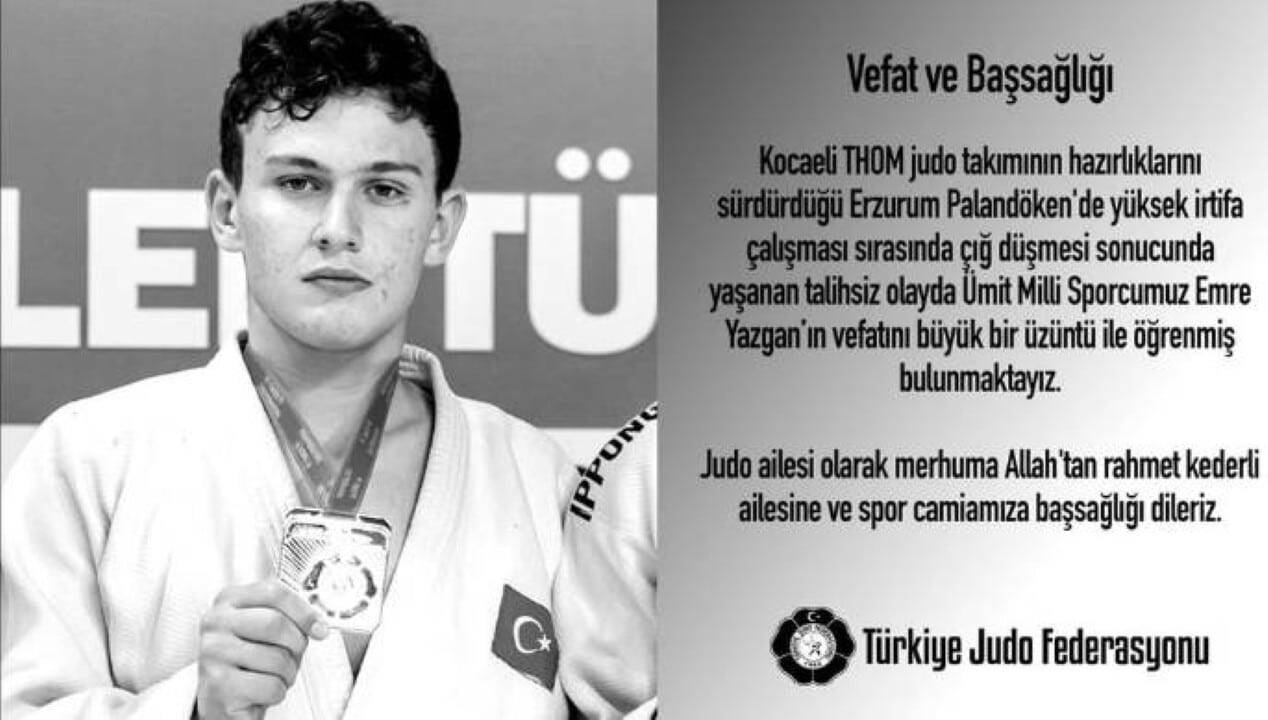
Turkish judoka Emre Yazgan, aged 18, a rising star in the sport, tragically lost his life in an avalanche in the mountainous region of Erzurum, Turkey. The accident occurred during a training hike involving 15 members of the Turkish junior judo team. Yazgan was rescued alive but later succumbed to his injuries, sparking an outpouring of grief from the Turkish and international judo communities.
The incident took place at Palandöken Ski Center, a popular location for winter sports and athlete training. Local authorities stated that the judo team had not notified security forces about their hike, a measure that could have helped prevent the tragedy. Emre was widely recognized for his dedication and achievements in the under-73kg weight category, standing out in both national and international competitions.
Yazgan’s death has raised concerns about safety measures during athletic training in mountainous regions, particularly in winter when weather conditions are more severe. Erzurum Governor Mustafa Çiftçi expressed sorrow over the athlete’s death and emphasized the importance of stricter protocols to prevent similar tragedies in the future.
Details about the avalanche and the accident site
The avalanche that claimed Emre Yazgan’s life occurred at Palandöken Ski Center, one of Turkey’s most popular destinations for winter sports and athlete training. With an average temperature of -1°C in December, the region sees significant snow accumulation, increasing the risk of avalanches.
Experts explain that avalanches are common in mountainous areas, especially after heavy snowfall followed by abrupt temperature changes. The accumulated weight of snow creates fractures in weaker layers, triggering massive slides that can reach high speeds.
In Erzurum’s case, a combination of harsh weather conditions and a lack of prior notification to local authorities heightened the risks for the judo team. Safety equipment, such as avalanche victim detectors and communication radios, is essential for activities in such areas, though it is unclear whether the group was equipped.
Emre Yazgan’s promising journey in judo
Emre Yazgan began his judo career at the age of eight alongside his twin brother, Yunus, through extracurricular activities at school. Demonstrating talent and discipline early on, he quickly earned medals in local and national competitions. At 16, he joined Turkey’s junior national team, competing internationally and representing his country in European championships.
In 2024, Yazgan achieved one of his most significant victories at the Skopje Junior European Cup in North Macedonia, defeating high-profile opponents such as Britain’s Oliver Ridout. His consistent performances positioned him as one of Turkey’s top prospects for future world championships and possibly the Olympic Games.
The International Judo Federation hailed Emre as a rising athlete with refined technical skills and immense potential. His untimely death has left a void in the judo community, which mourns the loss of a promising talent.
Emotional and social impact on the sports community
Emre Yazgan’s death has deeply affected the Turkish and international judo communities. Athletes, sports federations, and public figures have shared messages of support and condolences. Turkey’s Minister of Youth and Sports, Osman Aşkın Bak, described Yazgan as a symbol of dedication and passion for the sport.
The tragedy has also reignited debates about athlete safety during training and competitions in risky areas. The Turkish Judo Federation announced an investigation into possible negligence and pledged to implement safety measures to prevent future incidents.
The emotional toll has been significant for Yazgan’s teammates, who witnessed the accident. Sports psychology experts emphasize the importance of providing psychological support for athletes who experience traumatic events, particularly the loss of peers or coaches.
Historical facts about judo in Turkey
- Judo was introduced to Turkey in the 1960s as part of an effort to diversify national sports.
- The Turkish Judo Federation was established in 1966 and has since worked to promote the sport nationally and internationally.
- Turkey won its first Olympic judo medal in 2000 at the Sydney Games, with Hüseyin Özkan in the under-66kg category.
The dangers of avalanches in training areas
Avalanches are among the deadliest natural phenomena for climbers and athletes training in mountainous regions. Statistics show that approximately 150 people die annually from avalanches worldwide. In Turkey, Erzurum is one of the most avalanche-prone areas, particularly during winter.
Safety measures, such as weather monitoring, the use of tracking devices, and prior communication with local authorities, are critical for minimizing risks. Experts recommend that coaches and technical teams receive specialized training to handle emergencies in high-risk areas.
Tributes and reflections
Yunus Yazgan, Emre’s twin brother, shared that judo was more than a sport for them; it was a passion that united them since childhood. “He was my greatest partner on and off the mat. Losing Emre feels like losing a part of myself,” Yunus said emotionally.
Turkish Judo Federation President Sezer Huysuz also mourned the loss, describing Emre as a role model for young athletes. “He was an inspiration for the next generation of Turkish judo. His death is an irreparable loss for our community,” Huysuz stated.
Data and statistics on sports accidents
- Annual avalanche-related deaths worldwide: Approximately 150.
- Region with the highest incidence in Turkey: Erzurum, due to harsh climatic conditions.
- Recommended safety equipment: Avalanche beacons, probes, and shovels.
Lessons learned and future measures
The tragedy of Emre Yazgan underscores the need for stricter safety protocols during training in mountainous areas. Sports federations and clubs must adopt rigorous policies to protect their athletes, including:
- Safety training: Providing teams with emergency response skills.
- Appropriate equipment: Ensuring athletes have access to tracking and communication devices.
- Risk monitoring: Consulting weather conditions and terrain stability before activities.