Run if you can: China gears up for historic half marathon with robots and 12,000 humans in Beijing Por Beatriz
7 min de leitura
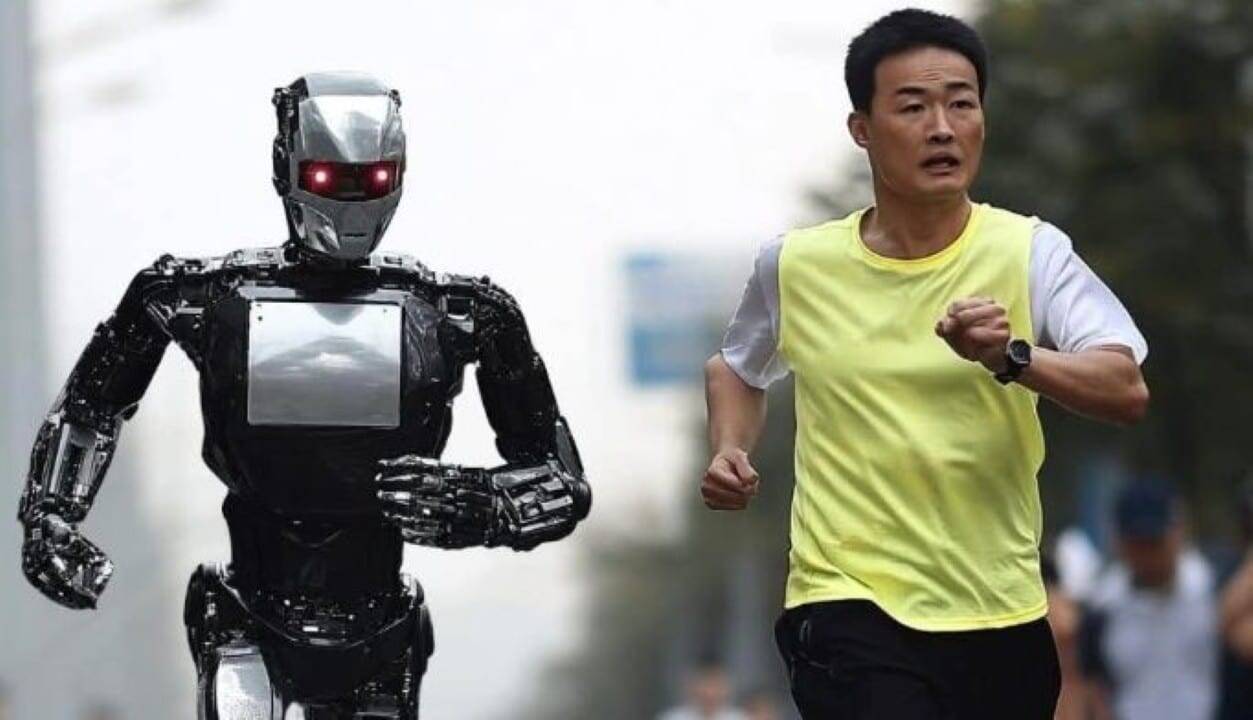 |
In April, China’s capital will host a groundbreaking event that promises to blend technology and sports like never before. Beijing E-Town, the Economic and Technological Development Area in Daxing District, will stage the world’s first official half marathon pitting humanoid robots against human athletes. Set for April 13, this 21-kilometer race will feature 12,000 confirmed participants, including robots developed by over 20 tech companies. More than just a competition, the event serves as a showcase for advancements in artificial intelligence and robotics, areas where China aims to solidify its global dominance.
The initiative underscores China’s ambition to integrate robots into various aspects of daily life. Unlike traditional races, this half marathon will feature dedicated lanes for robotic competitors, separated by barriers or green strips to ensure safety and prevent collisions with human runners. Among the standout participants is the Tiangong robot, developed by the Embodied Artificial Intelligence Robotics Innovation Center, which has already made strides in similar events and now faces an even greater challenge.
Supported by local authorities, the event will also include a robotics-themed exhibition, post-race demonstrations, and opportunities for the public to interact with the mechanical competitors. Expected to draw global attention, the race will reignite discussions about the boundaries between humans and machines in sports and beyond.
Technology on the move: What defines the race robots
The robots competing in Beijing aren’t just any machines; they must meet strict criteria to hit the track. Each robotic contender needs a humanoid structure, a height between 45 centimeters and 2 meters, and the ability to move solely on two legs—no wheels or alternative mechanisms allowed. These requirements push the cutting edge of robotics, testing balance, coordination, and endurance akin to that of a human runner.
One of the most anticipated entrants is Tiangong, which made history last year by running alongside athletes in the final stretch of the Beijing Half Marathon. Clocking an average speed of 10 km/h, it impressed onlookers and showcased China’s technological prowess. Now, it and other models will tackle the full 21-kilometer course, challenging not only their stamina but also advancements in battery life, sensors, and AI algorithms that power them.
Beyond the race itself, the event doubles as an open-air lab. Participating companies, including giants like Xpeng, which plans to invest up to 100 billion yuan (roughly $13.8 billion) in humanoid robotics, will see their prototypes tested in real-world conditions. This could fast-track the development of practical applications, from household assistants to industrial workers.
Past and present: When machines take on humans
The Beijing half marathon isn’t the first human-machine showdown to captivate the world. In 1997, IBM’s supercomputer Deep Blue defeated chess legend Garry Kasparov, marking a turning point in artificial intelligence history. Decades later, in 2016, DeepMind’s AlphaGo bested Go world champion Lee Sedol in a series of matches that stunned experts with its creativity.
In sports, the examples keep growing. In 2018, the curling robot Curly outplayed a South Korean team, demonstrating precision and strategy in a physical setting. More recently, humanoid robots have appeared in symbolic events, like Tiangong’s run last year. What sets this apart is the scale: never before have so many robots and humans competed officially in an endurance race like this.
These milestones reveal a clear trend: machines are stepping out of labs and into arenas once exclusive to humans. In Beijing, the 21-kilometer race will be another chapter in this evolution, testing not just speed but the machines’ ability to adapt to varied terrain and unpredictable conditions.
????♀????♂???? Running robot in #Shenzhen! ???? Shenzhen-based EngineAI (@engineairobot) just dropped a video of their PM01 #robot sprinting at 12 km/h on March 9! Meanwhile, Beijing E-Town has announced the world's first humanoid robot half-marathon, set for April 13. How high will… pic.twitter.com/iisyQShM2E
— Shenzhen Channel (@sz_mediagroup) March 10, 2025
Rules and prep: How the competition is shaping up
The Beijing E-Town half marathon has been meticulously planned to ensure safety and fairness. Robots will run in separate lanes from humans, preventing mishaps like collisions or trips. Special awards, such as fastest robot and most popular among spectators, are also on offer to spur innovation and appeal.
- Official date: April 13.
- Location: Beijing E-Town, Daxing District, Beijing.
- Distance: 21.1 kilometers.
- Participants: 12,000 human runners and robots from over 20 companies.
- Robot requirements: Humanoid structure, bipedal locomotion, height between 45 cm and 2 m.
Organizers have opened registration to teams from universities, research institutes, and robotics clubs worldwide, aiming for a truly global contest. While humans gear up with physical training, robots undergo software and hardware tweaks, with companies racing against time to perfect their models before the starting gun.
Ambitions past the finish line: Economic and social stakes
Hosting this event in Beijing is no coincidence. Beijing E-Town has a bold two-year roadmap to become an “AI city,” planning to integrate over 10,000 robots—1,000 of them humanoid—into key industries. The estimated investment nears 5 billion yuan (about $686 million), signaling the project’s scale and seriousness.
This half marathon is more than a spectacle; it’s a public trial for technologies that could transform sectors like manufacturing, healthcare, and services. If projections hold, China could command nearly a third of the global humanoid robot market within five years. The post-race exhibition, featuring demos and interactions, aims to bridge the gap between the public and this future, easing resistance and highlighting tangible benefits.
The event comes as China ramps up its tech innovation. Liu Weiliang, deputy director of Beijing’s Municipal Bureau of Economy and Information Technology, noted the city’s strides in large-scale AI models and human-machine interaction. The half marathon thus doubles as a strategic showcase for these advancements on the world stage.
Global spotlight: Why the world is watching Beijing
The human-robot competition in Beijing is already sparking heated debates. For some, it symbolizes an inevitable future of human-machine collaboration. Others, however, wonder what’s left of sports when human unpredictability gives way to mechanical precision. Tiangong, for instance, doesn’t tire, doesn’t misstep, and doesn’t feel the grind of the final kilometers—edges that test the core of athletic competition.
Follow-up events, like the planned World Humanoid Robot Games in Beijing this August, show China’s intent to keep the momentum going. The city will also host the World Robot Conference later this year, cementing its role as a robotics innovation hub. April’s half marathon is just the opening move in a broader agenda.
Meanwhile, participation from companies like Xpeng, which has signaled billion-dollar investments, highlights alignment between private enterprise and government goals. This public-private synergy could position China ahead of global rivals like the United States and Japan in the race for humanoid robotics supremacy.
Countdown: What to expect on April 13
As the date nears, preparations for the half marathon hit fever pitch. Humans fine-tune their training, while engineers refine algorithms and test batteries. The 21-kilometer course will wind through Beijing E-Town, an area known for its modern infrastructure and tech focus, making it an ideal backdrop for the event.
For spectators, the promise is an unforgettable day. Beyond the race, an interactive exhibition will let the public get up close with the competing robots and learn how they work. Post-race performances are also planned, showcasing the machines’ abilities beyond running—perhaps even a repeat of the Chinese robot’s jaw-dropping front flip that wowed the world recently.
The event will be a historic milestone and a launching pad. With 12,000 participants and the world watching, Beijing’s April half marathon will reveal how far technology has come—and hint at where it might take us next.