
Black smoke at Vatican: Conclave remains undecided on new pope at 4 PM on May 7
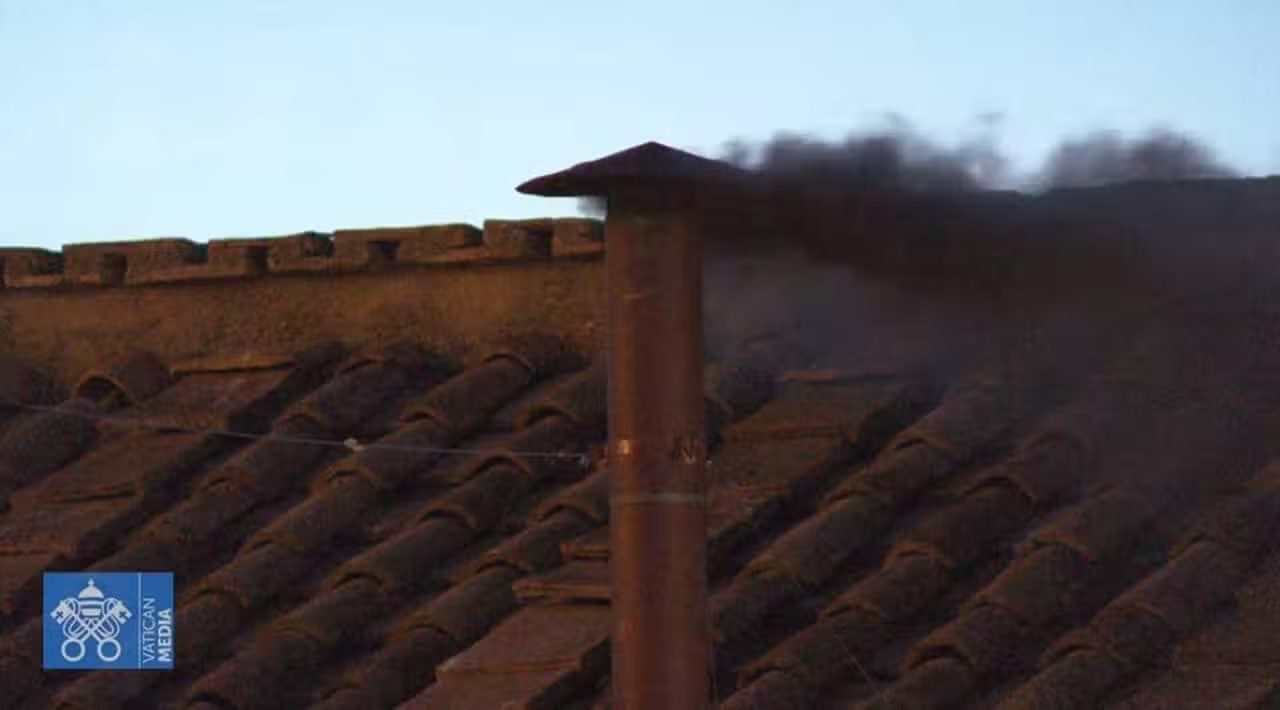
At 4 PM on Wednesday, May 7, 2025, black smoke rose from the Sistine Chapel’s chimney, indicating that the 133 voting cardinals have not yet reached a consensus to elect the new pope. The conclave, which began this afternoon, marks the start of a process following the death of Pope Francis on April 21. Thousands of faithful and onlookers gathered in St. Peter’s Square under a cloudy sky, while the world follows every detail of the centuries-old ritual. The absence of white smoke keeps global anticipation high for who will become the 267th pontiff of the Catholic Church.
The process, conducted in complete secrecy within the Sistine Chapel, began with a solemn Mass in St. Peter’s Basilica, followed by a procession of the voting cardinals. The black smoke, produced by burning ballots with chemical additives, signals that no candidate secured the required two-thirds majority, or at least 89 votes. This outcome is typical on the first day, as history shows that conclaves rarely select a pope in the initial vote.
- What does black smoke mean? It indicates the cardinals have not reached a consensus.
- How many cardinals vote? 133, including seven from Brazil.
- When is the next smoke expected? Thursday, around 7 AM or 2 PM (Brasília time).
The election of a new pope is one of the world’s most watched events, blending tradition, spirituality, and internal Church politics. The 2025 conclave, in particular, occurs at a time of transition, with 80% of the voting cardinals appointed by Francis, suggesting significant influence from his legacy.
Initial ritual sets the tone
The conclave began with a series of formal rituals. At 5 AM (Brasília time), the cardinals attended the Mass Pro Eligendo Pontifice in St. Peter’s Basilica, presided over by the dean of the College of Cardinals, Giovanni Battista Re. The ceremony, open to the public, brought together not only the 133 electors but also non-voting cardinals, priests, and faithful. The Mass featured prayers for discernment in choosing the new leader of the Catholic Church, guiding approximately 1.4 billion Catholics worldwide.
After the Mass, the cardinals dined at the Domus Sanctae Marthae, where they are staying during the conclave. At 11:30 AM, they gathered in the Pauline Chapel for a solemn prayer, chanting the Litany of All Saints. They then proceeded to the Sistine Chapel, where they took an oath of secrecy and fidelity to the process. Under Michelangelo’s frescoes, Cardinal Raniero Cantalamessa led a meditation, emphasizing the electors’ spiritual responsibility.
In the Sistine Chapel, the doors were closed with the proclamation of “Extra Omnes” (everyone out, in Latin), isolating the cardinals from the outside world. The first vote, held late in the afternoon, was inconclusive, as expected. The black smoke, released at 4 PM, was produced by burning ballots in a special stove with naphthalene to ensure a dark hue. This moment, broadcast live by global networks, drew the attention of millions.
Centuries-old tradition in focus
The conclave is a ritual dating back to the 13th century, when cardinals were literally locked in (cum clavis, “with key” in Latin) to hasten the choice of a new pope. Since then, the process has evolved but retains traditional elements. The Sistine Chapel, with its chimney visible in St. Peter’s Square, is the epicenter of the voting. To avoid confusion, since 2005, an electronic system enhances the burning of ballots, ensuring the smoke is distinctly black or white.
Voting takes place on paper ballots, where each cardinal writes the name of their candidate under the phrase “Eligio in Summum Pontificem” (I elect as Supreme Pontiff). To preserve anonymity, electors are instructed not to use their usual handwriting. Three cardinals, chosen as scrutineers, count the votes, while three others verify the tally. If no candidate secures 89 votes, the process restarts.
- First day: One vote, typically inconclusive.
- Second day onward: Up to four votes daily, two in the morning and two in the afternoon.
- Pause: After three days without consensus, a 24-hour break for prayer.
- Second round: After 33 or 34 votes, only the top two candidates compete.
The conclave’s duration varies. In 2005, Benedict XVI was elected on the second day, in the fourth vote. In 2013, Francis was chosen on the second day, in the fifth vote. Expectations for 2025 suggest a decision between Thursday and Friday, but history shows conclaves can extend for weeks.
Profile of the electors
Of the 133 voting cardinals, most were appointed by Francis, reflecting his vision of a more global and pastoral Church. For the first time, less than half of the voters are European, with strong representation from Latin America, Africa, and Asia. Brazil, with seven cardinals, holds notable influence: Leonardo Ulrich Steiner (Manaus), João Braz de Aviz (Brasília), Paulo Cezar Costa (Brasília), Orani Tempesta (Rio de Janeiro), Odilo Scherer (São Paulo), Jaime Spengler (Porto Alegre), and Raymundo Damasceno Assis (Aparecida).
The absence of two cardinals due to health issues reduced the number of electors from 135 to 133. Kenyan Cardinal John Njue and Spanish Cardinal Antonio Cañizares Llovera are not participating, adjusting the required quorum to 88 votes. The conclave is led by Cardinal Pietro Parolin, as the dean, Giovanni Battista Re, aged 91, is too old to preside.
Each cardinal brings their perspective, shaped by issues like Curia reform, inclusion of minorities, and the Church’s challenges in a secularized world. The initial vote, marked by black smoke, suggests the electors are still aligning their preferences, a process involving informal debates and negotiations during breaks.
Names considered for the papacy
Though the conclave is secret, speculation about potential candidates circulates in the press and among Vatican observers. Cardinals like Italy’s Pietro Parolin, Vatican Secretary of State, and the Philippines’ Luis Antonio Tagle, prefect of the Dicastery for Evangelization, are seen as strong contenders. Parolin, 70, is viewed as an experienced diplomat, while Tagle, 67, is known for his grassroots connection and pastoral charisma.
Other names include Hungary’s Péter Erdő, archbishop of Budapest, and Portugal’s José Tolentino de Mendonça, archivist and librarian of the Holy See. Erdő represents a traditionalist line, while Tolentino aligns with a progressive vision, echoing Francis. Austrian Cardinal Christoph Schönborn is also mentioned, though his age, 80, places him at the eligibility limit.
- Pietro Parolin: Diplomat, multilingual, moderate.
- Luis Antonio Tagle: Charismatic, focused on evangelization and peripheries.
- Péter Erdő: Traditionalist, influential in Europe.
- José Tolentino de Mendonça: Intellectual, advocate for an inclusive Church.
The choice will hinge on factors like continuing Francis’ legacy, fostering Church unity, and addressing global issues like climate change and social inequalities. No Brazilian is among the favorites, but the country’s seven cardinals hold sway in negotiations.
Expectations for coming days
On Thursday, May 8, the cardinals will hold up to four votes, two in the morning and two in the afternoon. The first smoke of the day is expected around 5:30 AM or 7 AM (Brasília time), depending on the outcome. If no consensus is reached, a second smoke, likely black, should appear at 12:30 PM or 2 PM. Ballots are burned at the end of each session, with morning and afternoon votes combined to reduce the number of fumigations.
St. Peter’s Square will remain crowded, with faithful, tourists, and journalists awaiting each chimney signal. Large screens in the square broadcast live footage, while international networks maintain teams on-site. Security has been heightened in the Vatican, with street closures and police presence to ensure order during the event.


If the conclave extends beyond Friday, a 24-hour pause will occur on Saturday for prayer and reflection. This break allows cardinals to discuss openly without voting, seeking consensus. After May 11, if no decision is made, the process could continue for up to 10 additional days, with pauses every seven sessions.
Technology and secrecy
The conclave blends tradition and modernity. The Sistine Chapel is equipped with signal jammers to prevent external communication, ensuring secrecy. Cardinals cannot use phones, send messages, or access the internet. Interpreters are available, as Italian is the official language, but electors come from dozens of countries.
The stove producing the smoke was modernized in 2005, with an auxiliary system ensuring clear colors. Naphthalene, used for black smoke, and lactose, for white, are added to ballots in a separate compartment. This precision avoids past confusions when grayish smoke caused uncertainty among onlookers.
- Signal jammers: Block external contact.
- Dual stove: One for ballots, another for chemical additives.
- Interpreters: Facilitate communication among cardinals from different languages.
The ban on external contact is reinforced by a secrecy oath taken by all involved, including Domus Sanctae Marthae staff and Vatican technicians. Any violation risks excommunication, safeguarding the process’s integrity.
Global audience watches
The papal election unfolds amid shifting geopolitical and social landscapes. The Catholic Church faces challenges like secularization in Europe, Catholicism’s growth in Africa and Asia, and the need for interfaith dialogue. The 2025 conclave is seen as a defining moment for the institution’s future, balancing tradition and renewal.
World leaders, including presidents and monarchs, attended Francis’ funeral on April 26, underscoring his global influence. The choice of his successor will be watched by governments, international organizations, and religious communities, as the pope wields both spiritual and diplomatic authority.
In St. Peter’s Square, faithful from various countries express their hopes. Many call for a pope who continues defending the poor and peripheries, hallmarks of Francis’ pontificate. Others seek a leader to strengthen traditional doctrine, responding to debates on issues like celibacy and minority inclusion.
Francis’ legacy at stake
Francis’ pontificate, from 2013 to 2025, was marked by reforms, such as greater transparency in Vatican finances, and a pastoral focus on the vulnerable. His death at 88, after a stroke and heart failure, ended the first Latin American papacy. The voting cardinals, mostly appointed by him, bear the responsibility of deciding whether to follow his path or chart a new course.
The College of Cardinals reflects Francis’ global vision. Of the 133 electors, 52 are from Europe, 24 from Latin America, 22 from Africa, 20 from Asia, and 15 from North America and Oceania. This diversity, the greatest in history, makes the conclave unpredictable, as electors represent varied theological and cultural priorities.
Today’s black smoke is just the first chapter of a process that may span days. Each vote refines the cardinals’ preferences, while the world awaits the moment when white smoke heralds the “Habemus Papam.” Until then, the Sistine Chapel remains the heart of a ritual bridging centuries of history with future expectations.
Intense preparations in the Vatican
Preparations for the conclave began immediately after Francis’ funeral. The Sistine Chapel was closed to the public, and a temporary floor was installed to accommodate voting tables. The chimney, mounted on the roof, was tested to ensure proper function. Vatican-released images show workers adjusting the stove and fumigation system.
The Domus Sanctae Marthae, housing the cardinals, was fitted with enhanced security measures. Each cardinal has a simple room without access to television or the internet. Meals, served in the dining hall, are prepared by a team also bound by a secrecy oath. These logistical details, though discreet, are vital to the conclave’s progress.
- Sistine Chapel: Closed since May 3 for adjustments.
- Domus Sanctae Marthae: Houses cardinals in individual rooms.
- Security: Includes electronic sweeps for listening devices.
- Chimney: Tested to prevent fumigation failures.
The Vatican also formally destroyed Francis’ Ring of the Fisherman and Lead Seal, rituals symbolizing the end of his pontificate. These acts, performed in the final general congregations, marked the official transition to the sede vacante period.
Faithful gather in the square
In St. Peter’s Square, the atmosphere is one of anticipation and prayer. Groups of pilgrims, many from distant countries, carry flags and signs with messages supporting the Church. Nuns from various orders, such as the Sisters of Charity, distribute prayer leaflets for the conclave. Young volunteers guide visitors, while the Swiss Guard maintains vigilance.
The black smoke, though anticipated, sparked murmurs in the crowd. Some faithful, equipped with binoculars, closely watched the chimney. Others, connected via messaging apps, followed news in real-time. Tourists, drawn by historical curiosity, add a cosmopolitan flavor to the event.
Media coverage is extensive, with journalists worldwide stationed at strategic points. Platforms like Vatican News provide live updates, while social media, such as X, capture real-time reactions. The hashtag #Conclave2025 is trending, with users sharing photos of St. Peter’s Square and speculating about the next pope.
Veja Tambem em Europa

União Europeia multa Temu em US$ 232 milhões por produtos ilegais e falhas de segurança online

Europa enfrenta onda de calor com recordes de temperatura em maio, Reino Unido marca 35ºC

Portugal investe em cápsulas reutilizáveis e almeja liderança na corrida espacial europeia

Papa Leão XIV critica cultura de poder da IA e pede freios éticos, além de perdão por escravidão histórica

Escavação em cidade alemã revela estrutura da Idade do Ferro com 2.300 anos

Mulher francesa é detida em Portugal por abandonar dois filhos em estrada

Documentos revelam exigência de “gestão de mídia rigorosa” para Andrew em 2001

Comandante italiano Salvatore Todaro resgata inimigos em mar de guerra, desafiando convenções militares de época

INPS corrige certificações únicas de 270 mil pensionistas com addizionale comunale omitida

Sindicato RMT suspende greves no metrô de Londres após negociação

Ondas de calor vêm da Espanha com picos de até 30 graus na Alemanha
