
Peugeot 2008 disappoints with one star in Latin NCAP safety test

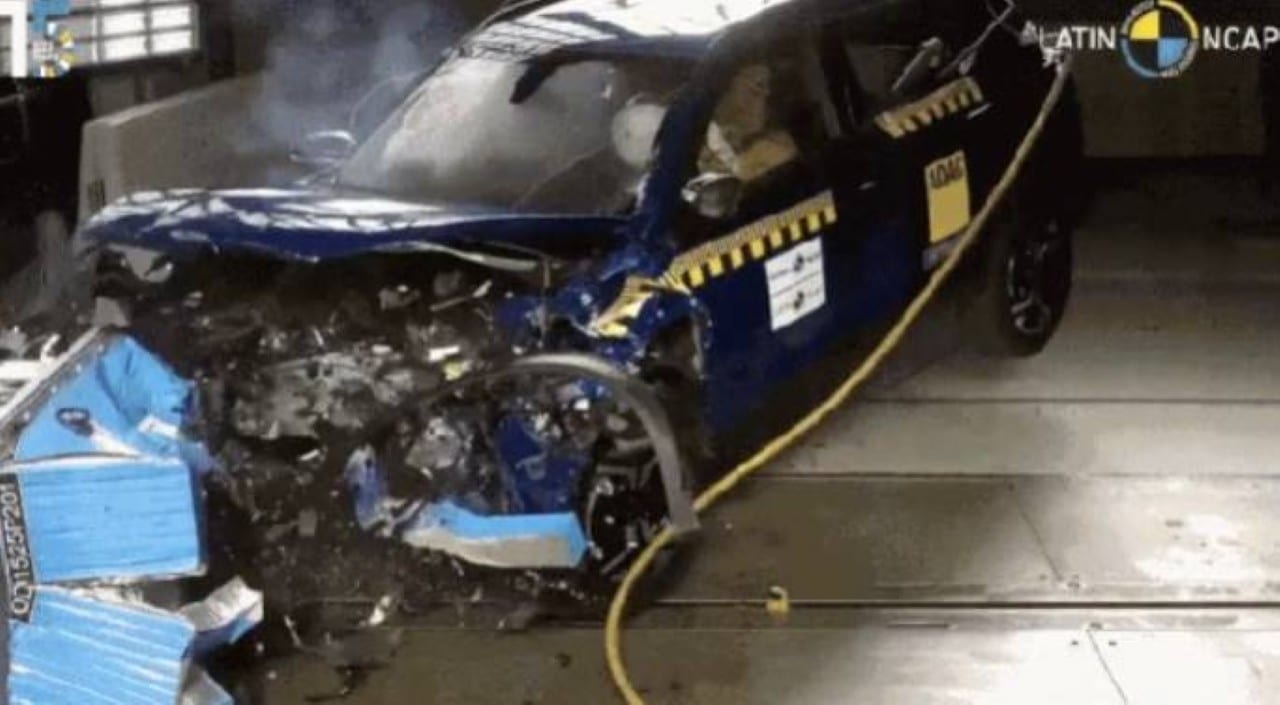
The Peugeot 2008, a compact SUV produced in Brazil by the Stellantis group, received only one star in the rigorous Latin NCAP safety test, announced on June 5, 2025, in São Paulo. The rating, which ranges from zero to five stars, reflects critical deficiencies in occupant protection, particularly in frontal collisions, where the driver’s chest and passenger’s legs showed vulnerabilities. The vehicle’s structure was deemed unstable, unable to withstand high-impact crashes, raising concerns about Stellantis’ safety strategy in Latin America. This result, the first to fail Latin NCAP’s safety recommendations since the Citroën C3 Aircross scored zero stars in 2024, reignites debate over prioritizing cost-cutting over safety.
The test results sparked sharp criticism from experts. Alejandro Furas, Latin NCAP’s secretary-general, stated that the performance reflects a deliberate choice by the manufacturer to offer vehicles with subpar safety standards. The Peugeot 2008’s case is not isolated, as other Stellantis models, such as the Fiat Pulse and Jeep Renegade, have also received low ratings recently.
Despite the shortcomings, the SUV showed strengths, including good protection in side impacts and effective neck protection in rear-end collisions. However, these aspects were insufficient to offset the safety gaps.
- Key issues identified:
- Unstable structure in frontal collisions.
- Inadequate chest protection for the driver.
- Vulnerability in the passenger’s legs.
- Lack of advanced active safety equipment.
Concerning performance in frontal collisions
The frontal crash test with a deformable barrier, simulating a collision with another vehicle, was the most critical point for the Peugeot 2008. The analysis revealed significant exposure to chest injuries for the driver and insufficient thigh protection for the front passenger. These findings suggest that in a real-world accident, occupants could face serious risks. Latin NCAP noted that the absence of technologies like seatbelt pre-tensioners contributed to the poor performance.
Moreover, the vehicle’s cabin structure was classified as “incapable of withstanding higher loads.” This instability compromises the vehicle’s integrity in high-energy scenarios, such as highway crashes. Experts argue that this issue reflects an engineering decision prioritizing cost reduction, a recurring practice in some Stellantis models sold in Latin America.

Positive results in other tests
Not everything was negative for the Peugeot 2008. In side-impact tests, the SUV demonstrated good occupant protection, achieving satisfactory results. Neck protection in rear-end collisions, assessed in the whiplash test, also scored well. These strengths indicate the vehicle performs adequately in specific scenarios, though not enough to improve its overall rating.
The inclusion of two airbags and electronic stability control (ESC) as standard features was a positive point, though Latin NCAP criticized the lack of driver-assistance technologies, such as autonomous emergency braking (AEB), even as optional features.
Stellantis’ track record with Latin NCAP
The Stellantis group, encompassing brands like Peugeot, Citroën, Fiat, and Jeep, has faced a series of unfavorable results in Latin NCAP tests in recent years. Since 2021, no Stellantis model evaluated under the stricter protocols, in place since 2020, has achieved more than two stars. This trend has drawn criticism from safety organizations and consumers, who question the automaker’s strategy in the region.
Recent results include:
- Citroën C3 Aircross (2024): 0 stars.
- Fiat Pulse (2023): 2 stars.
- Jeep Renegade (2023): 1 star.
- Fiat Strada (2022): 1 star.
- Fiat Argo/Cronos (2021): 0 stars.
The best performance by a Stellantis vehicle in Brazil was the Fiat Toro, which earned four stars in 2018, before the merger that formed the group. This track record contrasts with Stellantis’ ability to produce vehicles with high safety standards in markets like Europe, where the same models often receive five stars in Euro NCAP tests.
Expert criticism of Stellantis
Stephan Brodziak, chairman of Latin NCAP’s board, was blunt in his criticism of Stellantis. He called the Peugeot 2008’s one-star result “unacceptable” and indicative of a lack of commitment to basic safety in Latin America. Brodziak argued that the automaker has the technology and expertise to produce safer vehicles but opts for low-cost configurations that compromise occupant protection.
Alejandro Furas, Latin NCAP’s secretary-general, echoed this sentiment, noting that Stellantis appears to treat safety in Latin America as secondary. He compared the situation to European standards, where the company offers models with advanced equipment and stronger structures. Furas advocated for stricter regulations in the region to force manufacturers to raise safety standards.
Comparison with competitors
The Peugeot 2008’s performance contrasts with that of direct competitors in the Latin American market. Models like the Volkswagen Taigun, manufactured in India, and the BYD Dolphin Plus, the first electric vehicle to achieve five stars in Latin NCAP, demonstrate that robust safety is possible even in affordable vehicles. The Renault Kardian, tested in 2024, also earned four stars, excelling in frontal and side-impact protection.
These results reinforce the perception that Stellantis is lagging behind other automakers in the region. While brands like Toyota, Volkswagen, and BYD invest in standard active and passive safety features, the Peugeot 2008 and other Stellantis models rely on minimal configurations, with only two airbags and no advanced technologies.
Stellantis’ response to the results
Stellantis issued an official statement defending that the Peugeot 2008 complies with safety regulations in the markets where it is sold. The company emphasized that safety is considered from the initial development phase and that the CMP platform, used in the SUV, provides a robust structure. However, the automaker did not announce immediate measures to address the identified flaws or offer safer versions of the model.
The response was deemed insufficient by experts, who expected a clear commitment from Stellantis to revise its safety standards in Latin America. The lack of plans to include technologies like AEB or side airbags as standard fueled further criticism of the company’s strategy.
Safety standards in Latin America
Latin America faces longstanding challenges in vehicle safety regulation. Unlike Europe, where Euro NCAP standards are mandatory, countries like Brazil still allow the sale of vehicles with minimal safety equipment. Brazilian legislation, for instance, mandates only two airbags and ESC as standard since 2024 but does not regulate advanced technologies or stricter structural standards.
Latin NCAP has played a crucial role in exposing these gaps and pressuring automakers to improve their vehicles. Since its inception in 2010, the program has tested hundreds of models, driving changes like the adoption of airbags and ESC as standard in several markets. However, results like the Peugeot 2008’s show that significant progress is still needed.
Importance of safety tests
Latin NCAP tests evaluate four main categories:
- Adult occupant protection: Frontal, side, and pole impacts.
- Child occupant protection: Safety of restraint systems and child seats.
- Pedestrian protection: Impact on head, legs, and pelvis.
- Safety assistance: Technologies like AEB, seatbelt reminders, and ESC.
For the Peugeot 2008, scores were 32.13% for adult occupants, 29.10% for child occupants, 46.07% for pedestrians, and 34.88% for safety assistance. These figures reflect performance well below that of competitors, which often exceed 70% in at least two categories.
Automotive market landscape
The Peugeot 2008 is sold in Brazil as a compact SUV, competing with models like the Volkswagen T-Cross, Chevrolet Tracker, and Renault Captur. Despite offering modern design and efficient engine options, such as the 1.0 turbo, the vehicle struggles to gain traction in a market dominated by competitors with stronger safety reputations. Peugeot’s sales in Brazil remain modest, with the brand facing challenges in overcoming perceptions of lower reliability compared to rivals.
The Latin NCAP results may worsen this scenario, especially as consumers are increasingly aware of vehicle safety. Surveys indicate that 68% of new car buyers in Brazil consider crash test results a decisive factor in their purchase decision.
Evolution of Latin NCAP protocols
Since 2020, Latin NCAP has adopted stricter protocols, combining adult and child protection evaluations into a single star rating. Requirements include side-impact pole tests, assessments of driver-assistance technologies, and greater emphasis on pedestrian protection. These changes have made the tests more challenging but also more aligned with global standards, such as those of Euro NCAP.
The updated protocols have exposed the shortcomings of models designed for emerging markets, like the Peugeot 2008. While automakers like Volkswagen and Toyota have adapted their vehicles to meet the new requirements, Stellantis has struggled to keep pace, particularly with models manufactured in Brazil.
Future expectations
Latin NCAP has intensified its campaign for stricter regulations in Latin America, advocating for mandatory safety labels on new vehicles. This measure, already in place in markets like Australia, would allow consumers to directly compare the safety levels of available models.
For Stellantis, the recent results serve as a wake-up call. The company faces pressure to revise its safety strategy in the region, especially in a market where competitors like BYD and Volkswagen are gaining prominence with five-star models. Introducing technologies like side airbags, AEB, and stronger structures could be a path to regaining consumer trust.





