
Munich tops global air pollution rankings due to Canadian wildfire soot

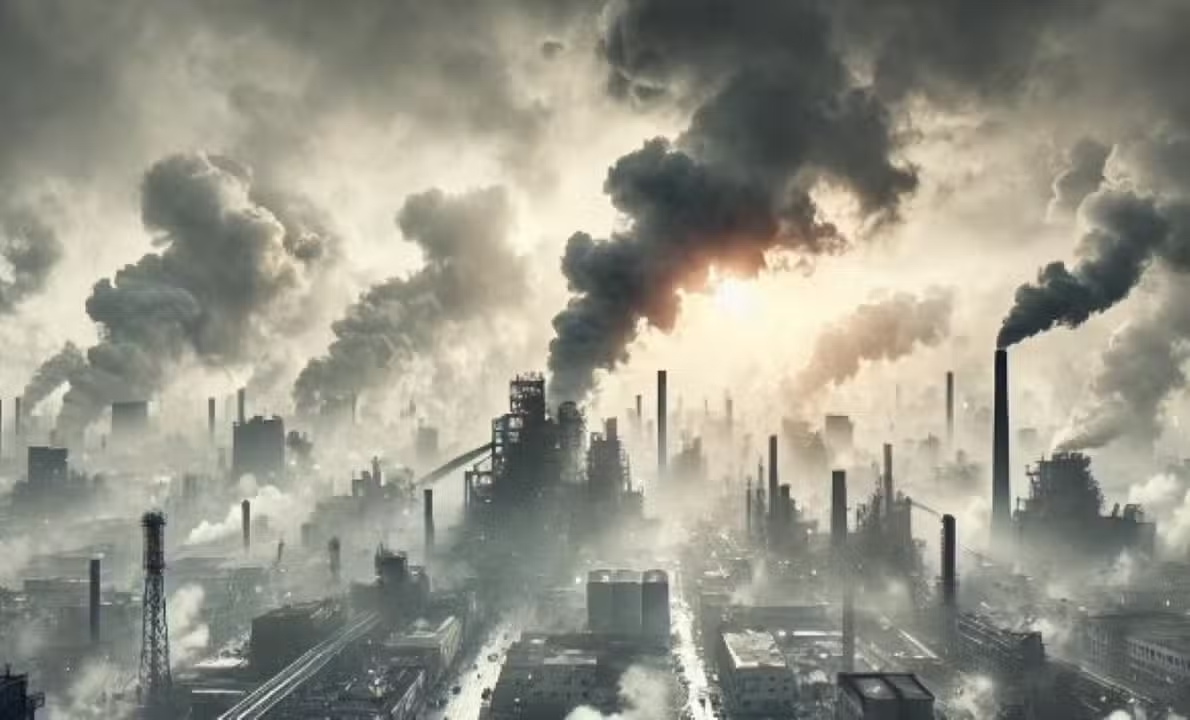
Munich, the bustling capital of Bavaria, is grappling with an unprecedented environmental crisis: on the afternoon of Tuesday, June 10, 2025, the city recorded the world’s worst air quality, surpassing even New Delhi, notorious for its chronic pollution. The culprit? A massive cloud of soot from devastating wildfires in Canada, which crossed the Atlantic and settled over Europe. Air quality monitoring stations sounded alarms as visibility in the city’s streets plummeted, and residents began feeling the effects of the pollution. Described as a “fine dust carousel,” this phenomenon highlights the vulnerability of European cities to global climate events. How did this happen, and why is Munich at the epicenter? The answer lies in atmospheric currents, climate change, and a weather system connecting continents.
The crisis in Munich is part of a broader global event affecting multiple European regions. Smoke from Canada’s wildfires, which have consumed millions of hectares of forest, was carried by high-altitude jet streams to Europe. Recent data show that levels of fine particulate matter (PM2.5) in Munich reached alarming peaks, placing the city at the top of the IQAir ranking, a Swiss company specializing in air quality monitoring.
The situation caught many residents off guard. “You could see the haze in the air, and there was a faint smell of smoke,” a local told a news outlet. Here are key points about the crisis:
- Pollution source: Wildfires in Canada, fueled by heatwaves and drought.
- Transatlantic transport: Jet streams carried soot thousands of kilometers.
- Local impact: Reduced visibility and elevated PM2.5 levels.
- Forecast: Rain expected by the weekend may ease conditions.
While Munich has drawn attention, other European cities have also reported declining air quality, underscoring the scale of the issue.
How soot crossed the Atlantic
The arrival of soot particles in Munich is tied to a large-scale meteorological system. The “Azores High,” a high-pressure system spanning the North Atlantic, has created what meteorologists call a “fine dust pump.” This system has steered jet streams to transport soot from Canada to Europe. The process is complex but involves wildfires releasing fine particles into the atmosphere, which rise to higher altitudes and are carried by fast-moving winds.
The Canadian wildfires are not an isolated event. Since May 2025, flames have ravaged forests in provinces like Ontario and Quebec, releasing record amounts of carbon dioxide and pollutants. Reports indicate over 8 million hectares have burned, surpassing the annual average of the past decade. These particles, upon reaching Europe, mix with local air, worsening pollution in dense urban areas like Munich.
Long-distance pollutant transport is not new, but the intensity of this event has surprised experts. “We’re seeing a perfect storm: extreme wildfires, shifting atmospheric currents, and a high-pressure system amplifying the issue,” a meteorologist told a European news portal.
Munich’s brief reign as pollution capital
For roughly two hours on Tuesday, Munich held the top spot on IQAir’s list as the world’s most polluted city. PM2.5 levels, fine particles that can penetrate deep into the lungs, hit critical thresholds. By 7:15 p.m., the city dropped to fourth place, but air quality remained concerning.
The comparison to New Delhi, which often leads the ranking due to industrial emissions and heavy traffic, is striking. In Munich, PM2.5 levels were up to 10 times higher than the World Health Organization’s recommended limits. These particles are particularly dangerous, linked to respiratory issues, cardiovascular problems, and worsening conditions like asthma.
Residents voiced concerns. Many reported breathing difficulties outdoors, while others stayed indoors. Local schools issued advisories urging children to avoid outdoor activities.
Factors worsening the crisis
Several elements have compounded Munich’s air quality issues. Beyond the Canadian soot, local factors have intensified the problem:
- Urban traffic: Munich’s heavy vehicle flow adds local pollutants.
- Weather conditions: Recent lack of rain has prevented particle dispersion.
- Topography: The city’s mountain-surrounded location can trap pollutants.
- Industrial activity: Though less significant, local industry contributes to baseline pollution.
These factors, combined with the transatlantic event, have created a “perfect storm” of pollution. Data from the European Environment Agency show that prolonged PM2.5 exposure is linked to thousands of premature deaths in Europe annually, highlighting the crisis’s severity.


Outlook for the coming days
The bad news is that the crisis may persist for a few days. Weather models suggest slight air quality improvements in Munich and other European cities starting Thursday, but conditions are unlikely to normalize until Sunday, when rain and northwest winds are forecast. These conditions could “wash” particles from the air, offering relief.
Until then, local authorities recommend precautions, especially for vulnerable groups like the elderly, children, and those with respiratory conditions. Measures include wearing masks outdoors and limiting intense physical activity.
The role of climate change
Munich’s crisis cannot be separated from the broader context of climate change. Canada’s wildfires, like other extreme events such as heatwaves and droughts, are intensified by global warming. Recent studies show that the frequency and severity of wildfires have risen significantly over the past decades, with 2025 among the most destructive years on record.
The link between these events and pollution in distant regions shows the interconnectedness of the climate system. “What happens in one part of the world doesn’t stay there. The air we breathe in Munich today carries the consequences of fires thousands of miles away,” an environmental researcher told a news outlet.
Recommended precautions
Authorities and experts suggest steps to minimize health risks:
- Avoid outdoor activities: Especially during peak pollution hours, like late afternoon.
- Use air purifiers: In indoor spaces, particularly for those with respiratory issues.
- Monitor alerts: Track air quality updates via apps like IQAir’s.
- Protect vulnerable groups: Limit outdoor exposure for children and the elderly.
These measures, though temporary, are critical until atmospheric conditions improve.
A global wake-up call
Munich’s situation underscores the interdependence of global climate systems. As Canada’s wildfires rage on, Europe faces the fallout of a problem that crosses borders. Other cities, like London and Paris, have also reported rising pollution levels, though less severely.
Environmental organizations have seized on the event to call for coordinated climate action. Reducing greenhouse gas emissions, investing in reforestation, and adopting cleaner technologies are seen as vital steps to prevent future crises.
What lies ahead
In the short term, hope rests on the weekend’s forecasted rain, which should ease conditions in Munich and other affected areas. Long-term, however, such events may become more frequent without action on underlying issues like global warming.
The crisis also highlights the value of air quality monitoring systems. Platforms like IQAir’s enable citizens and authorities to track pollution in real time, aiding swift responses. In Munich, the network of monitoring stations was key to identifying the problem’s severity and alerting the public.
Veja Também em Mundo

Pessoa é baleada próximo à Casa Branca em Washington durante lockdown
04/05/2026
Oracle desliga 30 mil funcionários após treinar inteligência artificial para suas funções
04/05/2026
Cardume gigante de olho-de-cão invade costa de São Francisco do Sul e impressiona pescadores
04/05/2026
Rússia declara pausa unilateral em combates na Ucrânia antes de celebração militar
04/05/2026
Terremoto de magnitude 5,6 sacode Cidade do México e dispara sistema de alerta sísmico
04/05/2026
Atriz francesa Claire Maurier, célebre por ‘Amélie’ e ‘Os Incompreendidos’, falece aos 97 anos
04/05/2026
Princesa Eugenie anuncia terceira gravidez, com bebê previsto para 2026
04/05/2026
Atropelamento fatal em Leipzig resulta em duas mortes e vinte feridos; motorista de 33 anos preso
04/05/2026
Segundo passageiro de cruzeiro testa positivo para hantavírus no Atlântico
04/05/2026
Embraer anuncia venda recorde de C-390 Millennium para os Emirados Árabes Unidos
04/05/2026
Decreto de Portugal torna nacionalidade mais rigorosa com novos requisitos legais
04/05/2026