
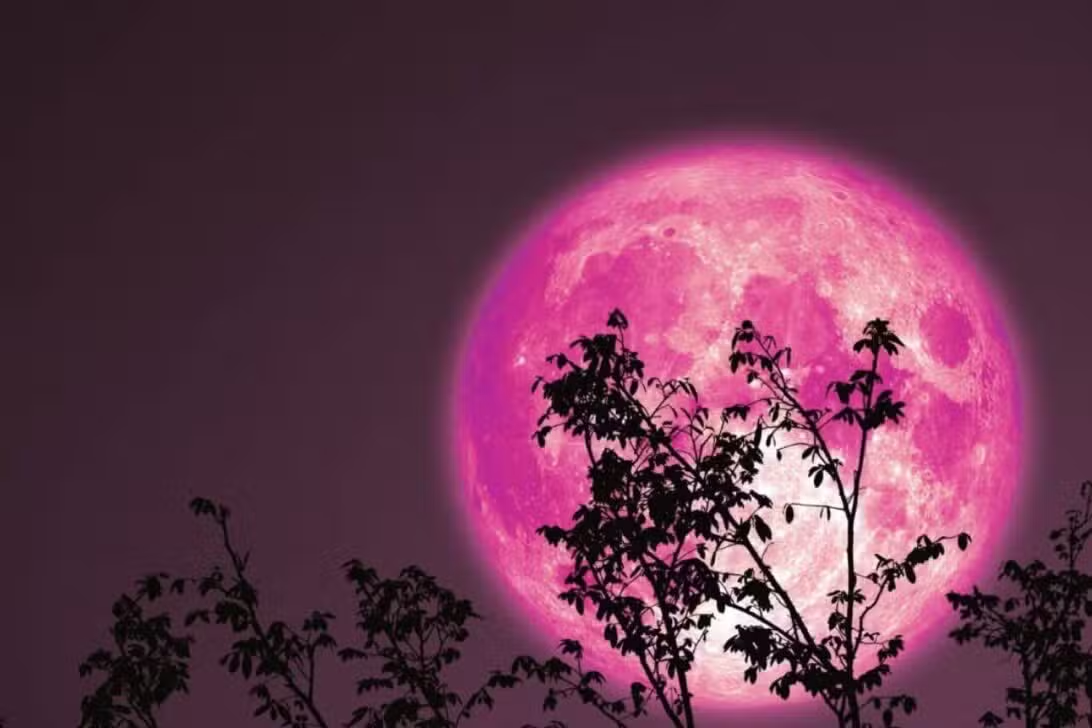
The full moon of June, known as the Strawberry Moon, will illuminate the Louisiana sky on Tuesday night and into early Wednesday morning, offering a rare astronomical event. This phenomenon, coinciding with a “major lunar standstill,” causes the moon to follow an unusually low path across the sky, a spectacle not seen with such intensity since 2006. Astronomers and skywatchers in Louisiana are gearing up to observe the moon, which, despite its evocative name, won’t display reddish hues. The event stems from complex orbital cycles influenced by solar gravity, marking a unique moment in the celestial calendar. This phenomenon, occurring every 18.6 years, sparks curiosity about lunar movements and their connection to Earth.
The term Strawberry Moon, though suggestive, refers to the strawberry harvest season in North America, not the moon’s appearance. Astronomers note that this year’s event is special due to the combination of the moon’s low orbit and the standstill, which shifts its rising and setting points on the horizon. The full moon will reach peak illumination at 2:44 a.m. Wednesday, Louisiana time, but will be visible from Tuesday evening.
- Key features of the event:
- Lower trajectory in the sky, noticeable in the Northern Hemisphere.
- Alignment with the major lunar standstill, a 18.6-year cycle.
- Strawberry Moon name tied to berry harvests, not color.
Despite its striking presence, the moon won’t be closer to Earth, ruling out a larger appearance like a supermoon. In fact, it will be farther away, having passed apogee, its farthest point from Earth, on June 7.
What is a major lunar standstill?
A major lunar standstill, or lunistice, is an astronomical event occurring roughly every 19 years, when the moon reaches the maximum extremes of its orbit relative to the horizon. Unlike a solstice, which tracks the sun’s position, a lunar standstill affects the moon’s rising and setting points, resulting in a visibly lower path across the sky. This phenomenon is driven by the gradual shift of the moon’s orbit, primarily due to the sun’s gravitational pull. Scientists note that the 18.6-year cycle is part of a broader celestial pattern, captivating astronomers and skywatchers for centuries.
In Louisiana, the event will be particularly striking as the moon appears to “skim” the sky, tracing an arc closer to the horizon. This movement creates a unique visual experience, though it doesn’t alter the moon’s apparent size. Experts recommend viewing from areas with clear horizons, such as rural fields or parks, for the best experience.
Why doesn’t the moon look bigger?
Despite its low trajectory, the June full moon won’t be closer to Earth. An instructor from Louisiana State University’s Department of Physics and Astronomy explains that the moon will be farther away, having passed apogee on June 7. This distance makes the moon appear slightly smaller in the sky, the opposite of a supermoon, when it’s at perigee, its closest point to Earth.
The perception of a larger moon near the horizon is an optical illusion. The human brain interprets objects on the horizon as closer, creating the sense that the moon is bigger when rising or setting. This “moon illusion” is unrelated to the moon’s actual distance, stemming instead from how we process depth and perspective.
The story behind the Strawberry Moon name
The name Strawberry Moon has cultural and historical roots, but it doesn’t reflect the moon’s appearance. It comes from Native American and colonial traditions in North America, which linked full moons to seasonal events. The June moon marks the strawberry harvest period, common in late spring or early summer. Other full moons throughout the year also carry nature-inspired names, such as Wolf Moon (January), Flower Moon (May), and Hunter Moon (October), according to records like The Old Farmer’s Almanac.
These names served as a way to track time and seasons before modern calendars. In Louisiana, where agriculture remains significant, the Strawberry Moon name resonates with the connection between the sky and the land, even if the moon itself lacks vibrant colors.
How to observe the moon in Louisiana?
The June full moon will be visible across Louisiana, with optimal viewing in areas with low light pollution. Peak illumination occurs at 2:44 a.m. Wednesday, but the moon will shine brightly from Tuesday night. Astronomers offer tips for enjoying the event:
- Choose locations with open horizons, like fields or lakes.
- Avoid urban areas with excessive artificial light.
- Use binoculars to spot lunar surface details, such as craters.
- Check weather forecasts for clear skies.
While the major lunar standstill isn’t as dramatic as an eclipse, its uniqueness lies in the moon’s path throughout the night. Keen observers will notice its low trajectory, especially when compared to other full moons.
The significance of lunar cycles
Lunar cycles, like the major lunar standstill, have been studied for millennia across cultures. Modern astronomers use these events to deepen their understanding of celestial mechanics and the gravitational interplay between Earth, the moon, and the sun. The 18.6-year cycle results from a gradual precession of the lunar orbit, shifting the moon’s rising and setting points over time.
In Louisiana, where the night sky draws both locals and visitors, such events spark interest in astronomy. Local observing clubs and universities, like LSU, often host events for full moons and other celestial phenomena, attracting amateurs and professionals alike.

Other full moon names
Beyond the Strawberry Moon, full moons throughout the year carry names reflecting culture and the environment. Each name tells a story:
- Wolf Moon: tied to winter, when wolves howled in hunger.
- Flower Moon: marks spring’s blooming season.
- Hunter Moon: linked to autumn’s hunting period.
- Cold Moon: reflects December’s intense chill.
Preserved by sources like The Old Farmer’s Almanac, these names connect the lunar calendar to seasons and natural cycles, offering a historical lens on how societies tracked time.
Ideal viewing conditions
Louisiana’s June weather generally favors stargazing, with warm nights and often clear skies. However, seasonal rains can interfere, especially in coastal areas. State parks and nature reserves are recommended for unobstructed views of the moon.
The moon’s low path also creates opportunities for stunning photographs, particularly with long-range lenses. Amateur and professional photographers in Louisiana are preparing to capture the Strawberry Moon against natural backdrops like swamps and rivers, enhancing the event’s visual appeal.
The moon’s cultural resonance in Louisiana
The full moon holds a special place in Louisiana’s culture, inspiring legends, music, and celebrations. In rural communities, stories about the moon and its cycles persist, often tied to Cajun and Creole traditions. Astronomical events like the Strawberry Moon reinforce this fascination, blending science and culture in a moment of skyward reflection.
The combination of the major lunar standstill and the June full moon makes this event a milestone for astronomers and enthusiasts. The moon’s unique trajectory, though subtle, underscores the complexity of celestial movements and their enduring ability to captivate humanity.