

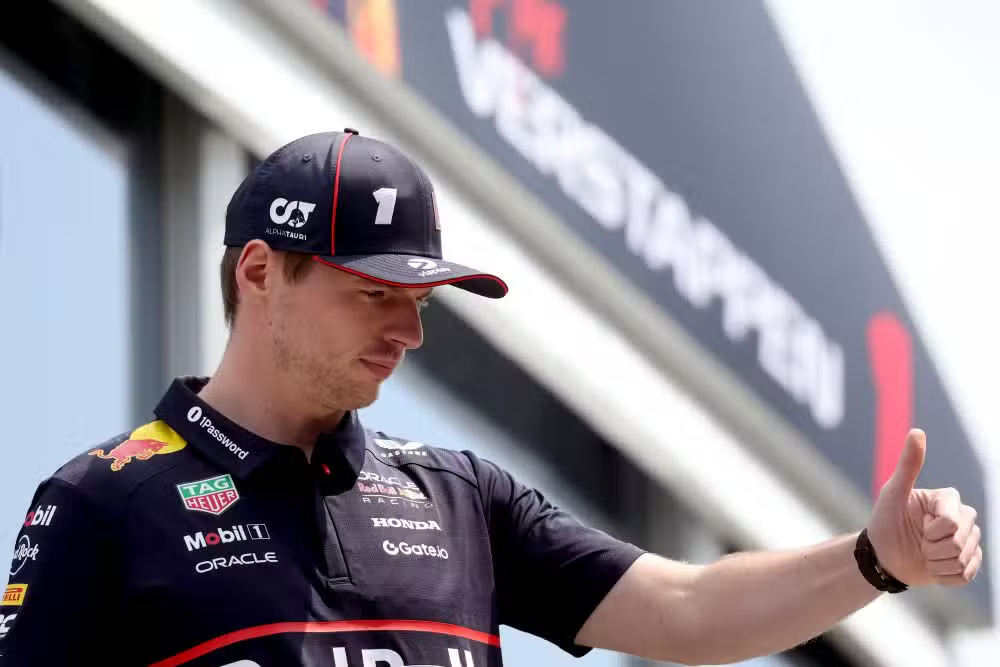
Max Verstappen, four-time Formula 1 champion, heads into the Canada Grand Prix, held from June 13 to 15, 2025, under intense scrutiny: with 11 points on his FIA superlicense, he’s one point shy of an automatic suspension. A deliberate collision with George Russell in the Spanish GP, which earned him three penalty points, has put him in a precarious position. Yet, at Montreal’s Circuit Gilles Villeneuve, the Red Bull driver dismissed calls for caution, stating that “missing a race isn’t the end of the world.” His bold stance sets the stage for the tenth round of the 2025 season.
Verstappen’s comments came during media sessions at the iconic Canadian circuit, known for its “Wall of Champions” and historic races, including wins by Nelson Piquet and Ayrton Senna. The Dutchman, trailing Oscar Piastri (186 points) and Lando Norris (176 points) with 137 points in the championship, faces pressure to stay consistent. Still, he remains unwavering in his aggressive approach.
- Key points in Verstappen’s situation:
- Holds 11 superlicense points, with a 12-point limit triggering a ban.
- Three points stemmed from the Russell collision in Spain.
- First points expire after the Austrian GP in July.
- Red Bull urges restraint, but Verstappen refuses to adapt.
The looming threat of a ban places Verstappen in the spotlight as Formula 1 resumes after a two-week break.
Tension at Circuit Gilles Villeneuve
The Canada GP, hosted in Montreal, ranks among the calendar’s toughest tracks. Its 4.361-km layout demands precision, blending fast straights with tight corners. Verstappen, a winner here in 2022 and 2023, faces a unique challenge in 2025. With his superlicense on the brink, he must balance aggression with caution—a balance he seems unwilling to strike.
Red Bull, wary of the stakes, advised Verstappen to avoid incidents. Team consultant Helmut Marko called a potential suspension a “disaster” for his title hopes. However, Verstappen brushed off concerns, emphasizing during the press conference that he can’t control stewards’ decisions and will “do my best” in every race.
Superlicense rules and penalty history
The FIA’s superlicense system is strict. Infractions like avoidable collisions or dangerous moves incur penalty points, valid for 12 months. Verstappen’s 11 points, amassed over the past year, include the notable clash with Russell in Spain. The Mercedes driver, while avoiding drama, stressed that the rules are fair, noting, “If he hits 12 points, it’s not unjust.”
- How the penalty system works:
- A 12-point threshold in 12 months results in a one-race ban.
- Points are issued for violations like collisions or rule breaches.
- Verstappen’s earliest points expire post-Canada and Austria GPs.
- Other drivers, including Russell, also track their licenses.
Verstappen’s case reignites debates over the system’s rigidity. Supporters argue it ensures safety; critics say it curbs drivers’ natural aggression.
Paddock reactions
Verstappen’s defiance sparked varied responses. Russell, impacted by the Spanish incident, kept his cool but reiterated that penalties exist for a reason. Lando Norris, second in the championship, focused on his own race but acknowledged the mental weight of a potential ban. Red Bull feels the strain most acutely, as a suspension could jeopardize their constructors’ lead, with McLaren’s Piastri and Norris dominating 2025. Ferrari, led by Charles Leclerc, eyes a chance to capitalize, especially after Leclerc’s 2024 Montreal win.
Challenges of the Canadian track
The Circuit Gilles Villeneuve, on Notre-Dame Island, is unpredictable. Its long straights and technical corners, like the hairpin at Turn 10, test drivers’ skills. The infamous “Wall of Champions” at the final chicane has claimed victims like Michael Schumacher and Sebastian Vettel. For Verstappen, staying error-free while pushing hard is critical.
The 2025 Canada GP marks the season’s tenth race. After nine rounds, McLaren leads the constructors’ standings with 362 points, followed by Ferrari (165) and Mercedes (159). Verstappen, with two wins this year, aims to close the gap to Piastri, but any misstep could be costly.
Iconic moments in Canada
The Canadian GP boasts a storied past. Renamed for Gilles Villeneuve in 1982, it has seen Brazilian triumphs from Piquet (1982, 1984, 1991) and Senna (1988, 1990). The 2011 race, won by Jenson Button after six hours of rain delays, remains the longest in F1 history. Verstappen, a past winner, knows the track demands focus.
- Canada GP highlights:
- Named for local hero Gilles Villeneuve since 1982.
- “Wall of Champions” is notorious for high-profile crashes.
- 2011 race lasted over 4 hours due to weather chaos.
- Brazilians have secured five victories here.
The mix of a tricky circuit and Verstappen’s high-stakes situation guarantees a thrilling weekend.
Rivalries heat up
The 2025 season is fiercely competitive. Piastri, with five wins, leads the drivers’ standings, closely trailed by Norris. Verstappen, in third, remains a contender but can’t afford setbacks. His feud with Russell, fueled by the Spanish clash, adds drama to the Canada GP. Russell, chasing points for Mercedes, voiced frustration over Verstappen’s tactics.
Other names, like Leclerc and rookie Gabriel Bortoleto, draw attention. Bortoleto, driving for Sauber, faced a pre-race scare when his backpack was stolen in Zurich but arrived in Montreal unscathed. The Brazilian, yet to score points, aims for a breakthrough.
Team strategies
Red Bull is taking a cautious approach with Verstappen, tweaking the car for Montreal’s straights and corners. McLaren banks on Piastri and Norris’s consistency, while Ferrari leverages its strong Canadian record. Tire choices—soft, medium, and hard compounds—will be pivotal, with degradation a key concern. Verstappen, plagued by slow pit stops in 2025, needs flawless execution.
Safety and driving standards
The superlicense point system prioritizes safety but sparks controversy. Verstappen argues that aggression fuels F1’s appeal, while the FIA holds firm, especially after incidents like Spain. His situation tests the balance between competition and responsibility. In Canada, starting with practice on Friday, June 13, and culminating in the race on Sunday, June 15, all eyes are on the champion.
Next steps in the season
Post-Canada, the Austrian GP offers Verstappen relief, as two superlicense points expire. Until then, every corner challenges his skill and discipline. With 24 races in 2025, the season promises more twists, and Verstappen remains a central figure.