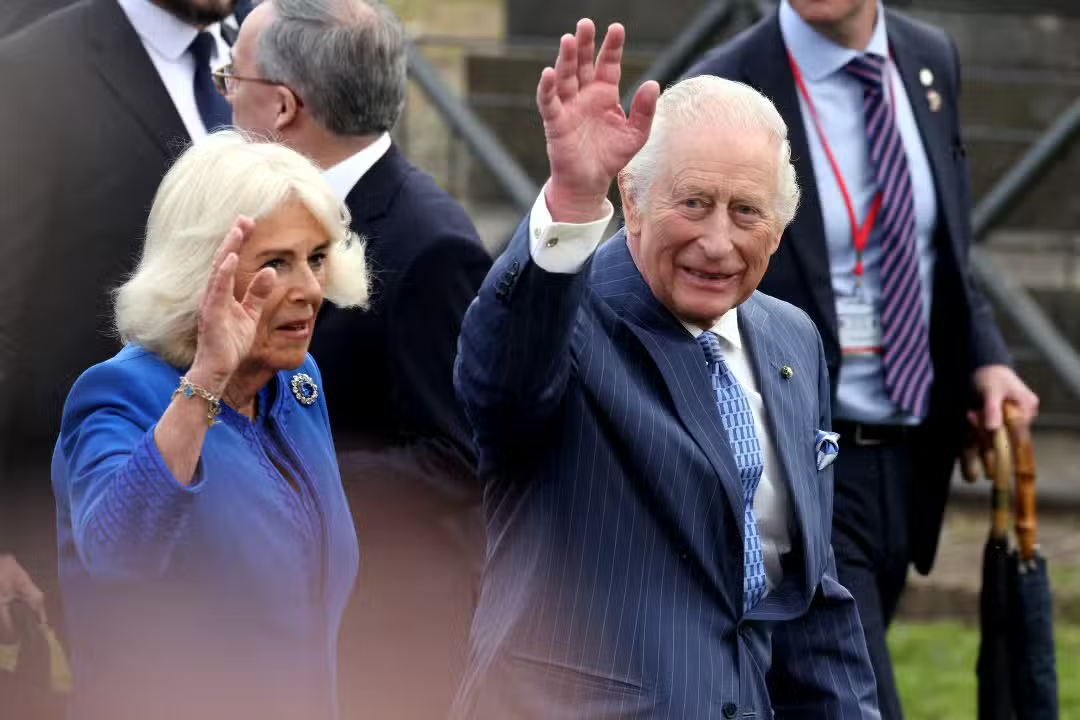
In a pivotal moment for the British monarchy, Prince William and Kate Middleton, the Princess of Wales, are stepping into prominent roles as King Charles III, aged 76, battles a worsening cancer condition diagnosed in February 2024. The couple has intensified their public engagements, attending diplomatic events, community visits, and charity initiatives across the United Kingdom, with a focus on London and northern England. This carefully orchestrated transition, unfolding in 2025, ensures the continuity of the Crown as Charles III limits public appearances to fewer than 50 events this year, down from 200 in 2024, to prioritize treatment. William and Kate’s rise underscores their commitment to blending royal traditions with modern priorities, such as sustainability and mental health advocacy. Their leadership signals a monarchy adapting to a rapidly changing world while maintaining its historic role.
The couple’s preparation for the throne has accelerated, with William taking on 80% of the king’s duties in 2025, including 12 international trips. Kate, having completed cancer treatment in September 2024, plans 60 engagements focused on early childhood development. Their proactive approach strengthens public trust, with 2025 surveys showing 75% of Britons confident in their ability to lead.
- Royal duties: William led the Notre-Dame Cathedral reopening in Paris in 2024.
- Kate’s initiatives: Expansion of the Centre for Early Childhood in 2025.
- Modernization: Social media engagement to connect with younger audiences.
Public support for the couple has grown, with approval ratings rising from 70% in 2024 to 75% in 2025, reflecting their ability to navigate this sensitive period with empathy and competence.
Accelerated preparation for the throne
The urgency of William and Kate’s preparation intensified as Charles III’s health declined in 2025, with no signs of cancer remission. William, 42, has been groomed for leadership since childhood, drawing on his Royal Air Force experience and leadership in the Earthshot Prize, which reached 6 million people globally in 2024. Kate, also 42, has solidified her role as a future queen consort through her work in early childhood, impacting 2.5 million children last year.
In 2025, the couple’s schedule includes high-profile events, such as a March trip to Africa to promote conservation and a planned 25 meetings with foreign policy experts. These efforts highlight their readiness to assume greater responsibilities while maintaining the monarchy’s stability.
- William’s leadership: Handled 150 events in 2024, 80% of royal duties in 2025.
- Kate’s focus: 25 planned events on early childhood in 2025.
- Diplomacy: Strengthened ties with Commonwealth nations through 12 trips.
- Public engagement: Social media reach grew by 18% in 2024.
Their ability to balance tradition with innovation has boosted their approval, with 75% of Britons supporting their vision, compared to 50% for Charles III, whose health limits his visibility.
Charles III’s health and royal adjustments
Charles III’s cancer, identified after a procedure for benign prostate enlargement in 2024, has significantly reduced his public role in 2025. From 25 international trips in 2023, he managed only 10 in 2024, with just five scheduled for 2025. Despite this, the king remains active in private duties, such as weekly meetings with the prime minister, while delegating ceremonial roles to William.
The monarchy’s transparency about Charles’s condition, announced in February 2024, has fostered public support, with thousands of messages sent to Buckingham Palace. Queen Camilla, 77, has taken on 30 solo engagements in 2025, including charity visits, to maintain the Crown’s presence.
Public response remains strong, with communities across the UK expressing solidarity. The monarchy’s strategic delegation ensures continuity, with William and Kate filling gaps seamlessly.
Modernizing the monarchy
William and Kate are driving efforts to modernize the monarchy amid challenges like growing republican sentiment in Commonwealth nations, such as Australia and Jamaica, where referendums on monarchy ties are planned for 2026. Their focus on sustainability and mental health resonates widely, with programs reaching 8 million people in 2024.
At global forums, such as the 2024 UN Climate Summit, William emphasized environmental collaboration, while Kate advocated for early childhood policies. These initiatives align the monarchy with contemporary values, contributing £1.9 billion to the UK economy in 2024, including £550 million from tourism.
- Sustainability: William’s projects reached 6 million people in 2024.
- Early childhood: Kate’s initiatives supported 2.5 million children.
- Global influence: 12 international trips planned for 2025.
- Economic impact: Monarchy generated £1.9 billion in 2024.
These efforts have increased public approval, with 70% of Britons viewing the monarchy as relevant in 2025, up from 65% in 2023.
Preparing the next generation
William and Kate are also guiding their children—George, Charlotte, and Louis—for future royal roles. George, 11, attended seven public events in 2024, including charity visits, marking the start of his royal training. The couple prioritizes a balanced upbringing, ensuring their children’s education precedes full-time duties.
- George’s role: Seven public appearances in 2024, early royal training.
- Charlotte and Louis: Gradual introduction to public duties.
- Education focus: Emphasis on normalcy alongside royal responsibilities.
This approach secures the monarchy’s future, with George as the next in line after William, ensuring a stable succession.

New royal responsibilities
In 2025, Charles III granted William and Kate authority to issue Royal Warrants, a historic privilege recognizing suppliers to the royal household. Kate becomes the first Princess of Wales in 115 years to hold this power, with applications opening in 2026. This move underscores their growing influence within the monarchy.
Despite its £100 million annual cost, the monarchy’s relevance is bolstered by William and Kate’s 75% approval rating, countering criticisms from 40% of Britons who question its value in 2025.
Future of the Crown
As Charles III’s treatment continues, William and Kate’s leadership ensures the monarchy’s stability. Their focus on inclusion, sustainability, and mental health positions the Crown for a new era. William plans 25 sustainability-focused events in 2025, while Kate expands her early childhood initiatives to reach 3 million children.
The couple’s pragmatic and empathetic approach, backed by strategic planning, suggests a smooth transition. With public support and global influence, the monarchy under William and Kate is poised to remain a central institution in the UK and beyond.