

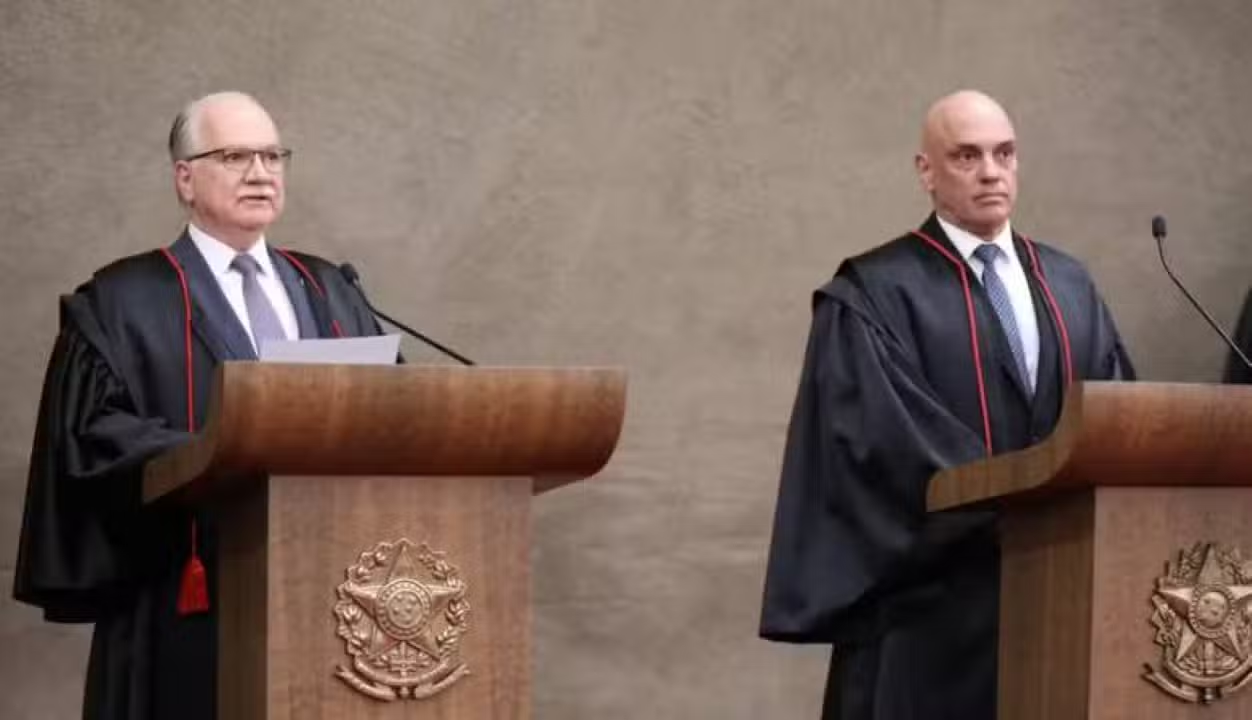
The Supreme Federal Court (STF) elected, on Wednesday, August 13, 2025, Ministers Edson Fachin and Alexandre de Moraes as president and vice-president, respectively, for the 2025-2027 term. Their inauguration is scheduled for September 29, when they will replace the current president, Luís Roberto Barroso. The symbolic and electronic vote followed the tradition of seniority, with Fachin and Moraes each receiving 10 votes, as per the rule that no minister votes for themselves. The election reinforces the Fachin-Moraes partnership seen in 2022 at the Superior Electoral Court (TSE), when both led the general elections. The choice comes amid international tensions, with Fachin signaling a defense of judicial independence against external criticism. The new leadership aims to maintain the STF as a guardian of the Constitution, focusing on collegiality and institutional dialogue.
The election of Fachin and Moraes was expected, as the STF follows a rotation system based on seniority. Fachin, the current vice-president, is the most senior minister yet to hold the presidency, while Moraes, appointed in 2017, takes the vice-presidency as the next in line. The vote, held in an administrative session, was secret and attended by all 11 Court justices.
- The seniority tradition guides the choice of president.
- Fachin succeeds Barroso, whose term ends in September.
- Moraes will serve as vice, likely assuming the presidency in 2027.
The leadership transition at the STF marks the start of a term facing significant challenges, particularly with the 2026 municipal elections approaching.
Fachin’s technical profile and institutional stance
Edson Fachin, born in Rondinha, Rio Grande do Sul, is known for his technical and reserved profile. Nominated by former President Dilma Rousseff in 2015, the minister has a robust academic background, holding a doctorate in Law from the Pontifical Catholic University of São Paulo (PUC-SP) and serving as a tenured professor at the Federal University of Paraná (UFPR). At the STF, Fachin was the rapporteur for high-profile cases, such as Operation Lava Jato, the temporal framework for indigenous land demarcations, and the action limiting police operations in Rio de Janeiro’s favelas.
His tenure at the TSE, from February 2022 to August 2023, was marked by strong actions against misinformation and in defense of the electoral system. Fachin led the rejection of the printed vote proposal, advocated by former President Jair Bolsonaro, and introduced measures to combat the spread of fake news. Experts suggest his STF presidency will prioritize harmony among the branches of government, with a less media-driven approach than Barroso’s.
- As Lava Jato rapporteur, Fachin overturned Lula’s convictions in 2021.
- At the TSE, he fought misinformation during the 2022 elections.
- He defends judicial autonomy against external pressures.
Fachin has already signaled concern over attempts at democratic erosion, particularly amid recent criticism from the U.S. government toward the Brazilian judiciary.
Alexandre de Moraes: a vice with growing influence
Alexandre de Moraes, elected vice-president, is a central figure in the STF. Appointed by Michel Temer in 2017 after Teori Zavascki’s death, Moraes has held prominent roles, including Minister of Justice and São Paulo’s Secretary of Public Security. At the Supreme Court, he is the rapporteur for sensitive inquiries, such as those on fake news and the January 8, 2023, anti-democratic acts.
His TSE tenure, as Fachin’s vice in 2022 and president until 2023, was marked by the conviction of Jair Bolsonaro, rendering him ineligible until 2030. Moraes is known for his combative stance against threats to democracy, placing him at the center of political debates and international tensions, such as sanctions announced by U.S. President Donald Trump.
- Moraes led inquiries into fake news and coup attempts.
- His TSE leadership strengthened electoral process security.
- He is poised to assume the STF presidency in 2027.
The partnership with Fachin, tested at the TSE, suggests a cohesive leadership focused on defending democratic institutions.
STF transition and challenges for 2025-2027
The election of Fachin and Moraes comes as Luís Roberto Barroso’s term, which began in 2023, concludes. Barroso, in his speech, praised Fachin’s moral and intellectual qualities, wishing him a successful tenure. The new administration will face sensitive issues, such as ongoing investigations into coup attempts and preparations for the 2026 municipal elections.
Fachin will also chair the National Council of Justice (CNJ), overseeing judicial oversight. His leadership is expected to strengthen collegiality and dialogue with other branches of government, positioning the STF as a key player in upholding the Constitution.
- The 2026 elections will test the new leadership.
- Fachin’s CNJ role will expand his judicial influence.
- Dialogue with the Executive and Legislative branches will be a priority.
The leadership of Fachin and Moraes will be closely watched, especially in a context of political polarization and external pressures.
Fachin-Moraes partnership history at the TSE
The Fachin-Moraes partnership is not new. At the TSE, from 2022 to 2023, they worked together during the general elections, tackling challenges like misinformation and attacks on the electronic voting system. As president, Fachin implemented measures to swiftly address false content, while Moraes, as vice, led investigations resulting in landmark decisions, such as Bolsonaro’s ineligibility.
This joint experience strengthens expectations of a cohesive STF leadership. Both ministers have shown alignment on issues related to democratic protection and combating threats to institutions.
- In 2022, the TSE faced attacks on voting system legitimacy.
- Fachin and Moraes led rapid responses to misinformation.
- Their partnership delivered firm, coordinated decisions.
- TSE experience will shape their STF leadership approach.
The symbolic election underscores the confidence of other justices in Fachin and Moraes’s leadership capabilities.
Expectations for the new leadership
Fachin’s presidency is expected to be marked by a reserved style, with less public exposure compared to Barroso. Known for avoiding political events and controversial statements, Fachin focuses on technical decisions and consensus-building. His term will navigate a complex political landscape, with the 2026 elections and potential tensions with the Executive.
Moraes, meanwhile, will maintain his influence as a rapporteur for high-stakes cases. His assertive approach may complement Fachin’s conciliatory style, balancing firmness and dialogue. The Court will address issues like social media regulation, environmental matters, and high-profile criminal cases.
- Fachin will prioritize technical, collegial decisions.
- Moraes will focus on democratic security issues.
- The leadership will face electoral and international challenges.
- The STF will remain a guardian of the Constitution.
The inauguration, set for September 29, will mark a milestone for the Brazilian judiciary, with Fachin and Moraes leading one of the most challenging periods in the STF’s recent history.