

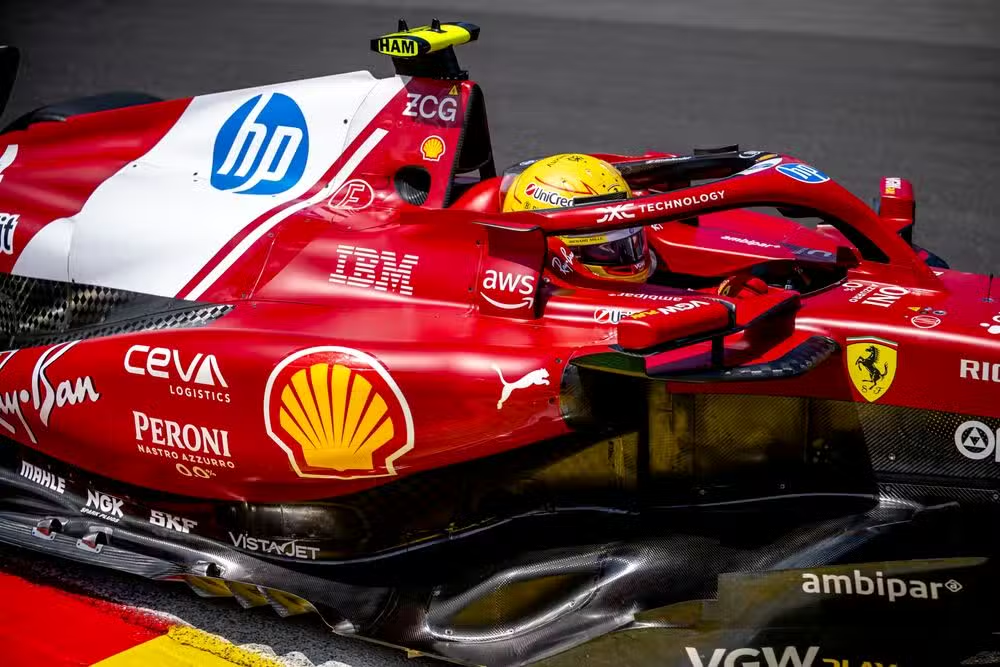
Lewis Hamilton, seven-time Formula 1 world champion, is navigating a challenging season at Ferrari, marked by underwhelming results and growing speculation about his potential retirement. After 14 races in 2025, the British driver has 109 points, placing him sixth in the Drivers’ Championship, 42 points behind teammate Charles Leclerc. Guenther Steiner, former Haas team principal, stated that Hamilton’s loss of confidence, combined with struggles to adapt to the SF-25 car, could lead him to exit the sport by year-end. The summer break, ending with the Dutch Grand Prix from August 29 to 31, will be pivotal for the 40-year-old to decide his future in the sport. This scenario contrasts sharply with the high expectations surrounding his move to Ferrari, which promised to revive the Italian team’s glory days.
Hamilton’s shift from Mercedes, where he won six world titles, to Ferrari was hailed as a historic milestone. Fans and analysts anticipated that his expertise would propel the team back to the top, something not achieved since Kimi Räikkönen’s 2007 title. However, the season has been fraught with setbacks, with only one sprint race win in China and a third-place finish in Miami, but no podiums in Grands Prix. Ferrari, second in the Constructors’ Championship with 248 points, faces criticism for technical issues with the car and inconsistent strategies impacting Hamilton’s performance.
The Briton has not hidden his frustration, particularly after the Hungarian Grand Prix, where he qualified 12th and called his performance “useless.” This rare outburst from a driver known for resilience fuels debates about his motivation and ability to compete at the highest level. The pressure is intensified by comparisons to Leclerc, who, despite also criticizing the car, has secured five podiums and one pole position.
Technical challenges of the SF-25
Ferrari’s SF-25 car has been a significant hurdle for Hamilton. Designed for high-speed circuits, it struggles with instability in low-grip corners and tire management, affecting qualifying performances.
- Balance issues: The SF-25’s unstable rear end reduces driver confidence in high-speed corners, a strength of Hamilton’s at Mercedes.
- Setup conflicts: Leclerc prefers a looser car, while Hamilton seeks greater stability, complicating unified adjustments.
- Plank wear issues: A poorly designed floor led to Hamilton’s disqualification in China, limiting aerodynamic performance.
- Limited upgrades: Ferrari introduced a new suspension at the Austrian Grand Prix, but gains remain insufficient to challenge McLaren and Red Bull.
Steiner emphasized that elite drivers must adapt to car limitations, but Hamilton has yet to find the ideal setup, exacerbating his confidence crisis.
Loss of confidence and emotional toll
The 2025 season has revealed a vulnerable side of Hamilton, who rarely exposes weaknesses publicly. His comments after tough races, like Hungary, indicate a significant emotional impact, which Steiner highlighted as central to his subpar performance.
- Public self-criticism: Hamilton admitted feeling “off the pace” in several races, unusual for a driver with 104 career poles.
- Leclerc comparison: His teammate has consistently outperformed him, with five podiums to Hamilton’s zero in Grands Prix.
- History of resilience: In 2022, Hamilton overcame a non-competitive Mercedes car, suggesting he could still turn things around.
- Summer break: The hiatus until the Dutch Grand Prix offers a chance to recalibrate his mindset and approach.
This lack of confidence, combined with technical struggles, creates a challenging cycle for a driver of Hamilton’s caliber.
Ferrari’s culture and internal dynamics
Joining Ferrari thrust Hamilton into a vastly different environment from Mercedes. The Italian team is known for its traditional culture and intense fan pressure, contrasting with Mercedes’ collaborative approach.
- Centralized structure: Unlike Mercedes, where Hamilton influenced car development, Ferrari maintains rigid processes.
- Rejected suggestions: Hamilton submitted proposals for 2026 car improvements, but faces internal resistance.
- Vasseur relationship: Despite trust in team principal Fred Vasseur, communication with engineers remains misaligned.
- Commercial expectations: Hamilton’s signing boosted Ferrari’s market value, but lack of results heightens pressure for performance.
This internal dynamic complicates Hamilton’s adaptation, as he navigates both the track and the team’s complex structure.
Hamilton’s uncertain F1 future
Speculation about Hamilton’s retirement intensified with Steiner’s comments, suggesting he might leave F1 if he cannot rediscover his passion for racing. With a contract until 2026, he has the option to continue, but his decision hinges on upcoming races.
- Summer break decision: The hiatus will be critical for Hamilton to assess his belief in Ferrari’s project.
- 2026 regulations: Lighter cars and hybrid engines could offer a chance to return to the top, but require patience.
- Established legacy: As a global brand, Hamilton does not rely on F1 for relevance, giving him freedom to choose.
- Next steps: The Dutch Grand Prix will test whether Hamilton can regain competitiveness.
His choice to stay or retire will mark the end of an era for one of F1’s greatest drivers.
Expectations for the season’s remainder
With 11 races left, Ferrari aims to enhance the SF-25’s performance, particularly at tracks like Monza, where long straights suit the car. Hamilton needs consistency to close the gap to Leclerc and the championship leaders.
- Promising circuits: Monza and Singapore offer chances for podiums if Ferrari optimizes the car.
- Technical upgrades: The team plans floor and aerodynamic updates for the Italian Grand Prix.
- Internal rivalry: Competition with Leclerc could motivate Hamilton but also increases pressure.
- Fan impact: A strong showing at Monza, in front of the tifosi, could boost Hamilton’s confidence.
His performance in upcoming races will determine whether he stays in F1 or bids farewell, leaving a legacy of 84 wins and seven world titles.