Trump: US steps up naval pressure against Maduro’s Venezuela with warships in the Caribbean Por Luís Henrique Costa
8 min de leitura
 |
Tensions between the United States and Venezuela have reached a new peak with the deployment of a U.S. naval fleet to the southern Caribbean, near the Venezuelan coast, in an operation Washington claims is aimed at combating international drug trafficking. Announced in August 2025, the mobilization includes six warships, a nuclear submarine, and approximately 4,500 troops but has faced delays due to Hurricane Erin and changes in plans, such as the cancellation of a stop in Curaçao. Venezuelan President Nicolás Maduro labeled the action a direct threat to the country’s sovereignty, mobilizing 4.5 million militiamen and 15,000 soldiers to the Colombian border. Venezuela appealed to the UN, demanding intervention against what it calls an “escalation of hostile actions.” The U.S. operation, involving destroyers and amphibious ships, raises regional fears of potential military intervention, while countries like Argentina and Ecuador support designating the Cartel of the Suns, accused of narcoterrorism, as a terrorist organization. The White House denies targeting Maduro directly, but statements suggest growing pressure on the Venezuelan leader.
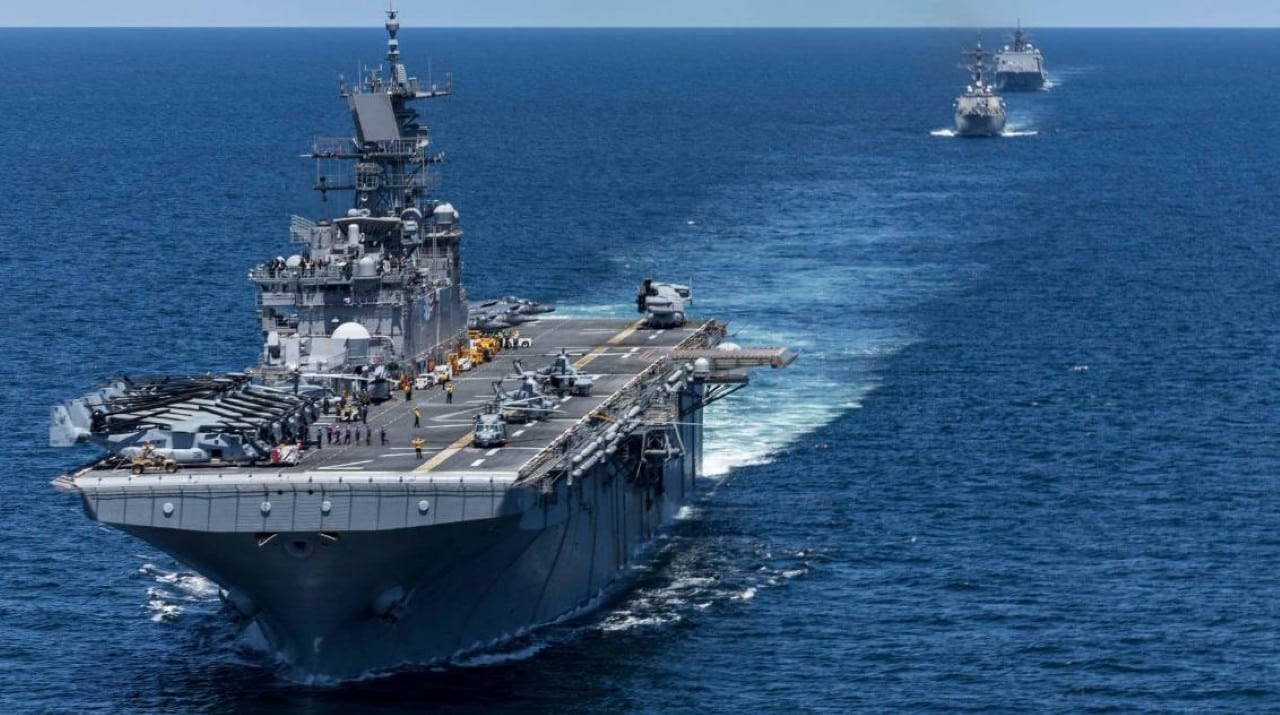
The deployment of U.S. naval forces comes amid heightened diplomatic friction. Since early August, the U.S. has intensified its rhetoric against Maduro, doubling the reward for his capture to $50 million and classifying the Cartel of the Suns as a terrorist organization. The operation, including destroyers USS Gravely, USS Jason Dunham, and USS Sampson, plus amphibious ships USS Iwo Jima, USS San Antonio, and USS Fort Lauderdale, was planned to operate in international waters. However, the lack of clarity about the mission’s ultimate goals fuels speculation of intentions beyond drug trafficking combat.
Venezuela has escalated its response. Beyond mobilizing militias, the government announced coastal patrols with drones and ships, reinforcing military presence along the Colombian border. Maduro’s rhetoric, calling the U.S. a “declining empire,” aims to rally domestic support around national defense. Meanwhile, the international community watches cautiously, with U.S. allies in the region endorsing the operation and others, like Colombia, rejecting cooperation with Caracas.
U.S. naval movements
The deployment of U.S. ships to the Caribbean was reported on August 18, with three destroyers equipped with Aegis missile systems capable of targeting air, sea, and land.
- USS Gravely: Equipped with Tomahawk missiles and chemical weapons defense systems.
- USS Jason Dunham: Features a helipad and missile interception capabilities.
- USS Sampson: Designed for multi-role operations, including surveillance. These were joined by the Iwo Jima amphibious group, carrying 4,500 troops, including 2,200 Marines, suitable for landings. The operation also includes P-8 Poseidon spy planes and a nuclear submarine, USS Newport News, raising concerns in Caracas due to its nuclear potential. The Pentagon, however, provided no mission details, stating only that it targets drug trafficking.
The mobilization faced setbacks. Hurricane Erin forced the amphibious squadron back to Norfolk, Virginia, on August 19, delaying its Caribbean arrival. Additionally, the cancellation of USS Jason Dunham’s stop in Curaçao, initially scheduled for August 28, raised questions about the ships’ current location.
Venezuela’s response to pressure
Maduro swiftly countered the U.S. movements, ordering the mobilization of 4.5 million Bolivarian Militia members, created by Hugo Chávez in 2009 to support the Armed Forces.
- Militia mobilization: 4.5 million civilians and retired military were called to protect the territory.
- Border reinforcement: 15,000 soldiers were sent to the Colombian border for anti-drug operations.
- Maritime patrols: Drones and Navy ships were deployed to monitor the coast. The Venezuelan government also appealed to the UN, urging Secretary-General António Guterres to intervene to “restore sanity” and halt the U.S. deployment. Venezuela labeled the operation a “serious threat to regional peace” and requested urgent consultations with the Organization for the Prohibition of Nuclear Weapons in Latin America.
Maduro’s rhetoric reinforces a narrative of national sovereignty. In speeches, he accused the U.S. of using drug trafficking as a pretext for a potential invasion, likening the situation to the Monroe Doctrine, historically used to justify U.S. interventions in Latin America.
Regional and international reactions
The U.S. operation elicited mixed responses in Latin America. Countries like Argentina, Ecuador, Paraguay, and Guyana aligned with the U.S., designating the Cartel of the Suns as a terrorist organization. Trinidad and Tobago also expressed support for the military action.
- Argentina: Adopted the terrorist classification for the cartel on August 26.
- Ecuador: Under Daniel Noboa’s government, was the first to follow the U.S.
- Colombia: Refused to cooperate with Maduro but denied direct support for the U.S. operation. Colombia, Venezuela’s neighbor, maintains a cautious stance, with Gustavo Petro’s government ruling out involvement in actions against Caracas. Brazil, meanwhile, monitors the situation with concern, according to military sources, but adopts a neutral stance, emphasizing regional sovereignty.
The Bolivarian Alliance for the Americas (Alba), founded by Hugo Chávez and Fidel Castro, condemned the U.S. deployment, calling it a threat to regional stability. The organization requested an extraordinary meeting of the Community of Latin American and Caribbean States (Celac) to address the crisis.
Context of the U.S. operation
The naval deployment comes amid escalating rhetoric against Maduro, accused by the U.S. of leading the Cartel of the Suns, which allegedly facilitates drug trafficking routes for cartels like Mexico’s Sinaloa and Venezuela’s Tren de Aragua. The White House, under Donald Trump, intensified pressure since the start of his second term in 2025.
- Reward: In August, the U.S. doubled the bounty for Maduro’s capture to $50 million.
- Sanctions: Since 2017, Washington has imposed an oil embargo on Venezuela, still in effect.
- Monroe Doctrine: Analysts suggest the operation reflects an attempt to reassert U.S. hegemony in the region. White House Press Secretary Karoline Leavitt emphasized that Maduro is not recognized as a legitimate president, calling him a “fugitive” and “cartel leader.” However, experts like Carlos Gustavo Poggio argue that the mobilized military assets, including Tomahawk missiles, are ill-suited for drug trafficking combat, suggesting broader intentions.
Impact on regional stability
The presence of U.S. ships in the Caribbean rekindles fears of military escalation in Latin America. While analysts dismiss a direct invasion due to high political and military costs, the operation is seen as a show of force.
- Psychological pressure: The naval deployment may aim to intimidate Caracas and force negotiations.
- Risk of confrontation: The nuclear submarine’s presence alarms Venezuela, fearing nuclear weapon use in the region.
- Domestic response: Maduro leverages the external threat to unify the population and bolster his support base. Uncertainty about the ships’ exact location and the mission’s ultimate goals fuels tension. While the U.S. claims to operate in international waters, Venezuela has intensified surveillance, with Defense Minister Vladimir Padrino announcing drone patrols along the coast.
Venezuelan military scenario
Venezuela’s Armed Forces, though numerous, face limitations due to international sanctions and a prolonged economic crisis. According to the International Institute for Strategic Studies (IISS), the country has:
- 337,000 troops, including reserves and militias.
- 229 aircraft, of which only 126 are operational.
- 34 ships, mostly outdated. Despite possessing S-300 air defense systems and Iranian drones, Venezuela’s arsenal is considered inferior to the U.S., which leads global military rankings. The militia mobilization, while impressive in numbers, is seen as a propaganda strategy to raise the political costs of any U.S. military action.
Regional perspectives
The U.S. operation in the Caribbean affects not only Venezuela but also countries like Colombia, Panama, and Mexico, which monitor the situation, fearing impacts on their security policies. Potential restrictions on Venezuelan maritime traffic, especially oil exports, concern Caracas, which relies on these resources to sustain its economy.
- Oil exports: U.S. sanctions already limit Venezuelan trade.
- Diplomatic reactions: Alba and Celac seek to mediate the crisis to avoid escalation.
- Brazilian neutrality: Brazil reinforces its border military presence but avoids alignment with the U.S. or Venezuela. The international community, particularly the UN, faces pressure to mediate the conflict and prevent a larger regional crisis.