

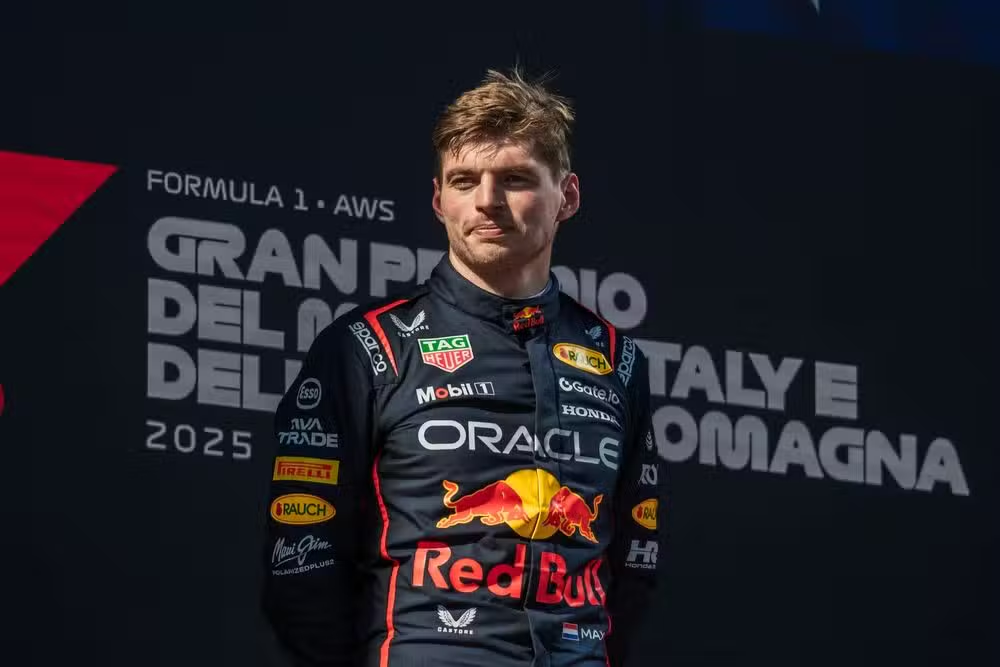
Max Verstappen, four-time Formula 1 champion, revealed in an interview with the Spanish portal Mundo Deportivo the essential traits for forming the perfect driver, highlighting Fernando Alonso and Charles Leclerc as references in several categories. The statement, made on September 11, 2025, in Rio de Janeiro, stirred the motorsport world by pointing out specific qualities of his rivals, such as intelligence, defense, and qualifying pace. The Dutchman, known for his competitiveness and precision, avoided naming a single “greatest driver in history” but shared a detailed view on what makes a competitor exceptional in F1. His choices reflect admiration for both veterans and new talents, reinforcing his own strategic approach to the sport.
The interview shed light on a detailed analysis of seven key attributes for an elite driver: qualifying, race pace, intelligence, overtaking, defense, charisma, and competitive mentality. Verstappen, who races for Red Bull, emphasized Alonso’s experience and Leclerc’s skill in critical moments. He also mentioned legends like Michael Schumacher and Ayrton Senna but stressed the difficulty of direct comparisons across different eras of F1.
- Points highlighted by Verstappen:
- Charles Leclerc excels in qualifying sessions.
- Fernando Alonso is a reference in race pace and defense.
- Experience is crucial for tactical intelligence in the sport.
The Dutchman, who has faced Alonso since his debut in 2015 and Leclerc since 2018, showed respect for his rivals but maintained his pragmatic stance by dismissing the relevance of charisma to on-track performance.
Skills that define an elite driver
Verstappen singled out Charles Leclerc as one of the best in qualifying, where speed in a single lap is crucial. The Monegasque, racing for Ferrari, has stood out for his consistency in securing front-row starts, often challenging Verstappen himself. The four-time champion also praised Leclerc’s overtaking ability, noting his controlled aggression as a key strength. Meanwhile, Fernando Alonso, a two-time world champion, was cited in three categories: race pace, intelligence, and defense.
The Spaniard, who returned to F1 in 2021 after a hiatus, is known for extracting the maximum from less competitive cars, as shown during his time with Aston Martin. Verstappen valued Alonso’s experience, which, at 44 years old, makes him one of the most respected drivers on the grid.
- Attributes highlighted by Verstappen:
- Qualifying: Charles Leclerc for his speed in flying laps.
- Race pace: Fernando Alonso for consistency and fighting spirit.
- Intelligence: Alonso, for his experience gained over decades in F1.
- Defense: Alonso, for his ability to hold positions.
Experience versus youth in F1
Verstappen’s choice of Alonso reflects the importance of experience in a sport where split-second decisions can define a race. The Spaniard, competing since 2001, has faced different generations of cars and drivers, making him a benchmark in strategy and adaptation. In contrast, Leclerc represents the new generation, with quick reflexes and a modern approach to driving. Verstappen, blending youth with the experience of four world titles, seems to seek a balance between these qualities.
The Dutchman also highlighted Alonso’s competitive mentality, emphasizing his determination in challenging races. This trait, according to Verstappen, is essential for anyone aiming to stand out in such a demanding sport.
The weight of charisma in Formula 1
When addressing charisma, Verstappen was blunt: “It doesn’t matter for driving an F1 car.” The statement reflects his pragmatic view, focused solely on on-track performance. Unlike drivers like Lewis Hamilton, known for their off-track impact, Verstappen prioritizes measurable results. This approach has been a hallmark of his career, which already boasts over 60 wins and four world titles at age 27.
Still, the Dutchman acknowledged the importance of past icons like Ayrton Senna, who combined charisma and talent. In previous interviews, he praised the Brazilian but reiterated that comparisons across eras are unfair due to differences in cars and track conditions.
- Reasons for dismissing charisma:
- It does not directly influence on-track performance.
- Focus should remain on technical and strategic skills.
- Charisma is more relevant for sponsors and media.
F1 legends in Verstappen’s view
When asked about the greatest driver in history, Verstappen avoided a definitive answer. Instead, he highlighted the challenge of comparing drivers from different eras, such as Juan Manuel Fangio, who dominated the 1950s, and Michael Schumacher, a seven-time champion in the 1990s and 2000s. Last year, the Dutchman listed Schumacher, Senna, Alonso, Hamilton, and Fangio as the top five, showing respect for a wide range of talents.
This broad perspective reflects his maturity as a driver. Verstappen acknowledges that each era of F1 brought unique challenges, from the less safe cars of the 1980s to today’s complex hybrid machines. His refusal to name a single “best” also shows humility, despite his recent dominance in the sport.
Alonso’s influence on the current grid
Fernando Alonso is not only a reference for Verstappen but also for young drivers like Gabriel Bortoleto, a Brazilian who debuted in F1 in 2025. Bortoleto recently stated that Alonso was a key influence in his career, particularly for his versatility and dedication. Verstappen’s repeated mentions of Alonso reinforce the Spaniard’s relevance, even in a phase of his career where he isn’t contending for titles.
The two-time champion, who has also competed in categories like IndyCar and Le Mans, is seen as an example of longevity and passion for motorsport. His ability to adapt to different cars and regulations makes him a respected figure, even among rivals like Verstappen.
- Why Alonso is so respected:
- Experience from over 20 years in F1.
- Ability to maximize performance in less competitive cars.
- Competitive mentality, even in smaller teams.
- Influence on new drivers, like Bortoleto.
The new generation and F1’s future
At 27, Charles Leclerc represents F1’s immediate future but already has enough experience to be cited by Verstappen. His rivalry with the Dutchman, particularly in the 2022 season, showcased his potential to challenge the best. Verstappen’s mention of Leclerc also suggests that the Monegasque is seen as a constant threat, especially on tracks where qualifying is decisive, like Monaco.
Additionally, drivers like Andrea Kimi Antonelli, who debuted in 2025, and Bortoleto himself show that F1 is constantly renewing. Verstappen, by balancing praise for veterans and youngsters, seems to recognize that the sport thrives on both experience and the innovation brought by new generations.
Verstappen and comparisons with Senna
Though Verstappen avoids direct comparisons, his name is often linked to Ayrton Senna, especially in Brazil. In an interview with ge.globo, he noted that each driver has a unique style shaped by their era. For him, Senna raced aggressively and intuitively in the 1980s and 1990s but would have adapted to modern cars if competing today.
This view reinforces the idea that F1 is a sport in constant evolution. Verstappen, who grew up idolizing Schumacher, also acknowledges Senna’s influence but prefers to focus on his own journey, marked by precocious records and a methodical approach.
- Differences across F1 eras:
- Cars from the 1980s and 1990s had less technology and safety.
- Modern drivers face greater technical complexity.
- Driving style must adapt to current rules and tires.
The impact of Verstappen’s choices
Verstappen’s statements about Alonso and Leclerc not only highlight the quality of his rivals but also reinforce his position as one of F1’s most analytical drivers. By building his “perfect driver,” he demonstrates a deep understanding of the sport, valuing technical and strategic aspects. His choices also sparked debates among fans, particularly about the absence of names like Lewis Hamilton in some categories.
The Dutchman, however, seems more interested in fueling discussions than settling them. His refusal to name a single “greatest driver” reflects a mature perspective that values the diversity of talents F1 has produced.