Mercado Libre reports issues in shopping cart and login due to AWS instability this Monday Por Luís Henrique Costa
4 min de leitura
 |
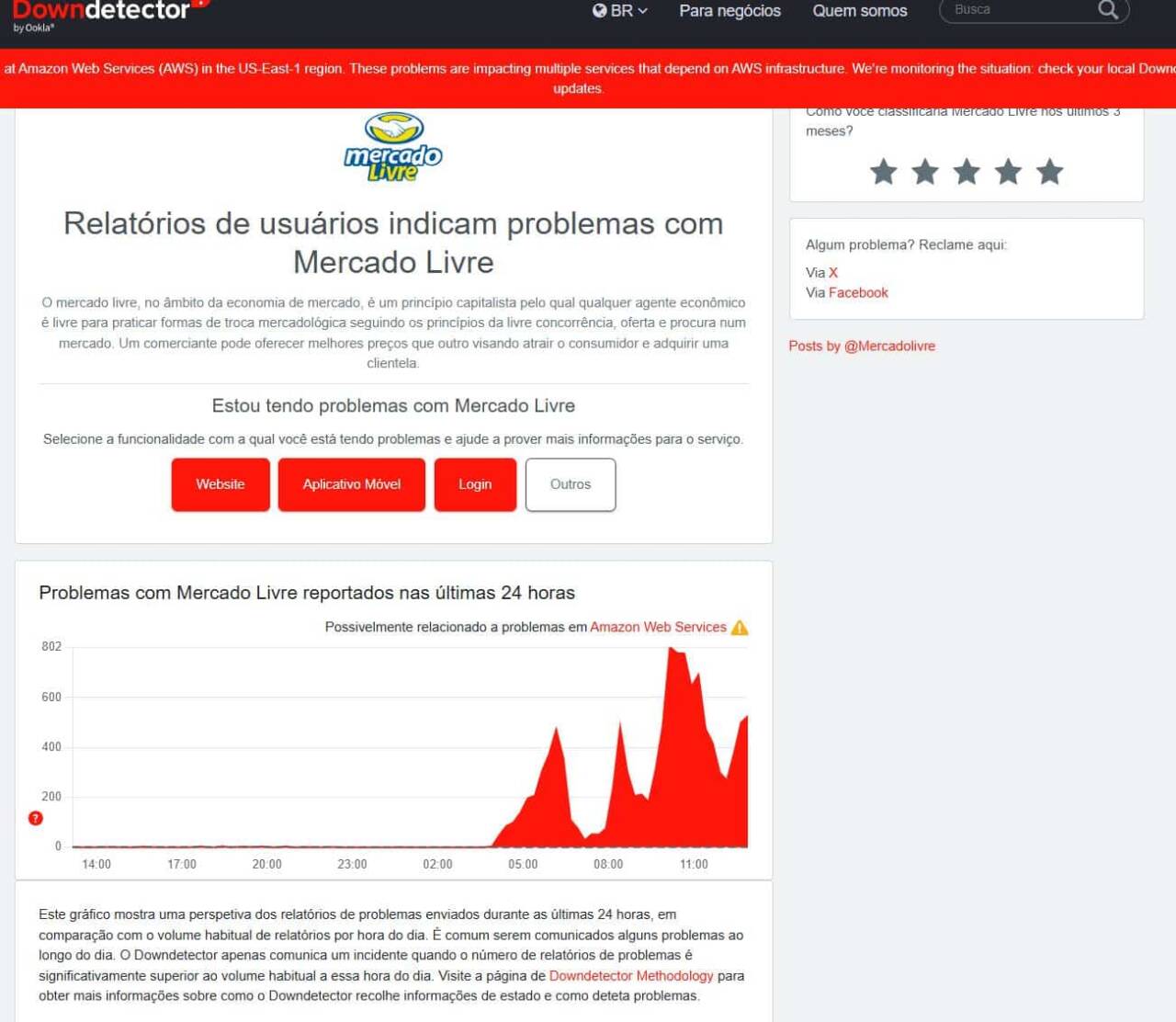
Mercado Libre experienced technical instability on Monday, October 20, 2025, primarily affecting the shopping cart and login process. The issue, reported around 1:10 PM, stems from a global failure in Amazon Web Services (AWS), the cloud infrastructure provider used by the platform. Users in Brazil reported difficulties completing purchases and accessing accounts, impacting sales and invoice issuance.
The disruption began in the early hours, around 3:30 AM Brasília time, affecting services across multiple regions, including the U.S. East Coast. Platforms reliant on AWS, such as Mercado Libre, faced slowdowns and connection errors. Amazon technicians identified the issue in a regional gateway and announced a fix by around 8 AM, though residual effects persisted during peak hours.
Sellers reported operational losses, with systems stalled for updating inventories and generating shipping labels. Consumers, meanwhile, could not proceed to checkout, halting transactions on a high-demand commercial day. Monitoring indicates 54% of complaints involve the website, followed by 38% on the mobile app.
- Initial reports emerged at 8 AM, with peaks at 1:10 PM in Brazilian access.
- Services like Mercado Pago also faced payment failures.
- AWS holds 31% of the global cloud market, amplifying the outage’s reach.
Dependence on cloud infrastructure
E-commerce platforms like Mercado Libre rely on AWS for hosting and data processing, enabling scalability but exposing them to centralized risks. The US-EAST-1 region, affected by the failure, hosts 30% of the provider’s global operations.
This structure allows quick responses to variable demands, but localized disruptions create cascading effects. In this case, login authentications failed due to issues in services like DynamoDB, used for session management.
Services impacted in Brazil
Mercado Libre was not the only service affected by AWS instability this Monday. Delivery apps, such as iFood, reported order processing issues, while payment platforms, including PicPay, faced transfer errors.
Digital wellness services, like Wellhub, experienced slowdowns in scheduling. Online games, such as Fortnite and Roblox, recorded connection drops on Brazilian servers.
Sellers on Mercado Libre described difficulties scanning codes at postal agencies, delaying scheduled shipments.
Real-time user reports
Consumers expressed frustrations with the shopping cart failing to update selected items, requiring constant reloads. A São Paulo seller reported, at 1:17 PM, an inability to print labels after generating invoices.
Another user from Rio de Janeiro noted, at 1:44 PM, that products appeared unavailable on individual pages despite confirmed stock. These incidents aligned with a 40% surge in complaints beyond the usual volume.
Alternative platforms, like Shopee and Amazon, maintained normal operations, redirecting traffic to competitors during the period.
Mitigation measures implemented
AWS applied fixes to the affected endpoint, restoring 90% of capacity by around 10 AM. Mercado Libre advised users to attempt access via the mobile app as a temporary alternative to the website.
Companies recommended checking local connections and using updated browsers to bypass residual errors. Internal platform monitoring indicates gradual recovery, prioritizing pending transactions.
Sellers received automatic notifications for extended shipping deadlines without penalties during the instability.
History of similar disruptions
AWS outages occurred previously, such as in 2023, when a software update caused a two-hour downtime in European regions. In Brazil, the last significant incident was in July 2024, affecting 15% of Mercado Libre access due to load balancer failures.
These events highlight the need for redundancies in hybrid architectures, combining multiple clouds for greater resilience. The provider records an average of 2.5 annual outages per region, per disclosed internal reports.
Mercado Libre, with over 200 million active users in Latin America, invests in contingency testing to minimize recurrences, including peak-hour failure simulations.
Expectations for normalization
Technicians anticipate full stabilization by late afternoon on October 20, with continuous performance metric monitoring. Users receive email alerts on the status of interrupted orders.
The platform plans detailed incident reports within the next 48 hours, including timelines and lessons learned for system updates. Meanwhile, support teams prioritize assistance for sellers affected by fiscal issuance issues.