James Webb reveals 15-20 meter radiated crust on interstellar comet 3I/Atlas by cosmic rays

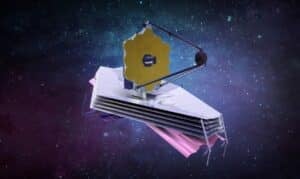
The James Webb Space Telescope has identified a 15- to 20-meter-thick radiated crust on the interstellar comet 3I/Atlas. This layer resulted from prolonged exposure to galactic cosmic rays during billions of years of travel through interstellar space. The comet, the third confirmed object of origin outside the Solar System, passed through perihelion on October 29, 2025, 1.36 astronomical units from the Sun.
Observations carried out in August 2025 with the NIRSpec instrument revealed a high concentration of carbon dioxide in the comet’s coma. The CO2/H2O ratio reached 7.6, a high value compared to comets in the Solar System. Cosmic rays converted carbon monoxide to carbon dioxide on the outer surface.
- The comet traveled without protection from the solar heliosphere.
- High-energy particles chemically remodeled surface ices.
- Simulations indicate that one billion years is enough to form the crust.
3I/Atlas was discovered on July 1, 2025 by the ATLAS system in Chile.
Formation of radiated crust
Researchers from the Royal Institute of Space Aeronomy in Belgium coordinated the study. Laboratory experiments simulated the effects of galactic cosmic rays. The tests reproduced the conversion of CO to CO2 and the synthesis of organic crusts.
The crust dominates the comet’s outer surface. Inner layers preserve primordial composition. The absence of the heliosphere’s protective bubble allowedintense interactions with cosmic particles.

Observed chemical composition
James Webb’s NIRSpec instrument detected elevated levels of CO2 in the coma. The CO/H2O ratio was 1.65. Spectra showed red skew, consistent with irradiated material.
- CO2 concentrations surpass solar comet standards.
- CO dominates along with CO2 in atypical proportions.
- Refractory organic layer contributes to reddish color.
Data from the SPHEREx satellite complemented the observations in August 2025.
Trajectory and recent activity
The comet follows a hyperbolic orbit with a speed of 57 km/s. It reached perihelion on October 29, 2025. Solar heating caused sublimation of the modified crust.
Gases and dust were released in large quantities. The coma had an intense bluish tone after perihelion. Erosion has exposed potentially intact layers.
Terrestrial telescopes recorded accelerated brightness and a dust tail. The object remains visible on prprofessionals. It will leave the Solar System in the coming months.
Irradiation processes
Galactic cosmic rays consist of high-energy particles originating outside the Solar System. They reach surface ices along the interstellar trajectory. Chemical conversion occurs on time scales of billions of years.

Simulations based on comet 67P, from the Rosetta mission, validated the model. One billion years of exposure forms a layer of 15 to 20 meters. The crust includes compact amorphous ice and an organic refractory mantle.
Post-Perihelic Observations
After October 29, 2025, the comet released volatiles from the irradiated crust. Comparisons between pre- and post-perihelic data help identify original composition. Jets of gas appeared in cold distances.
Images from Hubble and Gemini South show a condensed coma and elongated tail. The blue color results from heated carbon molecules. Monitoring continues with telescopes around the world.
The 3I/Atlas travels at 210 thousand km/h towards interstellar space. Its passage provides unique data on chemical evolution in galactic environments. The crust alters interpretations of origins in similar objects.
Internal layers preserved
Below the crust 15 to 20 meters, materials remain unchanged. They represent chemistry of the natal star system. Current solar erosion only affects the area processed by cosmic rays.
Future observations may access deeper layers if sublimation continues. The core is estimated to be between 440 meters and 5.6 kilometers in diameter.
Implications for future studies
The discovery requires consideration of radiation effects on interstellar objects. Surfaces can mask pristine compositions. Previous models assumed preservation of original materials.
Analyses of galactic visitors need to adjust for cosmic processing. The 3I/Atlas case calibrates expectations for upcoming objects.
Differences with solar comets
Comets in the Solar System maintain primitive ices thanks to the heliosphere. It blocks most galactic cosmic rays. Interstellar objects accumulate changes over long trajectories.
In 3I/Atlas, CO2 predominates over water in the coma. Proportions invert local patterns.
Veja Tambem em Ciência
Perda de gelo no Ártico supera ponto de inflexão e afeta nutrientes essenciais

Qual a fase da Lua nesta sexta (29)? Veja o calendário lunar de maio

Prática milenar de beber água quente viraliza nas redes; ciência analisa benefícios à saúde

Observações do James Webb identificam buraco negro supermassivo anterior à galáxia no universo primitivo

James Webb valida planetas JuMBO, antes tidos como ilusão, e redefine limites da formação cósmica

Eclipse solar de 2027 terá 6 minutos de duração máxima; fenômeno não se repete em 157 anos
James Webb revela planeta com 170ºC de variação térmica extrema entre o dia e a noite

Cientistas confirmam desaceleração da rotação da Terra em ritmo inédito nos últimos 3,6 milhões de anos

Pesquisadores detectam fratura inédita em placa tectônica do Pacífico, gerando alerta sísmico para Cascadia

Evento raro: Microlua Azul de 31 de maio de 2026 será 6% menor e 10% menos brilhante

Contrato da NASA destina US$ 188 milhões à Blue Origin para módulo lunar Blue Moon Mark 1