Interstellar comet 3I/ATLAS may have emitted a radio signal! detected 48 years ago, says astrophysicist


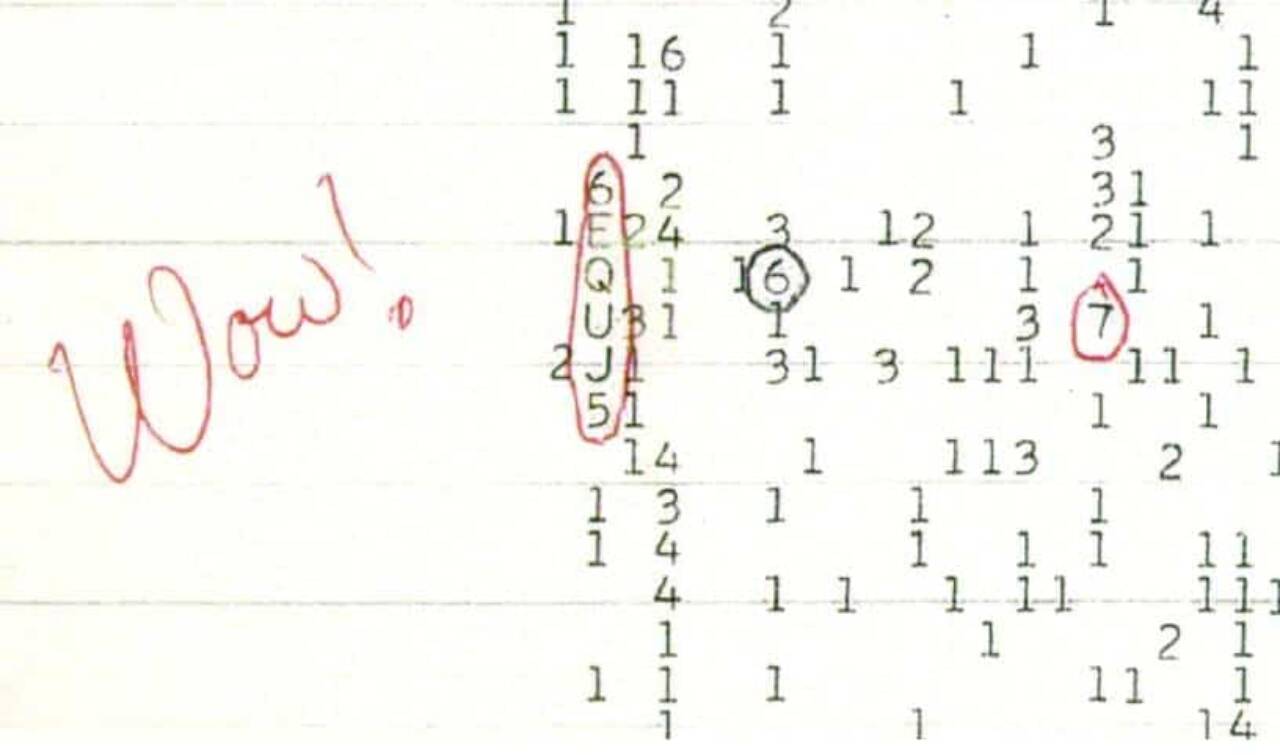
Astrophysicist Avi Loeb, from Harvard University, proposed that the famous Wow! radio signal, detected on August 15, 1977 by the Big Ear radio telescope at Ohio State University in the United States, may have been emitted by the interstellar comet 3I/ATLAS.
The signal, captured as a narrow and intense emission at a frequency of 1420 megahertz, lasted 72 seconds and was never repeated, generating debates about its extraterrestrial origin. Loeb calculates that in August 1977, the comet was about 600 astronomical units from Earth, aligned with the signal’s coordinates at a coincidence probability of 0.6%.
This hypothesis arises with the current passage of 3I/ATLAS through the Solar System, discovered on July 1, 2025 by the ATLAS telescope, in Chile, and confirmed as the third known interstellar object.
The analysis considers the signal’s blueshift of 10 kilometers per second, compatible with the comet’s approach speed, estimated at 60 kilometers per second.
Comet’s trajectory reveals unlikely coincidences
Comet 3I/ATLAS follows a hyperbolic orbit with an eccentricity greater than 6, indicating origin outside the Solar System.
On August 12, 1977, the object occupied a position close to the coordinatessignals of the Wow! signal, with a difference of 4 degrees in right ascension and 8 degrees in declination.
Astronomers highlight that this angular separation represents a statistical rarity.
- The signal strength varied between 54 and 212 Jansky, with a bandwidth of 10 kilohertz.
- A distance of 600 AU would imply transmission power of 0.5 to 2 gigawatts, equivalent to a terrestrial nuclear reactor.
- No other radio telescope recorded similar emissions at the time.
These data reinforce the need for current observations to test the theory.
Space observations monitor 3I/ATLAS closely
NASA and ESA probes directed instruments at the comet during its approach to Mars.
The Mars Reconnaissance Orbiter captured images in October 2025, when the object passed 30 million kilometers from the planet.
ESA’s Juice instrument plans analyzes between 2 and 25 November 2025, focusing on chemical composition and emissions.
These missions aim to detect any radio signal in the hydrogen line.
Chemical composition defies known models
The comet’s nucleus measures between 440 meters and 5.6 kilometers in diameter, with an initial speed of 221 thousand kilometers per hour.
Hubble observations on July 21, 2025, revealed marginal coma and elongation of 3 arc seconds, confirming cometary activity.
The estimated age ranges from 7.6 to 14 billion years, greater than that of the Solar System.
Recent emissions include nickel and iron in unusual amounts, with no typical initial tail.
Challenges in detecting interstellar signals
Terrestrial radio telescopes look for repeats of the Wow! in the direction of the comet.
The urgency increases with the perihelic passage on October 29, 2025, 203 million kilometers from the Sun.
- Center frequency: 1420.4556 megahertz, with a deviation of 0.005 megahertz.
- Absence of non-gravitational acceleration suggests stable trajectory.
- Observed jets may indicate active chemical reactions.
Proximity to Earth on December 19, 2025, at 270 million kilometers, provides final window for data.
Loeb hypothesis and criticism from the scientific community
Loeb classifies the object on the Loeb Scale, prioritizing responses based on detected properties.
He suggests using ground- and space-based telescopes to measure potential emissions.
Most astronomers see the connection as coincidence, withoutevidence of artificial origin.
Jets and emissions stir current debates
Images from November 5, 2025, from the Lowell Discovery Telescope, show jets as wide as 3 million kilometers.
These structures point toward the Sun, defying conventional explanations of ice sublimation.
- Composition includes excess carbon dioxide and hydroxyl.
- Color changes from red to green to blue indicate dynamic reactions.
- No artificial signal confirmed so far.
Future of searches for interstellar objects
3I/ATLAS should reappear in the morning sky from November 11, 2025, visible with 20-centimeter telescopes.
Its departure from the Solar System in December reinforces the importance of missions such as Comet Interceptor, scheduled for 2029.
This passage inspires new research into cosmic visitors.