A solar storm classified as “cannibal” is expected to hit Earth between the night of Tuesday (11) and the early hours of Wednesday (12), according to the National Oceanic and Atmospheric Administration (NOAA). The phenomenon, resulting from the merger of coronal mass ejections (CMEs), can cause aurora borealis to be visible in up to 22 states in the United States and interfere with radio communications, satellites and power grids. The geomagnetic storm, at level G3 (strong), occurs at the height of Solar Cycle 25, marked by intense solar activity. Astronomers monitor the solar region AR4274, which remains unstable.
NOAA’s forecast indicates that the event will be driven by a faster ejection that “swallows” a slower one, creating a jet of charged particles. This impact intensifies the Earth’s magnetic field, generating conditions for auroras in unusual locations, such as the Midwestern United States. Recent solar activity has included 28 flares in 24 hours, highlighted by an X5.2 flare, the strongest in 2025.
- Associated risks: Possible failures in satellites and electrical networks.
- Affected locations: Polar regions and American states such as Oregon.
- Monitoring: Teams follow the Sun to predict new events.
Origin of the phenomenon
The term “cannibal” describes the merger of two coronal mass ejections before they reach Earth. This process amplifies the strength of the geomagnetic storm, according to the Space Weather website.
The regionsolar AR4274, responsible for the eruptions, remains facing the planet, increasing the risk of new events.
Expected impacts
The storm can cause fluctuations in electrical networks, especially at high latitudes. Communication and navigation satellites, such as GPS, face the risk of temporary malfunctions.
Critical infrastructure operators have been warned by NOAA to take preventive measures.
In 2003, a similar storm caused blackouts in Canada and Sweden.

Auroras featured
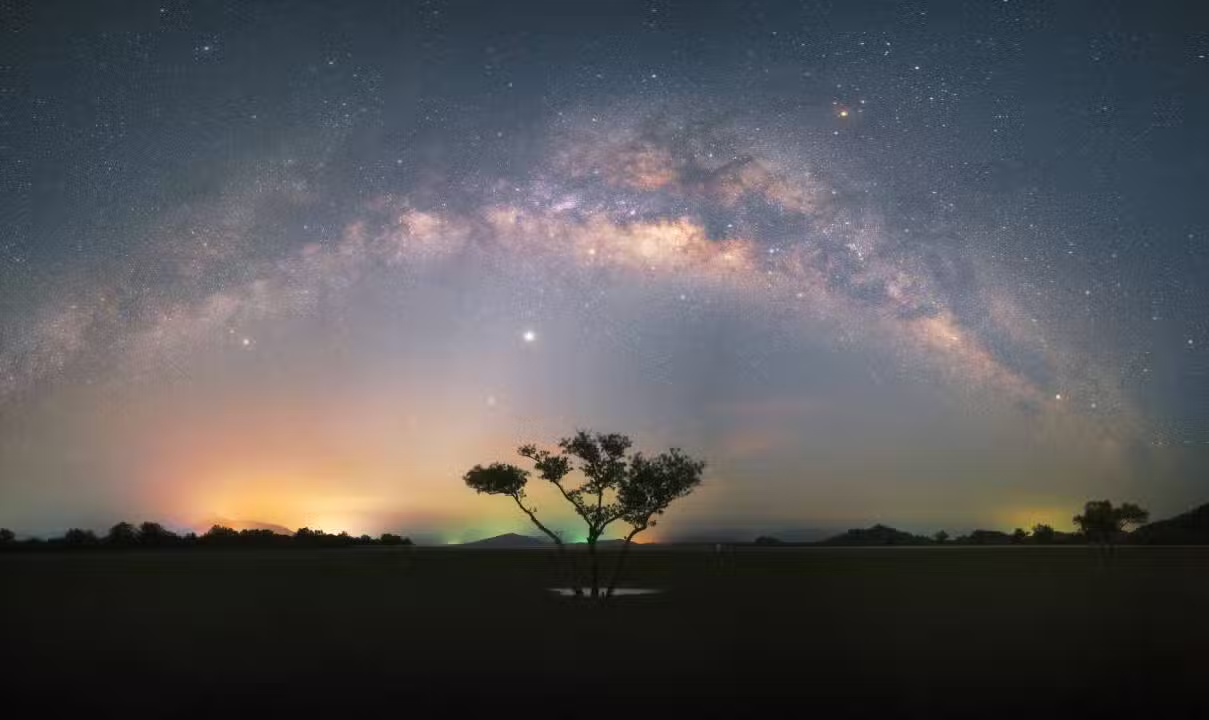
Northern lights should be visible in areas where they are rare, such as the state of Oregon. The phenomenon occurs when solar particles collide with gases in the Earth’s atmosphere.
Photographers and enthusiasts are already preparing to record the spectacle, which should reach its peak in the early hours of Wednesday.
The intensity of the lights will be amplified by the force of the cannibal jet.
Solar cycle underway
The Sun is in its 25th cycle, a period of high activity that occurs every 11years. This cycle, which began in 2019, is expected to reach its peak in 2025.
Solar flares, such as the X5.2 recorded, are more frequent during this period.
NOAA expects solar instability to persist for weeks, with new storms possible.
Preventive measures
Authorities recommend that satellite operators adjust systems to minimize interference. Energy companies in polar regions are on alert to avoid failures.
NOAA’s continuous monitoring ensures real-time updates on the event’s evolution.
Global alert
The geomagnetic storm, although it does not pose a direct risk to the population, requires attention from sectors such as aviation and telecommunications. In 2022, a similar storm damaged 40 Starlink satellites. NOAA has teams on alert to monitor solar activity in the coming days, as Solar Cycle 25 continues to generate large-scale events.