Interstellar comet 3I/ATLAS displays intense green glow and abnormal jets in new images from November

Astronomers captured images of the interstellar comet 3I/ATLAS on November 11, 2025, revealing an intense green glow and jets of dust and gas that defy patterns seen on known comets. The object, discovered in July by the ATLAS telescope in Chile, completed its perihelion on October 30 at 1.36 astronomical units from the Sun. These changes occurred in the morning sky of the southern hemisphere, where the comet reappeared after a period hidden by sunlight. NASA experts are monitoring the phenomenon to understand its composition, which includes traces of carbon monoxide and nitrogen at high levels.
The initial detection occurred on July 1, 2025, confirming the interstellar origin due to the object’s hyperbolic orbit. Unlike solar comets, 3I/ATLAS follows a trajectory that will take it back to interstellar space after passing through the Solar System. Preliminary observations indicate an estimated size of a few kilometers in diameter, with a speed of around 30 km/s. The proximity to Earth, scheduled for December 19th at 1.8 astronomical units, allows for detailed studies without the risk of collision.
Discovery and initial trajectory
Comet 3I/ATLAS emerged as the third confirmed interstellar object, following ‘Oumuamua in 2017 and 2I/Borisov in 2019. Ground-based telescopes detected the object in June, with pre-discovery data extending to June 14, 2025. Its hyperbolic orbit excludes gravitational ties to the Sun, indicating origin in another star system.
Astronomers used the ATLAS system for initial warnings, followed by confirmations by the Minor Planet Center. The trajectory aligns almost perfectly with the ecliptic plane, with a deviation of just 5 degrees, pprobability of 0.2%. July observations revealed a solar jet pointing toward the Sun, a rare phenomenon in comets.
- Average speed: 30 km/s during approach.
- Minimum distance to the Sun: 210 million km.
- Initial magnitude: 17, increasing to 12 in November.

Changes observed post-perihelion
Images from November 5 showed a compact source of light without a clear cometary tail, contrasting with expectations of a massive ejection. The nucleus lost at least 13% of its mass, according to calculations based on conservation of momentum, but without a visible coma of dust or gas. Hubble Telescope recorded the object on July 21, confirming diffuse structure.
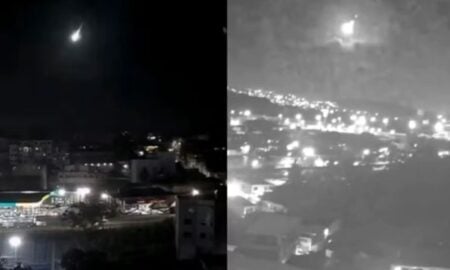
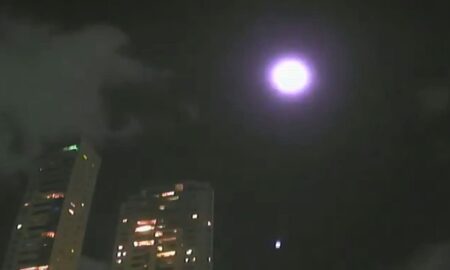
Brightness increased rapidly as it approached the Sun, peaking in November. Observatory in Begur, Spain, captured the image on November 5, showing a green halo without an elongated tail. Comparisons with Comet Lemmon highlight the absence of typical structure pointing away from the Sun.
Astronomers predict visibility until September 2025 for ground-based telescopes, with a return in December. Non-gravitational acceleration, with A1 coefficients of 1.662 × 10⁻⁶ au/d², suggests additional forces in the orbital plane. No deviation outside plyear was recorded.
Radio signals and chemical composition
MeerKAT Observatory in South Africa detected first radio signal on October 24, hydroxyl radical absorption lines consistent with cometary activity. The signal appeared as absorption due to solar proximity, confirming the presence of OH molecules typical of comets. This reinforces natural origin, despite anomalies.
The composition reveals excess carbon monoxide and nitrogen, with low dust, similar to comet C/2016 R2. Spectra indicate reactions to solar heat, generating jets of gas. Global studies investigate physical properties including size and density.
Real-time observations
Astronauts on missions to Mars and Jupiter plan additional observations in November. NASA probes track trajectories with advanced instruments, measuring emissions in real time. James Webb Space Telescope schedules sessions for December, focusing on infrared spectrum.
The scientific community shares data via collaborative networks, accelerating analysis. Amateur observers report visibility in the constellation Virgo with 15×9 field degree telescopes. Viewing conditions challenge the naked eye, requiring equipment.
Jets and energetic halo
The main jet of dust and gas forms a luminous halo, the result of a nuclear eruption caused by solar heat. Tail geometry differs from solar objects, with complex structure observed on November 8 at 29 degrees solar elongation.Energy intensity suggests continued release of material.
Photos from Ray’s Astrophotography on November 11 highlight anti-tail, with movement to the left and tail in front. This indicates unique geometric perspective, not optical illusion. Scientists calculate the fraction of lost mass to be greater than 13%, without corresponding visual evidence.
Increase in brightness from 17 to 12 magnitude follows predicted curve, but with unexpected peaks. Plots of real observations versus model show partial adherence, with deviations in acceleration.
Detailed orbital analysis
JPL Horizons data from November 3 confirms continued in-plane acceleration, with Δv of 60 m/s in 20 days. Zero A3 coefficient excludes out-of-plane motions, unusual for cometary ejections. Engineer Davide Farnocchia reported a deviation of 4 arcseconds in right ascension on October 29.
Avi Loeb’s calculations indicate a loss of one-sixth of the mass to explain acceleration, with no outgassing observed. Retrograde trajectory aligns with the ecliptic, challenging models of interstellar formation. Post-perihelion observations on November 5 show intact core.
Forecasts indicate fade after peak, with reappearance in the eastern morning sky on November 11. Distance to Earth in December allows accurate composition mapping.