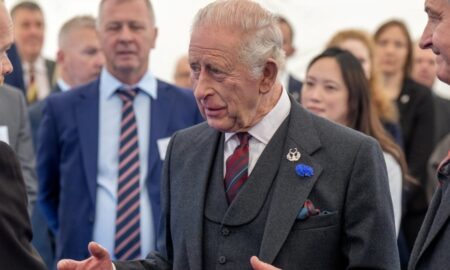
King Charles III prays with Pope Leo XIV in the Sistine Chapel in a historic gesture after five centuries of Anglican schism


King Charles III became, this Thursday (23), the first British monarch to participate in a public prayer with a Pope, an act that had not occurred for five centuries. The unprecedented ecumenical ceremony, led by Pope Leo
As reigning monarch, Charles III is the supreme governor of the Church of England, a religious denomination created by his predecessor, King Henry VIII, after the break with the Roman Catholic Church in 1534. The separation gave rise to the Anglican Schism, a milestone in the history of the Christian religion.
The prayer ceremony between Charles III and Leo XIV is seen as a historic gesture of reconciliation and rapprochement between the two denominations.
Historic event in the Sistine Chapel and the appointment of royal confrere
The joint prayer took place during the state visit of King Charles III and Queen Consort Camilla to the Vatican. The service in the Sistine Chapel, the site of papal conclaves, emphasized the central themes of Christian unity and care for the environment.
- The visit takes place in the context of a real agenda that seeks to strengthen international ties.
- The monarch and queen consort had a private meeting with the pontiff before the public ceremony.
- Pope Leo XIV has demonstrated openness to ecumenical dialogue since his election.
The prayers were accompanied by a shared Anglican and Catholic musical heritage, with hymns sung by members of the Sistine Chapel choir and by visiting royal choirs, such as that of St George’s Chapel at Windsor Castle.
Repercussion of inter-religious dialogue
Buckingham Palace highlighted the visit as an “important moment” for relations between nations and faiths. The gesture of public prayer is a powerful sign of progress in the ecumenical dialogue that has been built over the last few decades between Anglican and Catholic leaders.
The Holy See, in turn, classified the event as a historic moment in Anglican and Catholic relations, with a focus on the search for common goals. Experts in ecclesiastical history emphasize that the act goes beyond diplomacy, having a deep theological meaning in the search for unity.
The British monarch had already visited the Vatican on other occasions, before his accession to the throne, when he was still Prince of Wales, demonstrating his continued interest in inter-religious dialogue. These visits included meetings with previous popes such as Francis and Benedict XVI.
CharlesIII receives honor in the Basilica
After the ceremony in the Sistine Chapel, the king’s agenda includes going to the Basilica of Saint Paul Extramuros, in Rome, to receive the honor of “Royal Brother”. This recognition underlines the importance of the visit to the Vatican.
For the appointment, a special seat was created for the monarch in the basilica. This seat was designed to be permanent and could be used by his successors on the British throne, reinforcing the established connection. The initiative suggests that the Vatican hopes that this rapprochement will continue to develop in the coming reigns, solidifying the unprecedented level of collaboration and mutual respect.
Opening for Christian unity on the agenda
The appointment of Royal Fellow is an honor that historically reinforces the connection of important figures with the basilica. The symbolism of the state visit and joint prayer is a public manifestation of the openness of both churches to Christian unity, despite the deep theological and historical divisions that persist. The focus on themes of unity and environment suggests an agenda of practical collaboration on global challenges.
The initiative places Charles III in a prominent position as a religious leader who actively seeks to overcome historical barriers. His role as supreme governor of the Anglican Church gives the gesture significant institutional weight.
The meeting therefore marks a new era in the relationship between the British Crown and the Vatican, moving from a history of tension to one of cooperation. The joint prayer in the Sistine Chapel will be recorded as a watershed moment in the worldumenismo internacional.