

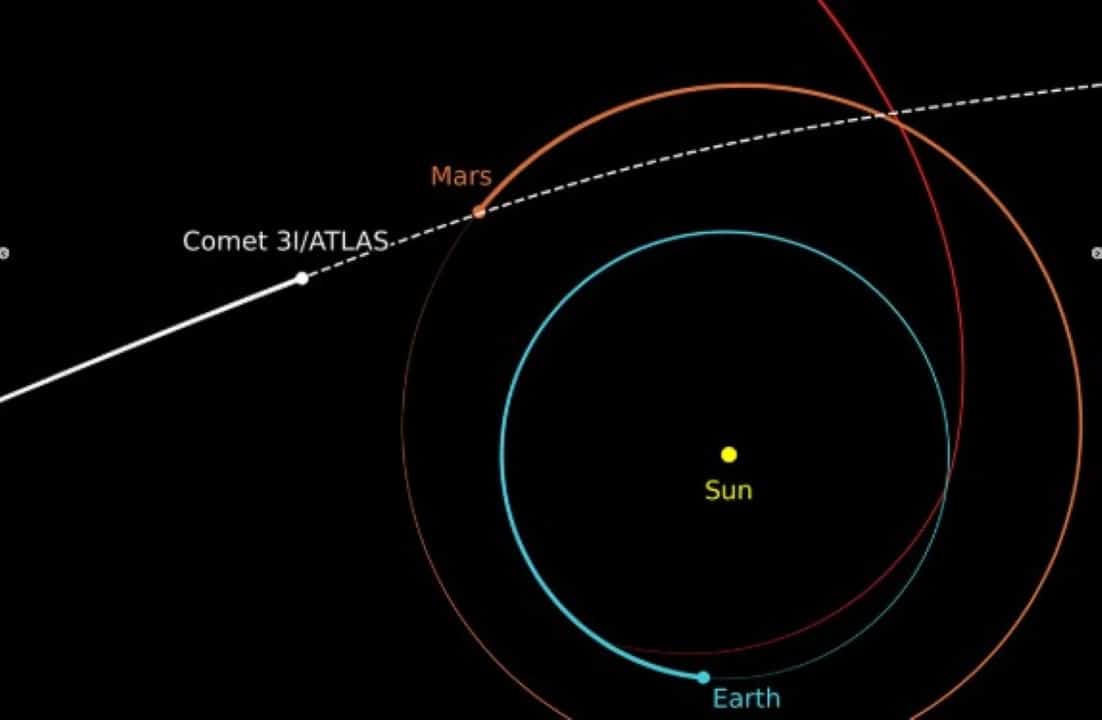
The interstellar comet 3I/ATLAS, the third known object originating from outside Sistema Solar, was detected in July 2025 by the ATLAS system. Sua hyperbolic orbit confirms extrasolar origin, similar to predecessors ‘Oumuamua and Borisov. NASA classifies the object as a natural comet, with a coma and tail observed by multiple telescopes.
Astronomers have monitored the comet since detection, recording non-gravitational accelerations during perihelion in October 2025.
The controversy gained strength with statements by astrophysicist Avi Loeb, from Harvard, who lists 13 anomalies in the object’s behavior. Loeb argues that trajectory precision defies purely natural explanations.
- Composition with a high carbon dioxide content (96% in coma);
- Low fraction of water (only 4% compared to solar comets);
- Collimated jets that maintain direction over long distances;
- Strong negative polarization, unusual in interstellar objects.
These features fuel debates about exotic origins, although most experts attribute them to formation conditions in another star system.
Highlighted orbital anomalies
Avi Loeb identified a non-gravitational acceleration of 5×10^{-7} AU/day² during perihelion, which adjusted the route of 3I/ATLAS. The Essa change positioned the comet for a closest approach to Júpiter of 53.445 million kilometers on March 16, 2026. The distance coincides almost exactly with the radius of Hill from
Experts in orbital dynamics note that such alignments occur on hyperbolic trajectories, but Loeb estimates the probability at 1 in 26,000, suggesting possible intentional adjustment. JPL’s Dados Horizons, based on observations from 230 telescopes, confirm the accuracy of the prediction.
NASA, through missions such as Juno and Hubble, plans additional observations to map variations in the orbit. Qualquer additional deviation could refine gas ejection models.
Chemical composition revealed
Spectroscopic analyzes of James Webb Space Telescope detected high levels of carbon dioxide in the coma of 3I/ATLAS, contrasting with comets of Sistema Solar, where water predominates. Essa composition suggests formation in a carbon-rich protoplanetary disk, typical of stars older than Sol.
The object exhibits rapidly increasing brightness post-perihelion, with negative polarization indicating smooth surface or aligned particles. MAVEN’s Observações, on Marte, captured images of the coma 277 million kilometers away from Terra in July 2025.
Researchers highlight that the low water fraction (4%) could result from selective sublimation during billion-year interstellar travel. The presence of high nickel in the gas plume reinforces the idea of origins in a different chemical environment.
Instruments such as the Hubble recorded jets directed towards the Sol, interpreted as an asymmetric ejection of volatiles. Esses data, combined with TESS measurements, improve models of cometary activity.
Responses from the scientific community
Astrophysicists like Jason Wright of Penn State dispute Loeb’s list of anomalies, arguing that peculiarities in a sample of three interstellar objects are to be expected. Wright points out that statistics used by Loeb underestimate uncertainties in orbital and compositional measurements.
At a press conference on November 19, 2025, NASA Associate Administrator Amit Kshatriya stated that 3I/ATLAS exhibits standard cometary behavior, with no technological signatures detected in radio or spectrum searches. The agency emphasizes the lack of evidence for artificial hypotheses.
Loeb responds that decisions should not come from administrators, but from future data, especially during the approach to Terra on December 19, 2025. Observações spectroscopic images during this period will be able to measure jet velocities and compositions in detail.
The debate reflects tensions between conservative and speculative approaches to astronomy, with Loeb advocating scientific humility in the face of unusual data.
Preparations for future observations
NASA coordinates a fleet of 14 missions to track 3I/ATLAS, including Hubble, Webb, Swift, and Parker Solar Probe. The Perseverance rover, in Marte, contributed images that increased orbital precision tenfold, aiding planetary defense simulations.
In March 2026, the Juno probe will monitor the encounter with Júpiter, looking for gravitational perturbations or new objects in orbit. Telescópios terrestrials like the VLT on Chile plan dedicated sessions to capture infrared emissions.
These efforts are part of the eighth UN and IAWN planetary defense exercise, which began on November 27, 2025, simulating responses to interstellar threats. Dados from SOHO and STEREO have already mapped the comet’s tail during perihelion.
Additional observations may clarify whether accelerations persist, refining trajectory and composition predictions.
Implications for interstellar exploration
The 3I/ATLAS study offers lessons for future missions, such as early detection of extrasolar visitors. Sua relative velocity of 65.9 km/s relative to Júpiter highlights challenges for capture or diversion in defense scenarios.
Loeb speculates that, if artificial, the object could deposit probes at the Lagrange L1 and L2 points of Júpiter, low-energy locations for stable orbits. However, experts note that such a maneuver would require propulsion to cancel out high speeds, with no current evidence.
The carbon-rich composition inspires models of planetary formation in distant systems, potentially guiding searches for habitable exoplanets. The object serves as a time capsule, preserving materials from billions of years ago.
Advances in spectroscopy, driven by this observation, will benefit studies of local comets, such as Halley or Encke, expanding the understanding of volatile reservoirs in Sistema Solar.
Global monitoring and exercises
União Internacional of Astronomia designated 3I/ATLAS as the focus of defense simulations, involving space agencies from multiple countries. Esses exercises test protocols for tracking and mitigating impacts, although the comet poses no threat to Terra.
Observatories at Europa, Ásia and Américas contribute real-time data, shared via the ESA and NASA networks. The Europa Clipper mission, en route to Júpiter, has adjusted instruments for timely captures in 2026.
The event highlights international collaboration, with more than 200 astronomers involved since July 2025. Preliminaries of SPHEREx, launched in 2025, have already mapped interstellar dust around the object.
These initiatives strengthen capabilities for future events, anticipating that interstellar visitors will become more common as telescopes advance.



