


The interstellar comet 3I/ATLAS, the third object confirmed from outside Sistema Solar, follows a trajectory that will pass exactly 53.445 million kilometers from Júpiter on March 16, 2026.
This distance coincides with the Hill radius of the planet, a region of gravitational influence, which represents a probability of one in 26 thousand for a random event.
NASA astronomers coordinate observations with telescopes and probes to analyze the chemical composition of the visitor, discovered on July 1, 2025 by the ATLAS system at Chile.
The proximity to Júpiter will allow data on gravitational interactions, without the risk of collision, as the object will travel at more than 60 km/s.
Initial discovery and confirmation
The object was initially identified in observations on June 14, 2025 by Zwicky Transient Facility of Caltech, before official detection.
On July 2, telescopes such as Nordic Optical Telescope confirmed cometary activity, with diffuse coma and tail elongation of 3 arc seconds.
- Composition rich in cyanide and nickel vapor detected by the VLT in August.
- The reddish color of the coma suggests dust similar to that of 2I/Borisov.
- Hyperbolic orbit with eccentricity greater than 6 indicates external origin.
The 3I designation reflects its status as the third interstellar, after ‘Oumuamua and Borisov.
Chemical composition reveals distant origins
Analysis of James Webb Space Telescope in July 2025 identified high levels of carbon dioxide in the coma, with a CO2 to water ratio of 8:1.
This proportion differs from typical solar comets and suggests formation in a carbon-rich protoplanetary disk.
Carbon monoxide vapors were observed in August, confirming an estimated age of more than seven billion years, older than that of Sistema Solar.
Telescópio Hubble captured an image on July 21 showing an icy core with a drop-shaped dust cocoon, 277 million miles from Terra.
Hyperbolic trajectory and accelerations
The comet entered the ecliptic plane aligned at 5 degrees, with a hyperbolic excess speed of 60 km/s.
During July, August and November 2025, it displayed a non-illusory solar jet (anti-tail), extending over a million kilometers.
In October, near perihelion on October 29 at 1.4 AU from Sol, it recorded non-gravitational acceleration of 5×10^{-7} AU/day².
This change adjusted the route to current accuracy at Júpiter, as per JPL Horizons data.
Space probe observations
ESA’s Juice probe passed 64 million kilometers on 4 November 2025, collecting data in UV, infrared and radio.
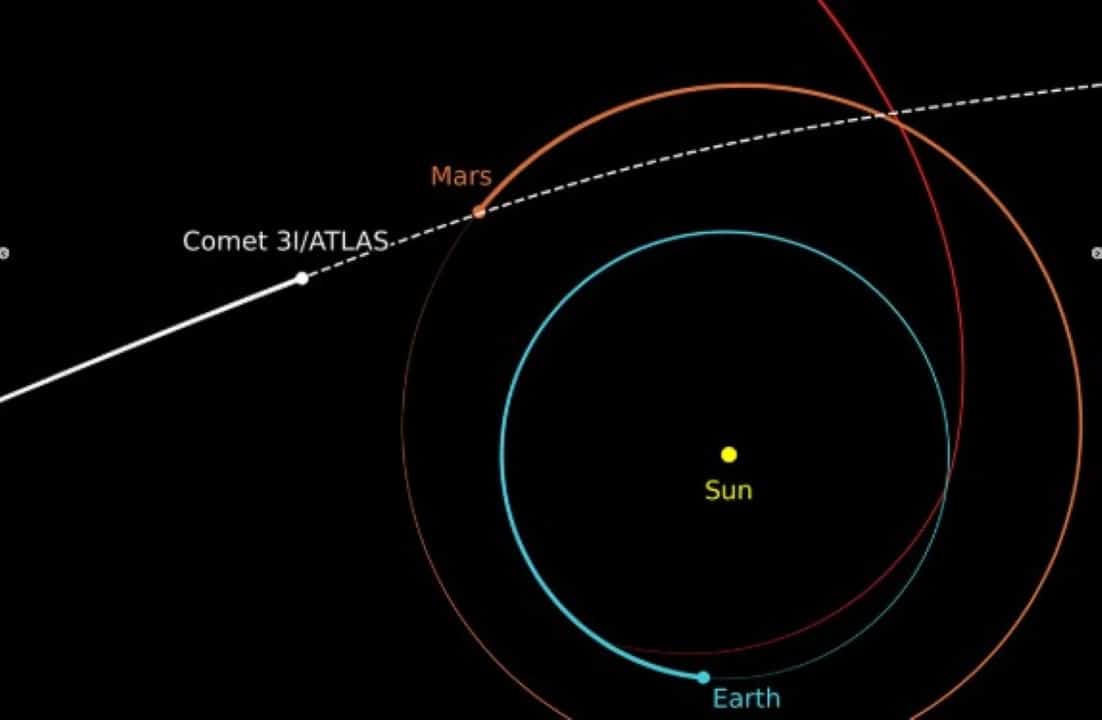
On October 3, it approached Marte at 29 million kilometers, immersed in the ionic tail observed by Hera.
The Lucy mission captured a back-illuminated image, showing dust structure, while the Mars Reconnaissance Orbiter recorded luminous extension ahead.
- MAVEN detected hydrogen atoms on September 28, from three sources: comet, Marte, and interplanetary medium.
- SOHO observed faint brightness between October 15th and 16th.
- Juno will deploy sensors by March 2026.
Avi Loeb highlights irregularities
The Harvard astrophysicist lists 13 anomalies, including extreme negative polarization and direction coinciding with the Wow signal! at 9 degrees.
The 16.16 hour rotation does not blur the collimated jets, observed on November 9th by Belgian telescopes.
Loeb classifies the object as rare, with a low combined probability for natural events, raising it on the Loeb scale to 4.
He suggests possible probe to seed Júpiter, but awaits December data for review.
Meeting with Júpiter in detail
On March 16, 2026, at 53.445 million km, the comet will cross the Hill radius limit of 53.502 million km.
Simulations indicate that the gravity of Júpiter will alter the final trajectory, ejecting it into the constellation of Gêmeos.
The Juno probe will observe from March 9 to March 22, potentially detecting new orbital objects.
This interaction will test models of orbital dynamics for interstellar objects.
The nickel-rich and iron-poor composition reinforces hypotheses of formation in a distant system.
Proximity to Terra in December
On December 19, 2025, 3I/ATLAS will reach 270 million kilometers from Terra, visible at Virgem and Leão at magnitude 12.
Amateur astronomers will be able to track it with medium telescopes, while professionals use the Hubble for spectroscopy.
There is no threat, but the passage offers a last glimpse before Sistema Solar leaves.
Radio data confirm sublimation of cold ice from Via Láctea, preserving ancient chemical record.
Continuous monitoring and insights
NASA has mobilized 20 imaging missions, including Europa Clipper, which will cross the tail in 2026.
Observations in December will focus on gaseous emissions and dust, enhancing understanding of planetary formation.
The object, with a diameter estimated at up to 11 km by Australian agencies, defies size models for interstellars.
Indian research simulated 500 orbital scenarios, confirming entry to Sagitário and exit to Gêmeos.



