NASA detects anomalous tail on interstellar comet 3I/ATLAS and debate about its origin intensifies

The North American space agency announced on November 5, 2025 the detection of an unusual structure in the interstellar comet 3I/ATLAS, a finding that is generating intense debate in the astronomical community about its composition and origin. The object, which travels at extreme speed through our system, presents characteristics that do not completely align with known cometary models, raising new questions about the formation of celestial bodies in other stellar systems.
Discovered in July 2025 by the ATLAS astronomical survey system (Asteroid Terrestrial-impact conclusively that it did not originate within our Sistema Solar, making each observation a unique opportunity to study material from another star.
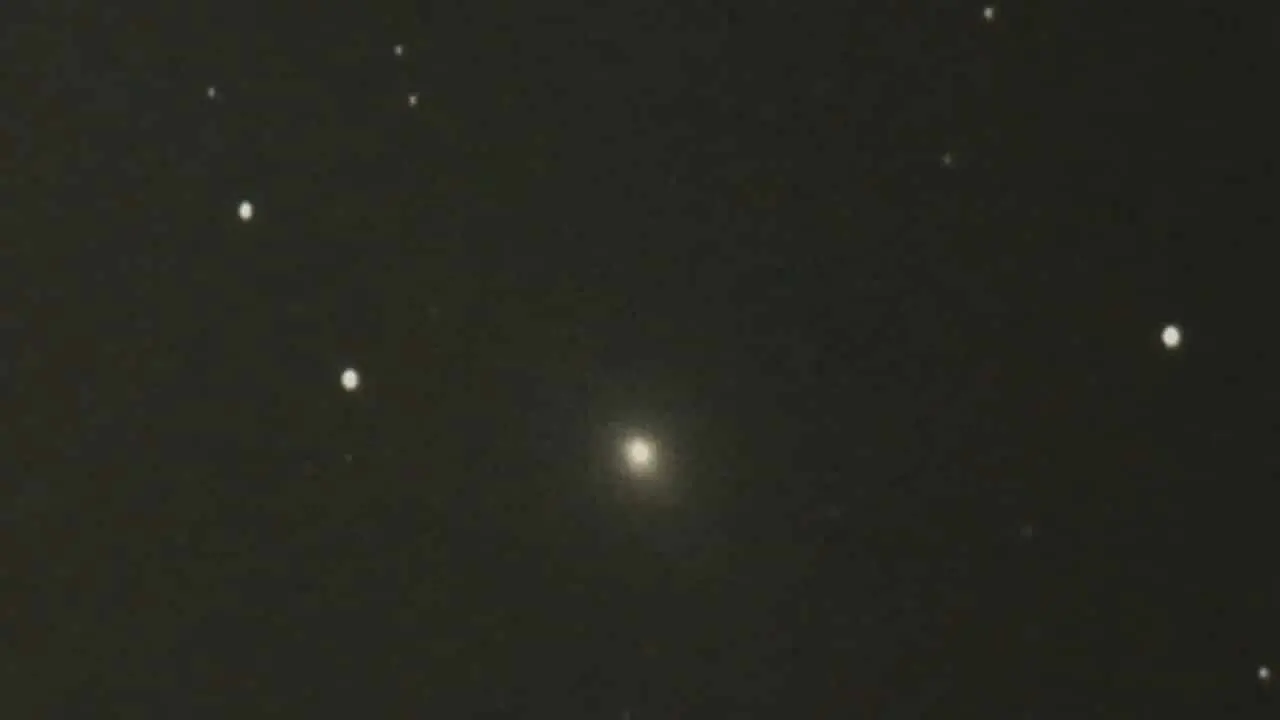
Since his identification, telescopes around the world and in space have been pointed at the cosmic traveler. Initial analyzes already pointed to atypical behavior, but the most recent observations have revealed details that defy conventional explanations and drive a new race to decipher its secrets before it disappears again into deep space.
The trajectory and speed of the cosmic visitor
Confirmation of the interstellar nature of 3I/ATLAS was established through analysis of its orbit. Astrônomos calculated that the object approaches Sol at an impressive speed of approximately 56,000 kilometers per second, a mark much higher than the escape velocity of our stellar system. Essa excessive kinetic energy is the signature of a body that is not gravitationally bound to Sol, having only a temporary passage through our cosmic neighborhood.
The comet passed its closest approach to Terra, known as perigee, on October 29, 2025, at a safe distance of about 270 million kilometers. Esse event allowed observatories to obtain crucial data about its composition and morphology. The information collected during this phase is fundamental to understanding the differences between this object and the native comets of our Cinturão of Kuiper or of the Nuvem of Oort, which have different speeds and compositions.
Features that challenge current models
The most intriguing aspect of 3I/ATLAS is its tail. Diferentemente of the dust and ion tails normally seen in comets, which are shaped by the pressure of solar radiation and the solar wind, this object’s tail exhibits a fragmented structure and gas emission dynamics that do not correspond to what is expected.
Spectrographic analyzes carried out with the Telescópio Espacial James Webb indicated the presence of gases in unusual proportions, suggesting a chemical composition different from that found in comets in our system.
This structural peculiarity suggests that the comet’s nucleus may be fragmenting in an atypical way or that its interaction with the interplanetary environment is more complex than previously assumed.
Scientists are now working on the hypothesis that the composition of the nucleus, possibly richer in certain metals or with a heterogeneous internal structure, is the cause of its anomalous behavior.
In-depth analysis of collected data
Radio observatories also joined the research effort and detected wave emissions at frequencies of 1.665 GHz and 1.667 GHz, associated with hydroxyl (OH) molecules, a byproduct of the breakdown of water molecules by sunlight. Contudo, the intensity and variation of these signals are not consistent with a cometary body composed primarily of water ice. The analysis suggests that 3I/ATLAS lost around 13% of its mass during its passage through perihelion, a considerably high value that indicates marked volatility or fragmentation. Essa rapid disintegration may be the key to understanding both the structure of its tail and its internal composition, which may be less cohesive than that of other comets already studied. The scientific community is reevaluating comet formation models to accommodate the possibility that there are objects with rocky or metallic cores covered by a thin layer of ice, which would behave very differently as they approach a star.
Leia Também



The third visitor from another star system
The arrival of 3I/ATLAS consolidates a new era in astronomy, the study of interstellar objects. Enquanto ‘Oumuamua was a rocky, elongated object with no visible coma and 2I/Borisov resembled a long-period comet from our own system, 3I/ATLAS presents a set of intermediate and unique features, showing that the diversity of smaller bodies in other stellar systems may be much greater than previously imagined.
Next steps in scientific research
The 3I/ATLAS observation campaign will continue intensively over the coming months as the comet moves away from Sol on its journey back to interstellar space. The expectation is that, by distancing itself from solar influence, its behavior may reveal more about its fundamental nature.
Missions like SOHO and STEREO-A will continue to monitor its interaction with the solar wind, providing valuable data about its tail and the material being expelled. International coordination between different agencies and observatories will be crucial to putting together the puzzle that this visitor represents.
Implications for the study of planetary systems
Each interstellar object that crosses our path offers a direct glimpse into the chemical makeup of other parts of the galaxy. Eles are like natural probes that bring samples from their home systems.
Studying the composition of 3I/ATLAS allows scientists to compare the “ingredients” that formed planets and comets around other stars with those that formed our own Sistema Solar.
This comparative analysis is vital to understanding whether the conditions that allowed life to emerge on Terra are common or rare in the universe. The search for complex organic molecules in these objects is one of the main focuses of research.
As detection technology advances, the identification of interstellar visitors is expected to become more frequent, opening a permanent window for exploring worlds far beyond our direct reach.