

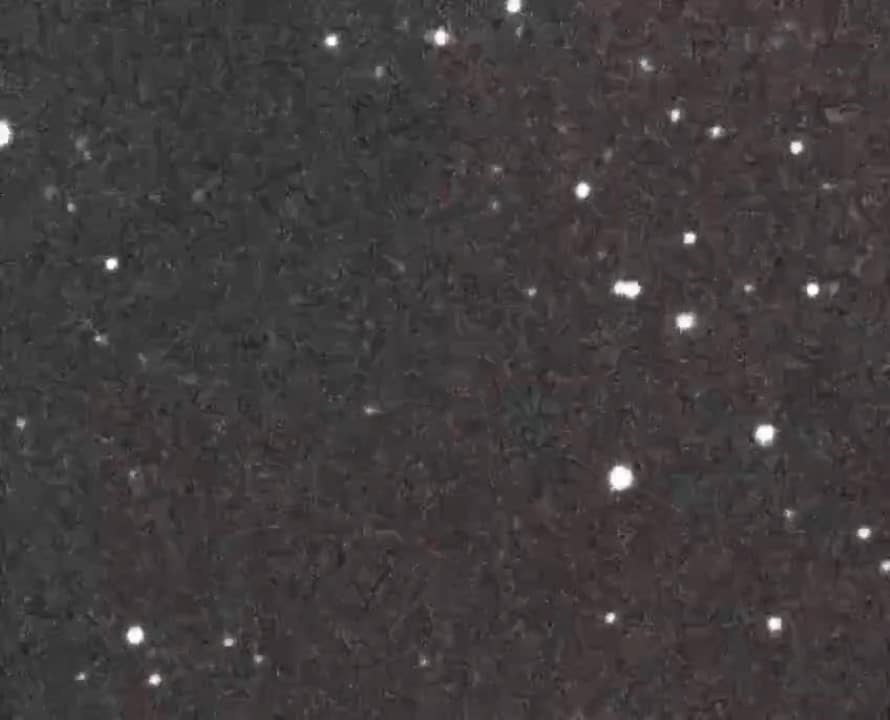
The interstellar comet 3I/Atlas, discovered in July 2025 by the Atlas telescope on Chile, follows a hyperbolic orbit that takes it outside Sistema Solar after its passage.
This trajectory brings it closer to Sol on October 30, 1.4 astronomical units away, and to Terra on December 19, 1.8 astronomical units away, without risk of collision.
Scientists at Nasa coordinate observations with international agencies to map its composition and speed of 125,000 miles per hour.
- Initial discovery on July 1, 2025, with pre-discovery observations from June.
- Age estimated at seven billion years, originating from the thick disk of Via Láctea.
- Approximate mass of 33 billion tons, covered by ice that forms a coma and tail.
Proximity to Marte on October 3 allowed detailed images from orbiters, revealing micrometer-sized dust grains.
Physical characteristics revealed in detail
The composition of 3I/Atlas includes irradiated organic compounds, such as tholins, which give the coma a reddish color.
Its coma expanded from 13,000 kilometers in June to 18,000 in July, indicating the release of dust and gases.
The icy core generates a tail of more than 600 thousand miles, with atypical behavior in pointing towards Sol instead of away.

Initial observations and detected anomalies
Ground-based telescopes captured the conical-shaped object with a greenish glow, confirming its cometary nature.
Data from Nasa indicate that the comet does not change its route irregularly, contradicting initial speculation.
International monitoring campaign
Rede Internacional of Alerta of Asteroides coordinates tracking from November 27th to January 27th, 2026.
Images captured by space missions
Telescópio Espacial Hubble recorded 3I/Atlas on July 21, 277 million miles from Terra, showing a drop-shaped dust cocoon.
The Lucy mission, en route to the Trojan asteroids of Júpiter, stacked photos from September 16, 240 million miles away, revealing the core as a weak point.
The Psyche mission obtained four observations on September 8 and 9 at 33 million miles, detecting early coma.
Orbitador of Reconhecimento of Marte captured images in October, 90 million miles away, showing a diffuse ball of dust and ice.
Anomalies and scientific theories
The comet displays an inverted tail and bluish color changes near Sol, attributed to the release of hydrogen and fine dust.
Researchers note 12 irregularities, such as a steep route through the galaxy, but confirm compliance with gravitational laws.
Planetary Defense Exercise in Action
The UN activates defense protocols with diversion simulations, using radars, satellites and machine learning for tests on December 29.
Agencies such as Esa and Jaxa are part of the effort, validating automatic detection and interception systems.
Contributions from amateur observers
Amateur astronomers at Canadá, Japão, Espanha, and Chile have provided sharp snaps, such as the image of
These contributions complement professional data, expanding the catalog of images for spectroscopic analysis.
Professor Avi Loeb, from Harvard, took photos on November 22nd and 24th, highlighting a bright coma and narrow tail.
Future of the comet after perihelion
After perihelion, 3I/Atlas passes through Vênus on November 3 at 0.65 astronomical units and through Júpiter on March 16, 2026 at 0.358 astronomical units.
Observations continue with missions such as PUNCH, which combined images from September to October showing tail elongation at 231-235 million miles from Terra.
Maven’s ultraviolet instrument, orbiting Marte, mapped hydrogen atoms around the comet on October 9.
Advances in detection of interstellar objects
The third interstellar visitor reinforces the importance of networks like Atlas for early warning.
3I/Atlas data improves defense models, simulating responses to real threats without public panic.
Extended observability allows studies of interstellar dust, comparable to 2I/Borisov, to understand galaxy formation.



