
Free on Steam, Real Moon uses real Moon data in partnership with JAXA for authentic exploration experience


The Japanese studio Historia announced this Monday, December 2, 2025, the imminent launch of the simulator “Real Moon” on the Steam platform, free of charge. Desenvolvido in collaboration with Agência of Exploração Aeroespacial of Japão (JAXA), the game recreates the lunar surface based on real observational data, allowing players to explore a scientifically accurate environment. The initiative aims to provide an immersive walking experience on Lua, at no additional cost to users.
The partnership between Historia and JAXA uses an advanced simulation environment, incorporating measured elevations and distributions of geological elements. Jogadores take on the role of lone explorers, completing short missions that last between 15 and 30 minutes. The focus lies on the feeling of presence in the lunar vacuum, with simple mechanics of movement on foot or in vehicles.
- Surface constructed from digital elevation data (DEM) collected by space missions.
- Reproduction of craters and rocks according to rates observed in scientific studies.
- Dynamic positions of Sol, Terra and Lua, affecting lighting and shadows in real time.
This structure ensures that the simulator serves as an educational tool, in addition to entertainment, highlighting advances in computational modeling.
Strategic partnership drives scientific precision
The collaboration with JAXA arises from a joint research project, where the studio accessed exclusive databases of lunar observations. Engenheiros from the agency contributed topographic validations, adjusting subtle ripples in the surface for greater fidelity.
The process included consultations with academic articles, integrating elements such as crater inclinations and dispersion of rocky debris. Essa approach elevates “Real Moon” above generic simulations, positioning it as a reference for astronomy enthusiasts.
Visual elements capture authentic lunar geology
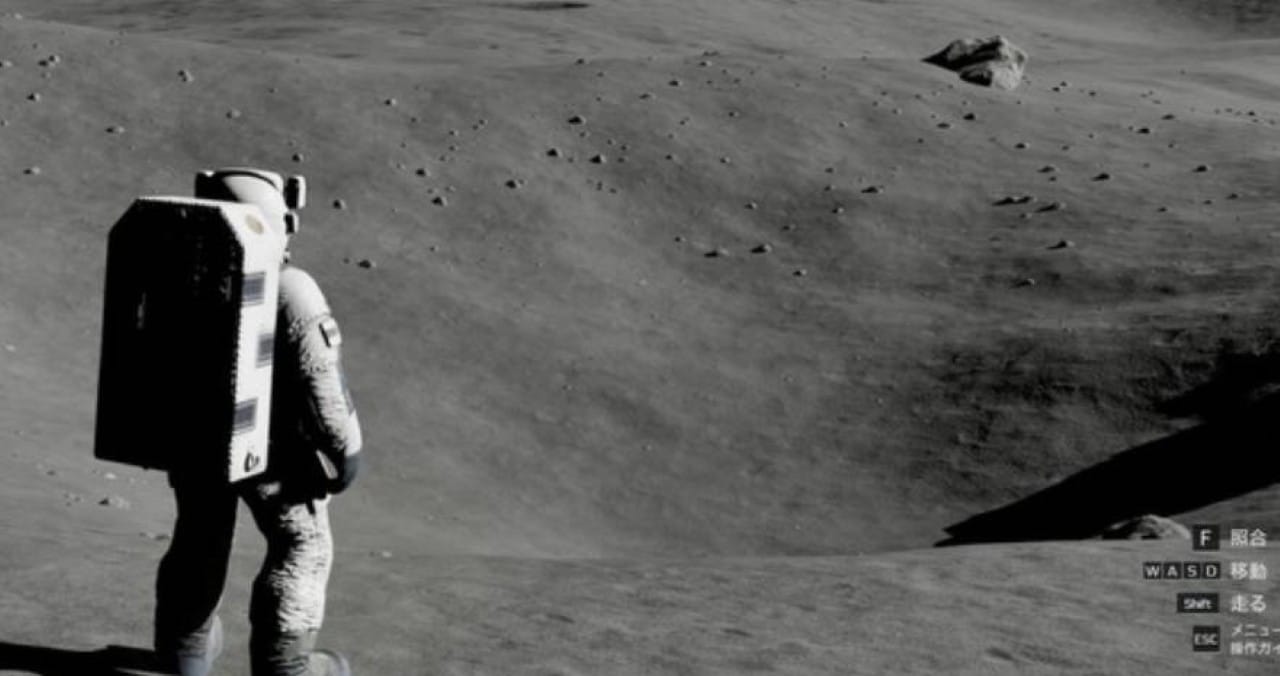
Elevation data forms the basis of the terrain, with craters distributed according to real patterns measured by orbiters. Rochas appear at observed densities, creating an irregular mosaic that reflects billions of years of cosmic impacts.
The lighting varies with the lunar diurnal cycle, simulating elongated shadows during the sunrise of Sol. Esses details, validated by experts, avoid stylized representations common in space games.
Exploration mechanics prioritize simple immersion
Players start in a desolate zone, equipped with virtual spacesuits for on-foot navigation. The control allows slow steps in a vacuum, with physics adapted to low gravity, requiring precise adjustments to avoid stumbling over irregularities.
Rover vehicles expand range, covering greater distances over rough terrain. Missões involve collecting virtual samples or mapping areas, but the core is the freedom to roam without narrative pressures.
One notable scene shows the encounter with a replica of the SLIM probe, positioned upside down after its successful landing in 2024. Essa’s inclusion pays homage to real missions, adding layers of historical context to the gameplay.
Data integration elevates environmental realism
The simulation incorporates relative celestial positions, changing the incidence of light throughout the lunar “day”, which lasts 14 Earth days. Sombras projected rocks and crater rims change dynamically, reinforcing the feeling of cosmic isolation.
Academic consultation guided the addition of microtextures, such as fine regolith dust that settles into grooves. Esses touches, derived from Apollonian samples, enrich the visualization without overloading the user’s hardware.
The Unreal Engine 5 engine supports high-resolution rendering, compatible with varied PC configurations. Testes internals confirm stable performance even on extensive explorations.
Short missions highlight audience accessibility
The design emphasizes brief sessions, ideal for those new to space simulations. A typical mission involves inspecting a nearby crater, recording geological anomalies with digital tools.
Another task tests the rover on winding routes, measuring propulsion efficiency in lunar dust. Essas activities, without severe penalties, encourage repetitions for varied discoveries.
Development reflects advances in digital simulation
Similar projects, such as using NASA data in educational games, inspired the Historia team. JAXA provided access to 2023 models, updated with recent observations from ground-based telescopes.
Prototype iterations focused on balancing accuracy and playability, with feedback from astronomers adjusting elevation scales. The result is a title that democratizes lunar knowledge, accessible via Steam globally.
Engineers highlight scalability, allowing future expansions with data from Artemis missions. For now, the initial scope covers a region of 10 square kilometers, faithful to historic landing sites.
Initial reception points to educational impact
Preliminary announcements generated interest on gaming and science forums, with wishlists growing quickly on Steam. Educadores foresee use in classrooms to illustrate concepts of planetary geology.
Its free nature removes barriers, attracting everyone from casual gamers to amateur researchers. Atualizações promises will include more lunar zones, based on data from active probes.



