
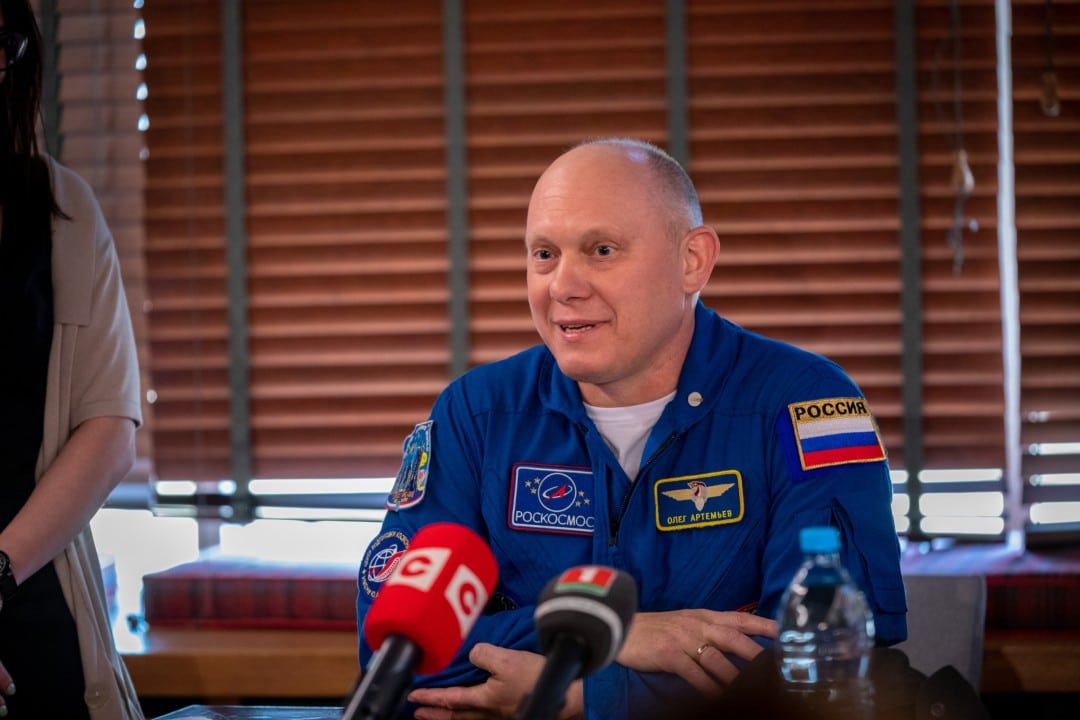
The Russian space agency Roscosmos announced this Tuesday, December 2, 2025, the removal of cosmonaut Oleg Artemyev from the main crew of the mission The decision comes two and a half months before the flight, which will transport astronauts to Estação Espacial Internacional under an exchange agreement between NASA and Roscosmos. Fontes linked to the space sector indicate that the exclusion results from an alleged violation of ITAR standards, American regulations that control the export of defense technologies, during training at SpaceX facilities, on Hawthorne, on Califórnia. Roscosmos reported that Artemyev was transferred to another role, without additional details about the incident.
Andrey Fedyaev, another Russian cosmonaut with experience in missions to the ISS, takes over as Artemyev on Crew-12. The official announcement came via a statement from the agency, highlighting the continuity of preparations for the launch.
The case gains relevance amid bilateral cooperation in space, despite recent geopolitical tensions.
Profile of Oleg Artemyev and his trajectory in space exploration
Oleg
Since 2019, Artemyev has served as a deputy in Duma Municipal of Moscou, for the Rússia Unida party, combining political activities with space training.
His removal comes at a time of intensive preparation for Crew-12, where he participated in simulations with the American team.

Details of the alleged breach during training at SpaceX
Space industry sources report that Artemyev photographed internal SpaceX materials, including images of rocket engines, using his personal cell phone during sessions on Hawthorne. Esses documents would be sensitive under ITAR rules, which prohibit unauthorized disclosure of technologies linked to US national defense.
The action would have taken place the week before the announcement, leading to the immediate interruption of training and the opening of an interinstitutional investigation involving NASA and American authorities. Analistas point out that such a procedure is unusual for an experienced cosmonaut, suggesting an intentional failure in safety protocols.
SpaceX, responsible for the Crew Dragon capsule, routinely enforces restrictions on electronic devices in restricted areas to protect intellectual property.
Replacement with Andrey Fedyaev and crew adjustments
Andrey Fedyaev takes over the position
Fedyaev, 41, has already participated in the Crew-6 mission in 2023, where he spent 186 days on the ISS alongside NASA and Emirados Árabes Unidos astronauts.
Its inclusion in Crew-12 was confirmed on the website of Centro of Treinamento of Cosmonautas Yuri Gagarin, the main Russian base for space preparations.
The cosmonaut now joins the American crew, ensuring balance in seat exchange.
Previous experience of Fedyaev
On its previous mission, Fedyaev contributed to microgravity experiments and orbital station maintenance.
He returns to joint training focused on systems integration at Crew Dragon.
Immediate impact on preparations
The change requires acceleration in qualification protocols for Fedyaev, who is already familiar with SpaceX procedures.
Russian coaches adjust schedules to align the new member to the team.
NASA monitors developments to avoid launch delays.
The Crew-12 mission and its role in space cooperation
The Crew-12 represents the 12th operation of the Crew Dragon capsule under NASA contract, with capacity for up to four crew members towards the ISS.
The launch, scheduled for February 15, 2026, at 8:30 am local time (ET), integrates the Programa of Tripulação Comercial and the swapped seats arrangement.
This structure has maintained a Russian presence at the station since 2020, with missions alternating between Soyuz and Dragon vehicles.
- The crew includes two NASA astronauts, one from Roscosmos and one international reserve.
- Estimated duration: around six months in orbit.
- Main objectives: maintenance of the ISS, scientific experiments and system upgrades.
ITAR regulations and security in joint missions
ITAR standards, established by the US Departamento of Estado, classify space technologies as defense items, subject to strict export controls. Violações may result in civil or criminal sanctions, especially for foreigners.
In cooperation contexts, such as the ISS, protocols require constant supervision of sensitive materials during training.
Similar cases in the past, such as inspections in 2018, have reinforced checks on international crew members’ personal devices.
Investigations under ITAR prioritize confidentiality to preserve diplomatic relations in space.
History of NASA-Roscosmos exchanges and lessons from previous incidents
The swapped seats agreement, initiated in 2019, aims to guarantee continuity on the ISS despite terrestrial differences.
In 2022, tensions over the invasion of Ucrânia tested the partnership, but joint flights continued.
- Previous incidents: In 2021, audits identified flaws in data sharing, leading to protocol updates.
- Benefits: Reduz costs and maintains mutual expertise in orbital operations.
- Future: Extensão of the program until 2030 discusses new security clauses.
These events highlight the need for alignment in training for future missions.
Final preparations for launch of Crew-12
With the replacement confirmed, the team resumes full-time simulations on Centro Espacial Johnson, on Texas.
Crew Dragon integration tests occur in parallel, focusing on propulsion and life support systems.
Roscosmos coordinates with NASA for knowledge transfers, minimizing impacts to the schedule.
The incident reinforces training on compliance with international regulations.



