
Hubble and Juice capture unprecedented images of comet 3I/Atlas 286 million km from Earth By Carolina Costa
5 min read
 |
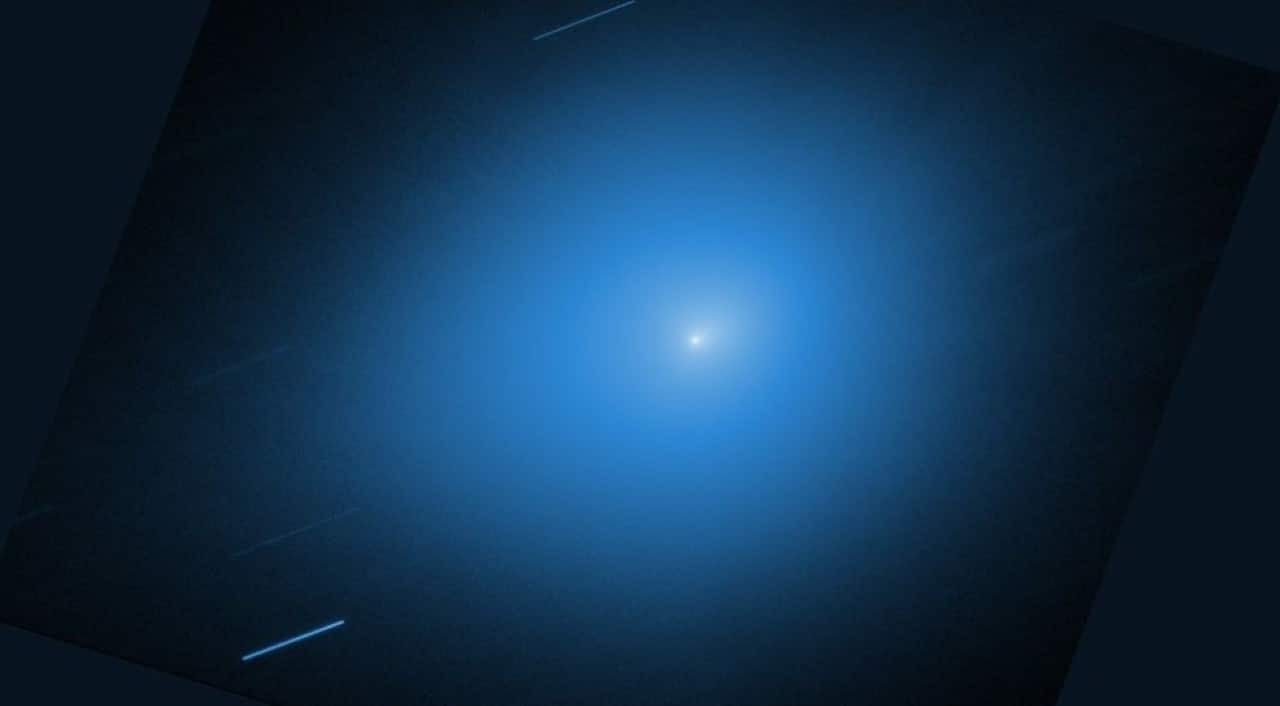
Telescópio Espacial Hubble, operated by Nasa, captured detailed images of comet 3I/Atlas on November 30, 2025, when the object was 286 million kilometers from Terra. Essa observation occurred shortly after the comet’s perihelion, in October, revealing a water drop-shaped coma with a nucleus surrounded by gas and dust. Nasa estimates that 3I/Atlas will reach its closest approach to Terra on December 19, at 270 million kilometers, without posing a threat to the planet.
Astronomers are coordinating global efforts to track the visitor, who is traveling at around 210,000 kilometers per hour. The hyperbolic trajectory confirms its origin outside of Sistema Solar, making it the third interstellar object detected. Descoberto on July 1, 2025 by the Atlas system in Chile, the comet offers valuable data on distant star formations.
- Core estimated at 440 meters to 5.6 kilometers in diameter;
- Coma with blue glow detected, indicating post-perihelion gas release;
- Background stars appear as trails due to the comet’s rapid motion.
These features were processed by Câmera of Campo Largo 3 of Hubble, providing the sharpest vision to date.
Observations from the Juice probe reveal unique composition
The Jupiter Icy Moons Explorer probe, Agência Espacial Europeia, began recording 3I/Atlas on November 2, 2025, using five of its ten scientific instruments. Projetada to study moons of Júpiter from 2031, Juice captured the comet 66 million kilometers along its route. The navigation camera recorded a bright coma of gas around the nucleus, with evidence of two distinct tails.
Preliminary data show emissions of cyanide and atomic nickel in the comet’s atmosphere, analyzed by spectroscopy. The probe’s closest approach occurred on November 4, allowing measurements of ejected particles without compromising the spacecraft’s thermals. Engenheiros Europeans advanced a quarter of the image, highlighting the plasma tail – charged gas – extending upwards, and the dust tail, more tenuous, curving to the lower left.
The observation campaign lasted from November 2nd to 25th, taking advantage of the geometry between probe, comet and Sol. Instrumentos as the dust monitor and particle analyzer collected remote samples, complementing terrestrial views.
Complete data arrives at Terra on February 18-20, 2026, due to delay caused by the main antenna used as a solar shield. Essa delay does not affect the integrity of the initial measurements.
Trajectory and discovery mark the third cosmic visitor
Comet 3I/Atlas was identified on July 1, 2025 by the Asteroid Terrestrial-impact Last Alert System telescope, in Rio Hurtado, Chile, funded by Nasa. Inicialmente 676 million kilometers from Sol, the object was moving at 220 thousand kilometers per hour, with an open orbit that does not return to our system. Astrônomos from Esa analyze their hyperbola to estimate origins in another star system.
Before it, 1I/’Oumuamua appeared in 2017, without a visible coma, and 2I/Borisov in 2019, with similar gaseous traces. The 3I/Atlas stands out for its estimated age of 7.6 billion years, 3 billion more than the Sistema Solar of 4.6 billion years. Essa longevity suggests formation under primitive galaxy conditions.
Observations of Very Large Telescope in August detected reddish organic dust in its coma. Telescópios terrestrials such as Gemini Sul captured cryovolcanic eruptions between November 22 and 27, with magnitude 11.5 visible in Virgem and Leão for amateur equipment.
Tail details and material release
3I/Atlas’s plasma tail extends in the opposite direction to Sol, composed of charged ions influenced by the solar wind. The Essa structure, captured by Juice, measures about 3 arcseconds in recent images of Hubble. Partículas electrically active cells create a luminous trail, analyzed to map interactions with the heliospheric magnetic field.
The dust tail, on the other hand, forms a tenuous expanse of tiny solid particles, bending due to solar radiation. Observações from Mars Express in October, 30 million kilometers away, confirmed intense post-perihelion release on October 29, 1.36 astronomical units from Sol. Sondas like Trace Gas Orbiter recorded varying chemical composition, including carbon and hydrogen.
These tails evolve with distance from the Sol, losing brightness as the comet moves away. In December, the dust reflects sunlight diffusely, allowing tracking until January 2026 during opposition.
Chinese monitoring by Tianwen-1 in orbit around Marte paused for six hours on October 3 due to exposure limitations, without changing the confirmed speed of 210,000 kilometers per hour.
Additional mission contributions to the study
Probes in Marte, such as Mars Express and ExoMars Trace Gas Orbiter, spotted 3I/Atlas in October 2025, 29.9 million kilometers away. Essas unexpected observations revealed a diffuse coma, with a cloud of gas and dust 30 million kilometers away. Esa used the data to validate trajectories, contributing to science without initial planning.
The SOHO mission, a joint mission between Nasa and Esa, orbiting the point of Lagrange 1, processed images between September and October, incidentally identifying the comet. The PUNCH telescope on Nasa recorded sequences from September 28 to October 10, showing the evolution of the coma. The STEREO probe captured side views during the Martian flyby.
These contributions multiply the angles of analysis, with 12 Nasa instruments involved. Observatórios terrestrials like Joan Oró, in Espanha, documented gas jets in November, enriching the data catalog.
Image processing by NOIRLab confirms the absence of anomalies, reinforcing the safety of the land approach.
Ancient origin intrigues international astronomers
The suspicion that 3I/Atlas is 7.6 billion years old is based on orbital modeling of Esa, compared with stellar ages in Via Láctea. Sua primitive composition, rich in organics, differs from local comets formed 4.6 billion years ago. Espectros of Observatório Astronômico of Xangai detect rare traces of nickel, suggesting formation in distant nebulae.
Ucla astronomers process data from Hubble, noting teardrop shape in early July coma. Colaborações with Observatório Internacional Gemini reveal reddish dust typical of interstellar objects. The global campaign includes weekly updates on Nasa blogs, accessible to researchers.
These insights expand understanding of cosmic migrations, with the comet leaving Sistema Solar after December. Observações amateurs grow, with magnitude allowing visibility in 20-centimeter telescopes.
Integration of data from multiple agencies ensures accuracy, with no discrepancies in reported speeds or directions.











