


Astronomers at Nasa recorded a rare cosmic event on July 2, 2025, when a black hole consumed a star, producing a burst of gamma rays that lasted at least seven hours. Esse phenomenon, known as GRB 250702B, represents the longest recorded in more than 50 years of observations and has released energy equivalent to that emitted by a thousand suns shining for 10 billion years.
The event occurred in a distant galaxy, about 8 billion light years from Terra, in the constellation of Scutum. Diferente of typical gamma bursts, which last minutes, this one maintained X-ray flares for days, indicating continuous accretion of matter from the destroyed star.
Data from multiple telescopes confirmed that the black hole continued feeding after the initial burst. Imagens of Hubble and James Webb revealed the host galaxy as a massive structure, possibly in the process of merging, with a dust lane obscuring parts of the view.
Instruments involved in detection
Several Nasa and international observatories captured GRB 250702B at different wavelengths. The Fermi Gamma-ray Space Telescope identified the initial gamma-ray signal, while the Neil Gehrels Swift Observatory monitored X-ray emissions.
- Fermi Gamma-ray Burst Monitor: Detectou the extended burst.
- Swift Burst Alert Telescope: Confirmou unusual properties.
- Hubble and James Webb: Forneceram images of the distant galaxy.
- Chandra and NuSTAR: Analisaram post-event flares.
These instruments worked together to map the phenomenon. Additional Observações from Keck and Gemini helped determine the galaxy’s distance and characteristics.
Explanatory models for the phenomenon
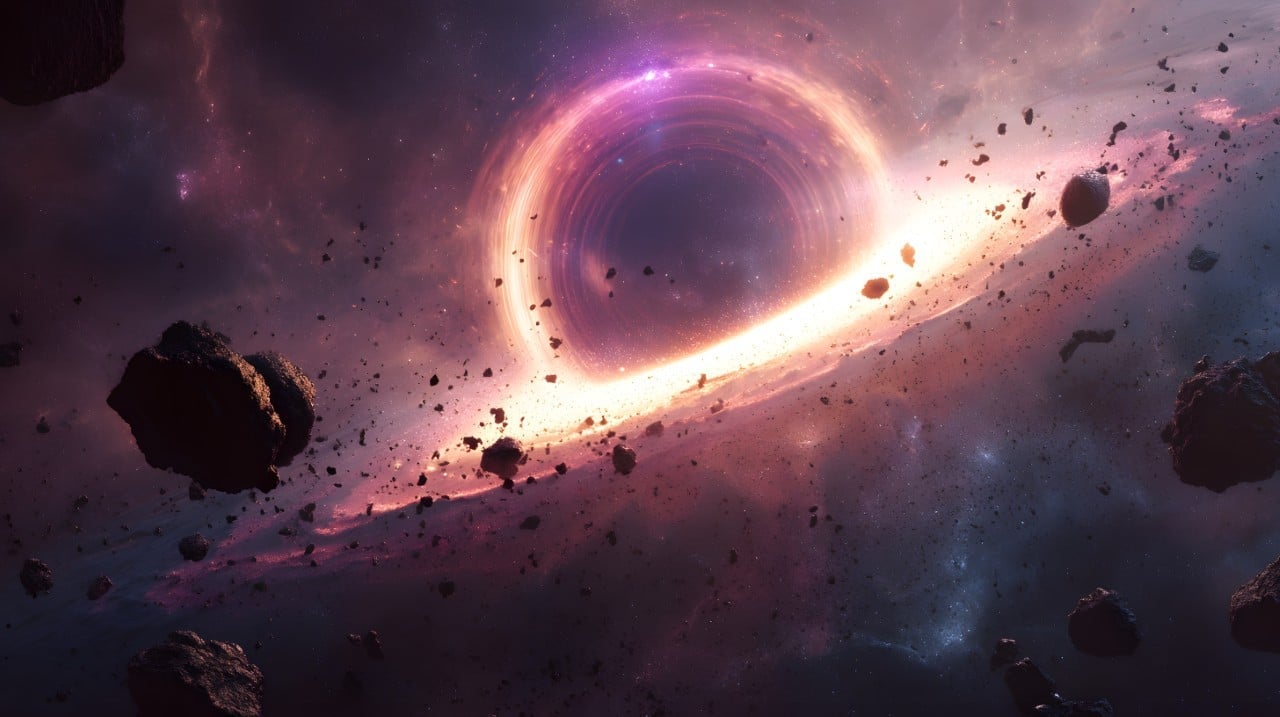
Scientists propose two main scenarios to explain how the black hole devoured the star. One involves an intermediate-mass black hole, thousands of solar masses, that ripped apart a nearby star in a classic tidal disruption event.
The other model suggests a smaller black hole, of about three solar masses, merging with a companion helium star. In this case, the black hole penetrates the star’s core, rapidly consuming matter and launching jets of gamma rays.
Both processes form an accretion disk that glows brightly. The prolonged duration indicates that the jets did not shut down immediately, unlike standard gamma bursts.
Research indicates that the black hole continued to accrete material for days. Essa sustained accretion explains the flares observed in X-rays after the main event.
Characteristics of the host galaxy
The galaxy where GRB 250702B occurred has more than twice the mass of Via Láctea. Sua light traveled 8 billion years to reach Terra, offering a glimpse into the ancient universe.
Images from James Webb revealed a streak of dust running across the galaxy, which may obscure an associated supernova. The burst’s position close to the galactic plane complicated initial analyses, but confirmed an extragalactic origin.
The structure suggests possible merger with another galaxy. Essa dynamics may have displaced the black hole or star, facilitating the fatal encounter.
Implications for long gamma bursts
This event challenges traditional models of gamma bursts, usually linked to stellar collapses or neutron star mergers. The hours-long duration points to exotic origins involving consumption of stars by black holes.
Astronomers highlight that prolonged bursts can reveal new types of stellar explosions. GRB 250702B almost doubles the previous record, opening the way for studies of intermediate black holes.
Future observations of similar events will help refine theories. Dados collected reinforce the importance of multiwavelength monitoring to capture transient phenomena.
Energy released and comparisons
The initial burst released immense amounts of energy in gamma rays, followed by continuous emissions. Comparado to standard bursts, this one maintained prolonged activity, with sustained relativistic jets.
The total energy is equivalent to multiple supernova explosions. Sem evidence of visible supernova, possibly blocked by dust, focus remains on accretion process.
Details of the consumption process
When a star gets too close, gravitational forces stretch and tear it apart. Parte of matter forms a disk around the black hole, heating up and emitting radiation.
Jets are launched along the axis of rotation, producing gamma rays. In the case of GRB 250702B, the process took days due to continuous feeding.
Fusion models describe the black hole immersed in the star, exploding it internally. Essa dynamics explains absence of observed optical supernova.
Additional observations
Ground-based telescopes like European Southern Observatory’s VLT have contributed spectroscopy. The Dark Energy Camera helped map the field.
Monitoring at Estação Espacial Internacional detected variations in Todas X-rays and the data converge to origin in stellar consumption.
Advances in understanding black holes
Events like this make it possible to study black holes in action, especially intermediate-mass ones, which are rare to detect. The combination of gamma, X and optical data provides complete picture.
Published research highlights unique properties of the burst. Esse record sets new standard for duration of GRBs associated with disruptions.



