Nasa and astronomers intensify 2025 observations of 3I Atlas comet C/2023 A3 for origin insights

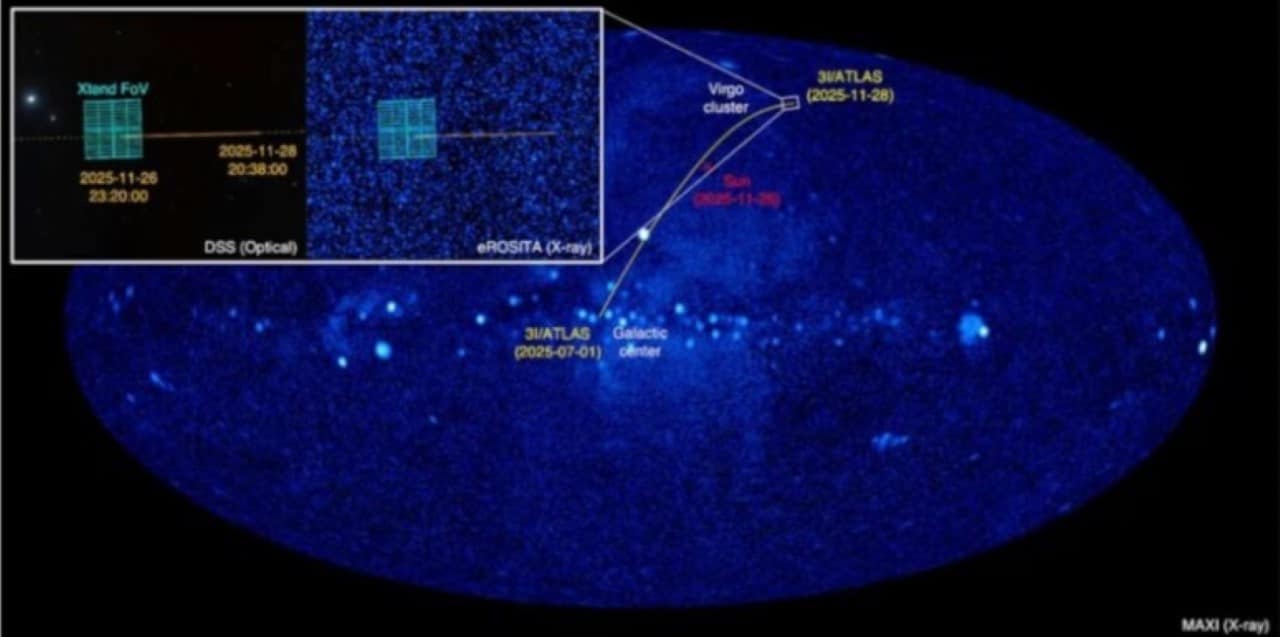
NASA and international astronomical observatories are intensifying their focus on Comet C/2023 A3 (Tsuchinshan-ATLAS), with critical observations and data analysis extending well into 2025. This celestial visitor, discovered in early 2023, has captivated scientists due to its unique trajectory and potential to offer unprecedented insights into the solar system’s primordial conditions. Its journey through the inner solar system, particularly its close approaches in late 2024, has set the stage for a year of profound scientific exploration in the subsequent year.
Astronomers worldwide are currently scrutinizing the vast datasets collected, aiming to unravel the comet’s volatile behavior and its interaction with solar radiation. The robust data streams from various telescopes provide a rich tapestry for detailed examination.
The scientific community’s interest in C/2023 A3 stems from several key aspects:
Discovery and trajectory
The comet C/2023 A3 (Tsuchinshan-ATLAS) was first identified by astronomers at the Purple Mountain Observatory in China and subsequently confirmed by the ATLAS survey in South Africa. Its initial detection highlighted a trajectory that would bring it relatively close to both the Sun and Earth, sparking immediate scientific interest.
Its orbital path suggests it is a long-period comet, meaning it originates from the distant Oort Cloud, a spherical shell of icy objects surrounding our solar system. Such comets are considered pristine remnants from the solar system’s formation, preserving material untouched for billions of years.
NASA’s observational commitment
NASA has dedicated significant resources to tracking 3I Atlas, utilizing a network of ground-based telescopes and space-borne instruments. The agency’s Jet Propulsion Laboratory (JPL) has been instrumental in refining the comet’s orbit and predicting its behavior.
This commitment ensures continuous monitoring, allowing scientists to gather comprehensive data on its nucleus, coma, and tail. Data collected during its closest approach to Earth in October 2024 is now undergoing extensive processing and analysis throughout 2025.
The agency’s deep space network also played a role in receiving telemetry and observational data, crucial for understanding the dynamic changes occurring as the comet interacted with the solar wind and radiation.
Unveiling primordial secrets in 2025
The scientific community anticipates that 2025 will be a pivotal year for deciphering the data gathered from Comet ATLAS. Researchers are particularly keen on analyzing its chemical composition to understand the conditions of the early solar system.
Comets like C/2023 A3 are essentially time capsules, carrying materials from the protoplanetary disk that formed the Sun and planets. Studying their volatile compounds, such as water ice, carbon monoxide, and various organic molecules, can reveal insights into the building blocks of life itself.
One primary objective for 2025 is to model the comet’s outgassing rates and how these vary with its distance from the sun. This information is crucial for understanding the internal structure and thermal evolution of its nucleus.
Furthermore, scientists are examining any signs of fragmentation or outbursts, which can provide clues about the comet’s structural integrity and the forces it experiences as it travels through space.
Challenges in predicting cometary behavior
Predicting the exact behavior and brightness of comets, especially long-period ones, remains a significant challenge for astronomers. Factors such as the comet’s size, composition, and the presence of volatile ice pockets can lead to unpredictable changes in brightness and tail development. Early projections for Comet ATLAS varied widely, underscoring the inherent uncertainties in cometary science, making continuous, multi-instrument observation absolutely critical.
The volatile nature means that a comet can suddenly brighten or diminish, sometimes even fragmenting, making it a dynamic object of study. The comprehensive data collected during its active phases in 2024 and analyzed in 2025 will help refine predictive models for future cometary encounters, improving our ability to anticipate such celestial events.
Spectroscopic analysis and molecular signatures
One of the most exciting avenues of research for 2025 involves the in-depth spectroscopic analysis of the light emitted and absorbed by the comet’s coma. Spectrographs break down light into its component wavelengths, allowing scientists to identify specific chemical elements and molecules present in the comet’s atmosphere. For Comet ATLAS, this includes searching for complex organic molecules that could hint at the ingredients available for the emergence of life in the early solar system. The presence and distribution of these molecules can provide a chemical fingerprint of the comet’s origin region within the Oort Cloud, potentially differentiating it from comets originating closer to the Sun or from the Kuiper Belt, thereby adding another layer of understanding to planetary formation theories and the distribution of life-enabling compounds across the cosmos.
Future implications for planetary science
The study of 3I Atlas comet C/2023 A3 (Tsuchinshan-ATLAS) in 2025 will contribute significantly to the broader field of planetary science, enhancing our understanding of cometary evolution and the processes that shaped our solar system. The findings will inform future missions aimed at sampling cometary material directly.
Public engagement and astronomical education
While Comet ATLAS’s peak visibility for the naked eye in 2024 was uncertain and varied by location, its scientific journey continues to fuel public interest in astronomy. Educational initiatives by NASA and other institutions are leveraging the comet’s story to inspire a new generation of scientists and space enthusiasts.
The ongoing analysis provides valuable material for outreach programs, illustrating the dynamic nature of space and the collaborative efforts required to unravel its mysteries. Public observatories and science centers are expected to continue sharing updates and insights from the 2025 research.