

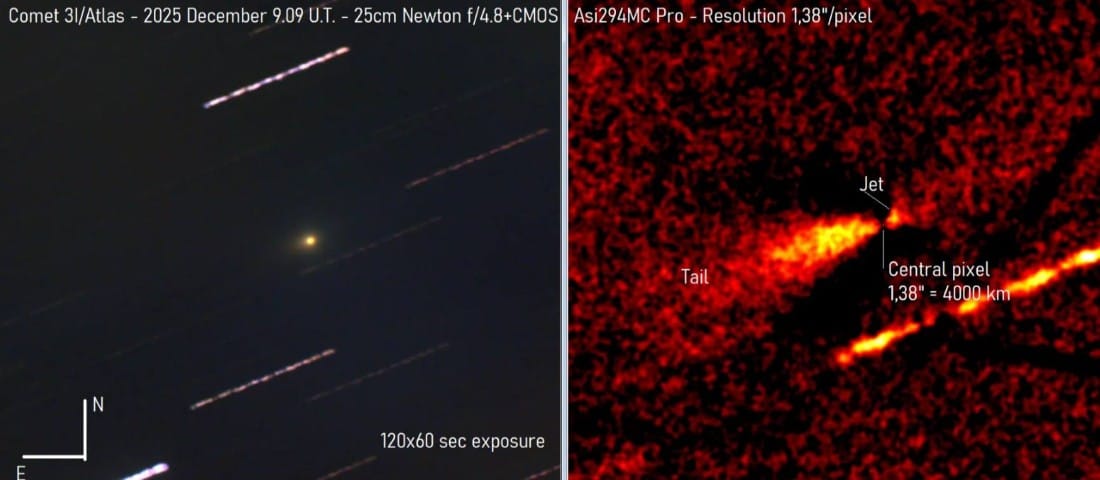
The dramatic fragmentation of comet 3I Atlas several years ago continues to be a focal point for Nasa scientists, whose ongoing analysis significantly shapes the agency’s deep space observation strategies for 2025. This celestial event, which captivated astronomers worldwide, provided an unprecedented opportunity to study the physical processes that govern cometary disintegration, offering critical insights into the composition and evolution of these icy wanderers from the outer solar system.
Initially hailed as a potential ‘great comet’ due to its unexpected brightening, 3I Atlas instead offered a rare spectacle of its own demise. Its rapid breakup into multiple pieces under the sun’s increasing warmth allowed for detailed observations that are now proving invaluable for future missions.
Scientists are leveraging the extensive data collected from 3I Atlas to enhance predictive models and develop more robust observational techniques, directly influencing how Nasa approaches cometary encounters and asteroid deflection research in the coming year and beyond.
Unraveling cometary mechanics in 2025
Nasa’s Jet Propulsion Laboratory, along with other research institutions, maintains an active research program dedicated to the comprehensive study of comet 3I Atlas’s remnants. The data sets, which include high-resolution imagery and spectroscopic measurements taken during its fragmentation phase, are being re-evaluated with advanced computational tools available in 2025.
This renewed focus aims to pinpoint the exact mechanisms that led to the comet’s demise, from internal structural weaknesses to the volatile effects of solar radiation. Understanding these factors is paramount for assessing the risks and opportunities associated with future cometary flybys and sample return missions.
Advanced observational techniques for future missions
The lessons learned from 3I Atlas are directly influencing the development of new observational protocols and instrument designs for 2025. Engineers and astronomers are collaborating to create systems capable of detecting subtle changes in cometary activity, providing early warnings of potential fragmentation or outbursts.
Improved telescope arrays and enhanced data processing algorithms are being implemented to track distant comets with greater precision. This technological advancement ensures that any similar events in the future can be captured with even higher fidelity, furthering our understanding of these enigmatic objects.
Furthermore, Nasa’s upcoming missions are incorporating adaptive optics and advanced imaging sensors that were refined based on the challenges encountered during 3I Atlas’s observation. These enhancements promise clearer views and more comprehensive data collection from targets across the solar system.
Implications for planetary defense and resource exploration
The study of 3I Atlas extends beyond pure scientific curiosity, offering practical implications for planetary defense and the burgeoning field of space resource exploration. Understanding how comets react to solar forces helps in predicting potential impact trajectories and developing mitigation strategies.
For planetary defense, the data from 3I Atlas provides a crucial case study in the behavior of icy bodies under stress. This knowledge is essential for simulating and planning potential responses to near-Earth objects that might pose a threat.
Regarding resource exploration, comets are believed to contain vast reserves of water ice and other volatiles. Nasa’s detailed analysis of 3I Atlas’s composition, even in its fragmented state, offers clues about the distribution and accessibility of these resources, which could be vital for future long-duration human missions.
Shaping future deep space endeavors
In 2025, Nasa’s cometary science program continues to evolve, heavily influenced by the indelible mark left by 3I Atlas. The agency is prioritizing research into cometary nuclei stability and volatile release mechanisms, aiming to build a more complete picture of these cosmic time capsules.
Future missions, including those planned for the late 2020s and early 2030s, are being designed with enhanced capabilities to study cometary dynamics. The experience with 3I Atlas has underscored the unpredictable nature of these objects and the necessity for flexible, adaptable mission architectures.
Collaboration and data sharing
International collaboration has been a cornerstone of the 3I Atlas research, with data shared among observatories and scientific teams globally. This collective effort has maximized the scientific return from the event, fostering a unified approach to cometary science that persists into 2025.
Scientists emphasize the importance of open access to observational data and research findings, allowing a broader scientific community to contribute to the analysis. This collaborative model ensures that complex phenomena like cometary fragmentation are understood from multiple perspectives.
Key takeaways from 3I Atlas for 2025
The ongoing study of comet 3I Atlas by Nasa and its partners highlights several critical areas for cometary science in 2025:
- Enhanced understanding of cometary nuclei composition and structural integrity.
- Refinement of early detection and tracking systems for volatile celestial bodies.
- Improved predictive models for cometary behavior under solar influence.
- Development of more resilient mission designs for future deep space explorations involving comets.
A continuing cosmic mystery
While 3I Atlas may no longer grace our skies as a single, bright object, its scientific legacy continues to illuminate the mysteries of the solar system. Nasa’s commitment to its study ensures that this fragmented comet remains a vital component of our cosmic understanding in 2025 and beyond.