


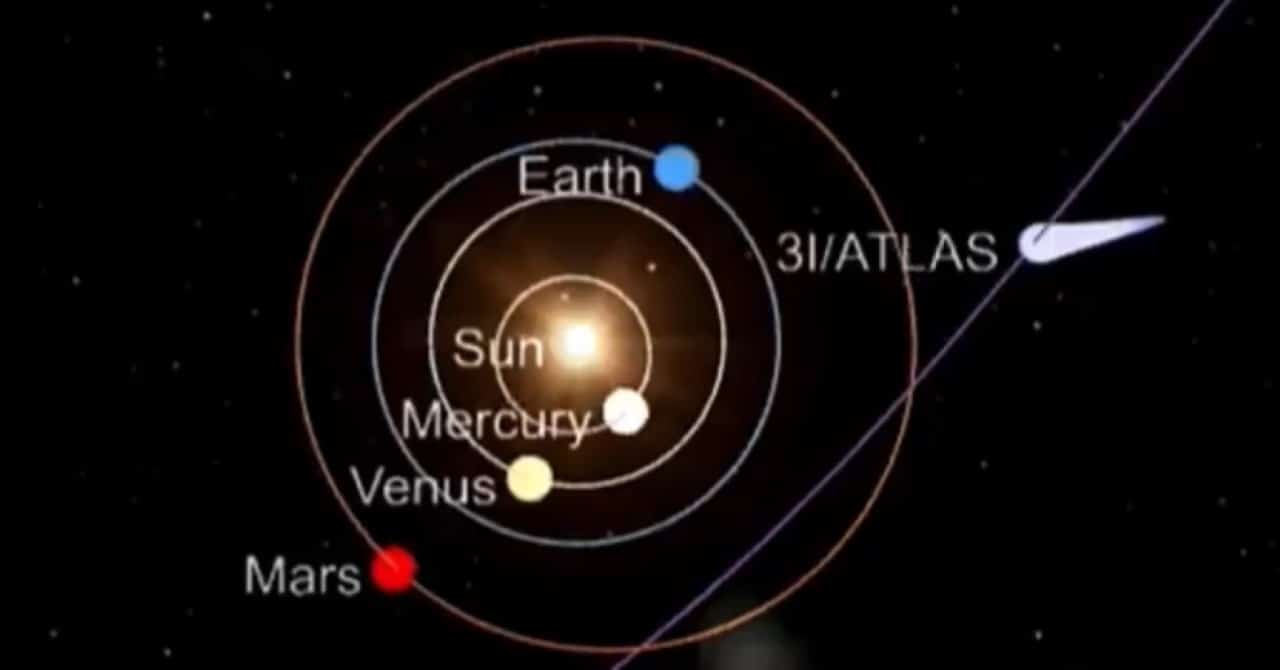
The interstellar comet3I/ATLAS, the third confirmed object coming from outside Sistema Solar, reaches its closest proximity to Terra this Friday, December 19, 2025. The minimum distance will be approximately 270 million kilometers, a value that does not represent any risk to the planet. Descoberto in July 2025 by the ATLAS system in Chile, the comet follows a hyperbolic trajectory, confirming its external origin.
Recent observations highlight the presence of aanti-tail, a structure that points towards Sol, a phenomenon considered rare and that intrigues astronomers. Telescópios like Hubble and James Webb record details of the coma and tails, allowing in-depth analysis of the composition.
- The comet passed perihelion in October 2025, about 210 million kilometers from Sol.
- Its high speed indicates that it has never orbited a star before.
- Estimates point to an age greater than 4.6 billion years, possibly up to 14 billion.
Astronomers use multiple instruments to capture data before the object leaves Sistema Solar permanently.
Interstellar origin of the comet
O 3I/ATLASIt differs from traditional comets because it does not belong to Sistema Solar. Sua hyperbolic orbit reveals that it was ejected from another star system billions of years ago. Estudos indicate that the object may belong to the thick disk of Via Láctea, composed of old stars with low concentrations of heavy elements.
Spectral analyzes show a composition rich in carbon dioxide, with the presence of water vapor, carbon monoxide and carbonyl sulfide. Essas features suggest formation in an environment far from its original star.
Anti-tail phenomenon
A anti-tailobserved in 3I/ATLAS points towards Sol, unlike the common tails that move away due to the pressure of solar radiation. Recent Imagens, including those from December 2025, show an extension of up to half a million kilometers. Especialistas attribute the phenomenon to the ejection of volatile material from a specific region of the nucleus, possibly due to an ancient impact that created a crater.
Other hypotheses involve larger dust particles that resist the solar wind. The feature has persisted since July, allowing continuous observations with special filters.
Observations by space telescopes
Telescópio Espacial Hubble captured detailed images in July and November 2025, revealing teardrop-shaped coma and distinct tails. James Webb performed infrared spectroscopy in August, confirming abundance of CO2.
Missions such as MAVEN and XMM-Newton detected X-ray emissions, indicating interaction with the solar wind. Observatórios terrestrials complement the data with high-resolution images.
Trajectory and high speed
The comet travels at speeds exceeding 200,000 kilometers per hour, a record for visitors to Sistema Solar. Após approaches Terra, it heads outward, passing close to Júpiter in 2026.
Its flat trajectory facilitates observations from both hemispheres. Astrônomos predict that the object will gradually become fainter until it disappears.
Chemical composition revealed
Spectra indicate the presence of hydrogen cyanide and nickel in the coma. The reddish color suggests dust rich in organic compounds.
Comparisons with 2I/Borisov show similarities, but 3I/ATLAS has a greater amount of carbon dioxide. Dados help understand the formation of distant planetary systems.
Global visibility and monitoring
Although not visible to the naked eye, the comet can be observed with small telescopes in the pre-dawn sky. Campanhas international organizations coordinate efforts to maximize data collection.
The unique pass offers a rare opportunity to study primordial material from another star system. Observações will continue until spring 2026.
3I/ATLAS represents progress in the detection of interstellar objects, thanks to modern technologies. Sua analysis contributes to understanding galactic dynamics and comet evolution.



