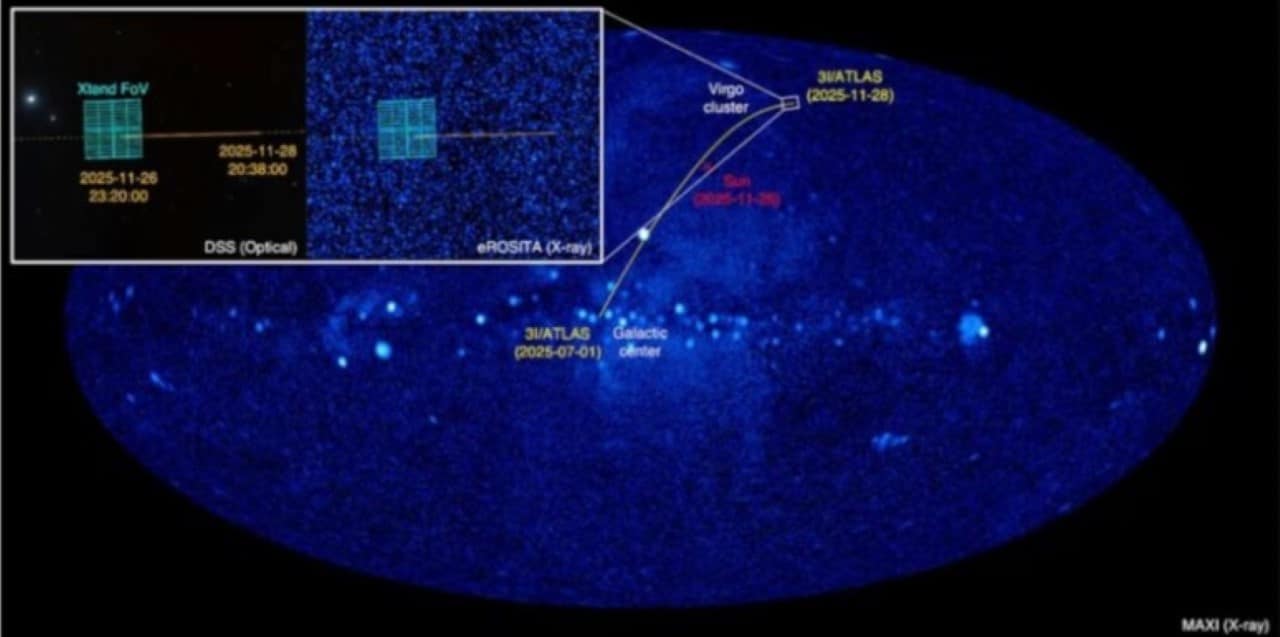
Scientists at NASA have confirmed the precise trajectory of a newly identified interstellar comet, provisionally designated 3I/Atlas, signaling a monumental opportunity for deep space observation in 2025. This celestial wanderer, originating from beyond our solar system, offers an unparalleled chance to study pristine material from another star system, potentially revolutionizing our understanding of planetary formation and the cosmos. Its journey through our neighborhood is anticipated to provide a wealth of data through advanced telescopic observations.
The discovery of an interstellar object is a rare event, with only a handful confirmed to date. These unique visitors are invaluable, providing direct samples of extrasolar material that otherwise remain unattainable. Comet 3I/Atlas promises to be one of the most thoroughly studied of its kind, given its projected visibility and the advanced observational capabilities available.
Initial detection of this intriguing object was made by the Asteroid Terrestrial-impact Last Alert System (ATLAS), a robotic astronomical survey system designed to detect near-Earth objects. Following this initial flagging, NASA-funded observatories and global partners quickly initiated follow-up observations to confirm its interstellar origin and refine its orbital path.
Unprecedented celestial visitor
Comet 3I/Atlas distinguishes itself with a highly eccentric, hyperbolic orbit, a definitive signature of an object that originated outside the gravitational influence of our sun. Unlike comets native to our solar system, which typically follow elliptical paths, 3I/Atlas is merely passing through, offering a fleeting glimpse into the composition of another stellar nursery. Its unique trajectory suggests it was ejected from its home star system long ago, traversing vast interstellar distances before its chance encounter with our sun.
The composition of 3I/Atlas is of particular interest to astrophysicists. Early spectroscopic data, though preliminary, indicates a potentially rich mixture of volatile compounds and silicates, differing from known solar system comets. Scientists hope to uncover clues about the conditions and elemental abundances present in its birthplace, providing a comparative study against the formation of our own solar system. This comparative analysis is critical for understanding the diversity of planetary systems across the galaxy.
NASA’s observational strategy for 2025
NASA is mobilizing a comprehensive array of observational assets for 3I/Atlas’s closest approach in mid-2025. The Hubble Space Telescope and the James Webb Space Telescope are slated to dedicate significant observation time to gather high-resolution imagery and detailed spectroscopic data. These powerful instruments will be crucial for analyzing the comet’s nucleus, coma, and tail, seeking out unique chemical signatures.
Ground-based observatories around the globe, including those operated by the National Science Foundation, will complement space-based observations. These facilities will track the comet’s movement, monitor its brightness, and contribute to a continuous data stream. The combined efforts aim to provide a multi-wavelength view of 3I/Atlas, capturing its behavior as it interacts with the sun’s radiation and solar wind.
International collaboration is a cornerstone of this ambitious observational campaign. Agencies such as the European Space Agency (ESA) and the Japan Aerospace Exploration Agency (JAXA) are coordinating their resources and expertise, pooling data to ensure the most complete scientific picture emerges. This global approach maximizes the chances of capturing critical data and mitigating potential gaps due to weather or instrument availability.
The journey of 3I/Atlas
The precise origin of Comet 3I/Atlas remains unknown, but its interstellar velocity suggests it traveled for millions, if not billions, of years through the cold vacuum of space. Astronomers are currently modeling potential trajectories to trace back its journey, perhaps identifying its original star system or a region of the galaxy known for stellar formation. This intricate detective work relies on sophisticated computational models and a deep understanding of galactic dynamics.
Its hyperbolic orbit, with an eccentricity significantly greater than one, unequivocally marks it as an interstellar visitor. This characteristic orbital path means it will not be gravitationally bound to our sun and will continue its journey back into interstellar space after its passage. Such objects provide a natural experiment, allowing scientists to observe materials untouched by the sun’s long-term influence.
Current projections indicate that 3I/Atlas will make its closest approach to the sun in the third quarter of 2025, reaching its perihelion well within Earth’s orbit. This proximity to the sun will cause it to brighten significantly, potentially making it observable even with smaller telescopes for a limited period. The specific dates and viewing windows are being continuously refined as more data becomes available, ensuring optimal planning for observational campaigns.
Following its perihelion, 3I/Atlas will rapidly accelerate away from the sun, eventually fading from view as it heads back into the interstellar void. The brief window of observation in 2025 is therefore critical, as it represents humanity’s only opportunity to study this particular object directly. Scientists are preparing for an intense period of data collection, knowing that every observation counts.
Scientific implications and future research
Studying 3I/Atlas offers an unprecedented window into the chemical diversity and physical processes occurring in protoplanetary disks around other stars. By analyzing its composition, scientists can infer the types of materials available for planet formation in its home system, comparing them to the building blocks that formed Earth and its neighbors. This direct comparison could confirm or challenge prevailing theories on planetary system evolution.
The data gathered will also contribute to a broader understanding of how objects are ejected from star systems and travel through the galaxy. Such ejections are common during the turbulent early stages of stellar formation or through gravitational interactions within dense star clusters. Analyzing 3I/Atlas’s trajectory and potential origin will help refine models of galactic migration and the distribution of matter across the cosmos.
Public engagement and viewing opportunities
The arrival of Comet 3I/Atlas in 2025 is expected to generate considerable public interest, much like previous high-profile cometary events. NASA and its partners are planning extensive public outreach initiatives, including live streams from observatories, educational materials, and guides for amateur astronomers. These efforts aim to engage the global community in this exciting scientific endeavor, fostering a deeper appreciation for space exploration.
While specific viewing details for amateur astronomers will be released closer to 2025, the scientific community is already buzzing with anticipation. The opportunity to directly observe material from another star is a rare and profound event, highlighting the dynamic nature of our galaxy and the endless possibilities for discovery. This comet’s passage serves as a potent reminder of the vast, unexplored universe beyond our immediate cosmic neighborhood.
Challenges in tracking interstellar objects
Tracking interstellar objects presents unique challenges for astronomers. Their high velocities and often unpredictable trajectories mean that detection and subsequent observation windows can be extremely narrow. Rapid response systems like ATLAS are crucial for initial identification, but sustained follow-up requires significant coordination and resource allocation. The sheer speed at which these objects traverse our solar system necessitates swift action to gather meaningful data before they disappear.