

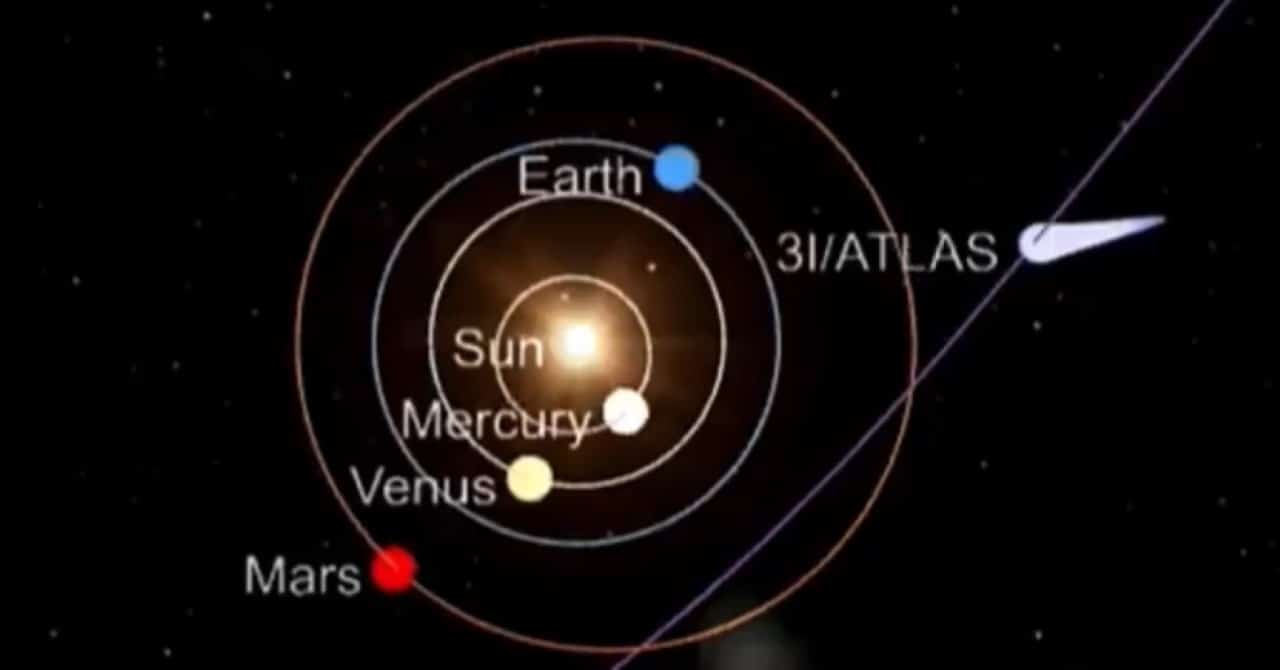
The interstellar comet3I/ATLAS, the third confirmed object coming from outside Sistema Solar, approaches the closest point to Terra on December 19, 2025. The minimum distance will be approximately 269 million kilometers, without any risk of collision. Recent Observações continue to record a protrusion directed at Sol, known as anti-tail, more than a month after perihelion in October.
This characteristic persists in images captured by ground-based telescopes in several countries. Astrônomos have been tracking the object since its discovery in July 2025, when Telescópio Espacial Hubble first identified the unusual structure. The anti-tail extends toward Sol, unlike the conventional comet tails of Sistema Solar.
- The object travels in a hyperbolic trajectory, confirming its interstellar origin.
- Its high speed indicates ejection from another star system.
- It presents no risk to Terra in its current passage.
Recent observations of the anti-tail
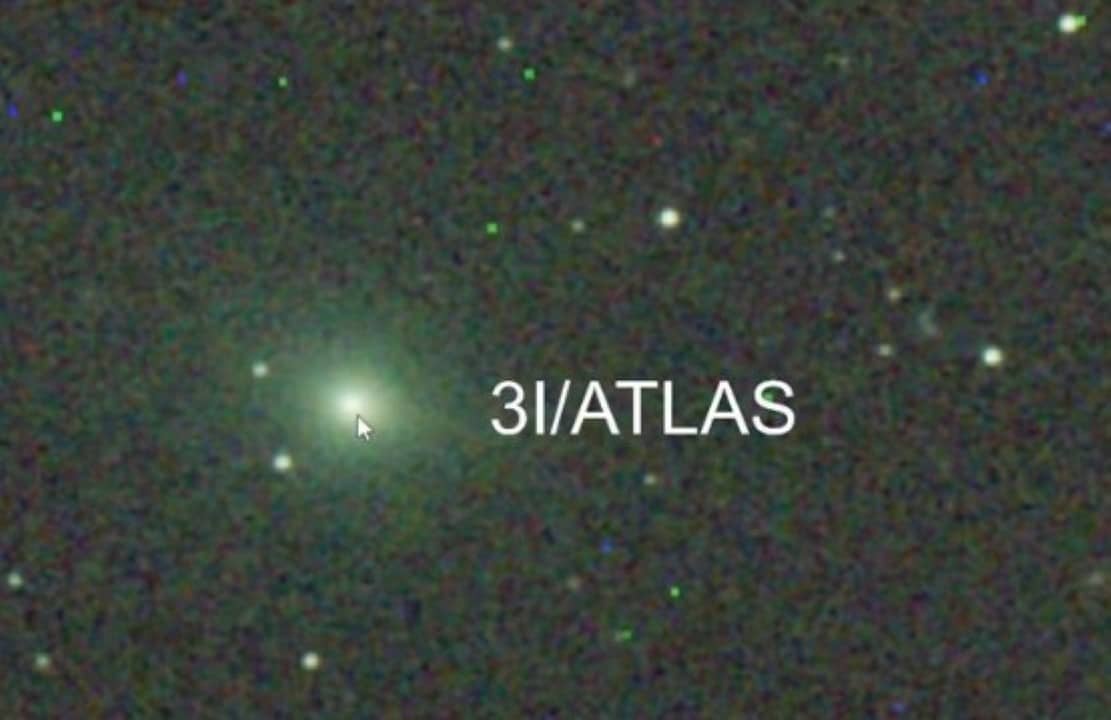
Images taken on December 13, 2025 by a telescope at Tailândia show the anti-tail prominent. Processing with rotational filters highlights the physical jet towards Sol. Essa structure does not result from perspective effect, as occurs in some solar comets.
Another capture from December 15 reveals an extension of more than 500 thousand kilometers. Essa dimension exceeds the average distance between Terra and Lua. The tight collimation of the jet, with an opening of around 8 degrees, draws the attention of experts.
Scientific explanations for the phenomenon
Experts propose that larger dust particles are ejected from the daytime side of the nucleus. Essas particles resist more solar radiation pressure and accumulate sunward. Outra hypothesis involves ice fragments sublimating before being repelled.
Some astronomers consider non-gravitational acceleration detected in the object. Dados from JPL indicate deviations in the trajectory compatible with material ejection. Estudos recent studies analyze periodic oscillation in the pre-perihelion anti-tail.
Trajectory and approach to Terra
3I/ATLASit passed perihelion on October 30, 2025, about 210 million kilometers from Sol. Após this passage emerged from the sun’s glare allowing new observations. On December 19, it reaches perigee 268.9 million kilometers from Terra.
Terrestrial and space telescopes focus their efforts on this window. Relative proximity facilitates detailed studies of composition and activity. The object moves out of the Sistema Solar after passing through.
Sunward Jet Features
The jet maintains a sunward direction even after gravitational deflection at perihelion. Observações indicate alignment of the axis of rotation with the solar direction at large distances. Período rotation estimated at about 15 to 16 hours derives from brightness variations.
Tight collimation extends over hundreds of thousands of kilometers without significant scatter. Essa configuration differs from typical behaviors in known comets. Dados from multiple observatories confirm the structure’s persistence.
Debates about the nature of the object
Some scientists attribute the anti-tail to natural sublimation processes. Poeira and ice explain the sunward accumulation in conventional models. Outros highlight unusual geometric and dynamic anomalies.
Studies indicate a low probability for observed alignments to occur by chance. Observações Future spectroscopic examinations may clarify the composition of the ejected material. The astronomical community awaits additional data from the nearby pass.
Implications for interstellar studies
3I/ATLASoffers a unique opportunity to analyze material from another star system. Sua chemical composition reveals conditions in environments far from Via Galáxia. Comparações with solar comets highlight differences and similarities.
Early detection allowed continuous monitoring from great distances. Telescópios like Hubble and Gemini provide high-resolution images. Safe passage reinforces the importance of planetary surveillance networks.
- Collimated anti-tail spans record distances.
- Axial alignment suggests specific core configuration.
- Oscillation detected indicates stable rotation.
- Maximum extension surpasses previous marks in comets.
Future observation perspectives
After December 19, the comet gradually moves away from Sol and Terra. Observações remain viable until the early months of 2026. Telescópios amateurs with medium equipment capture the object in the pre-dawn sky.
International projects coordinate efforts to maximize data collected. Análises post-passage will clarify riddles of the persistent anti-tail. The event reinforces advances in detecting interstellar visitors.



