

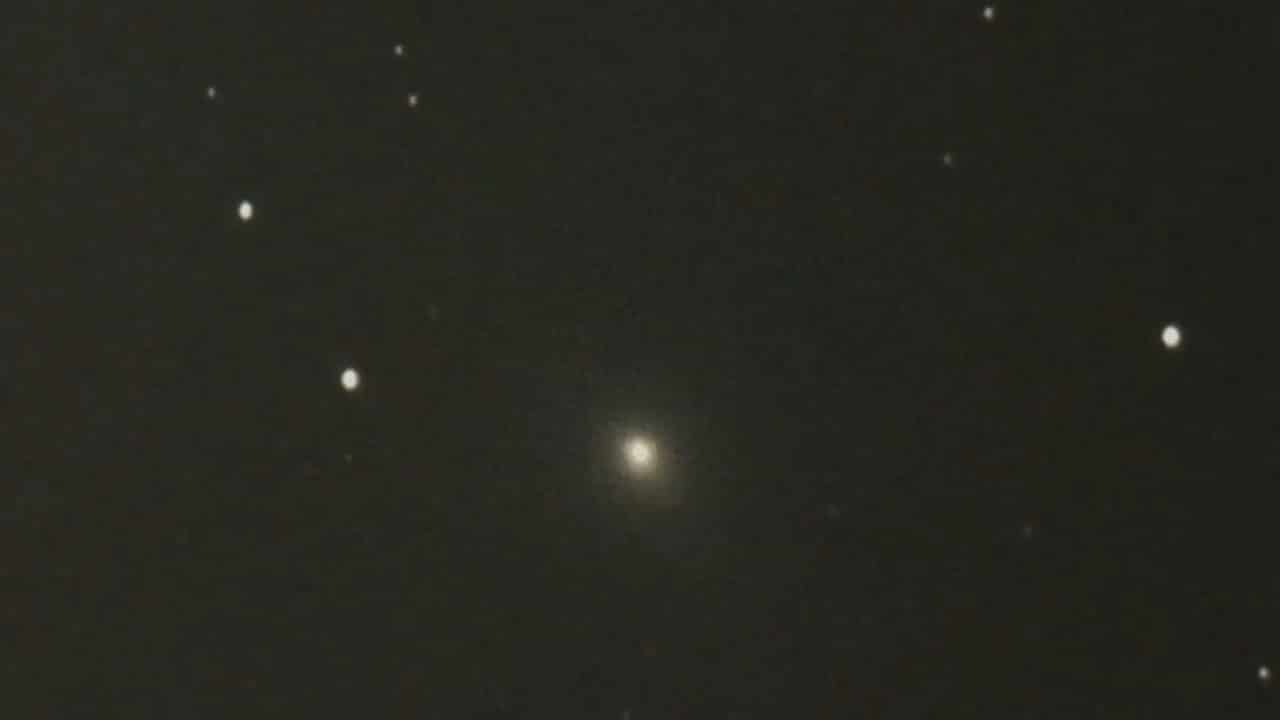
Comet 3I/ATLAS, the third interstellar object confirmed in Sistema Solar, will make its closest approach to Terra on December 19, 2025.
Scientists and astronomers from several institutions, such as PUC at Chile and UFRJ at Brasil, are dedicated to analyzing the unique characteristics of this cosmic visitor, which does not pose a risk of collision. The comet’s hyperbolic trajectory indicates that it will leave Sistema Solar definitively in the coming months.
These observations, carried out by advanced telescopes such as Hubble, NASA even confirmed that 3I/ATLAS is in fact a comet, adding yet another unique object of study to the astronomical catalog.
Unique features observed
The comet demonstrated non-gravitational acceleration, the presence of an “anti-calda” and an extensive cloud of gas that includes carbon dioxide. Tais phenomena challenge the usual understandings about the behavior of comets in our system.
Telescopes have detected X-rays coming from an interstellar object for the first time, as well as elements such as hydrogen and cyanide in its coma. Estas detections are crucial to understanding the chemistry of distant stellar environments.
Preliminary studies estimate its age at between 7 and 14 billion years, and its composition reveals a wealth of metals and organic matter, suggesting it was formed under conditions very different from those of our Sol.
Primordial chemistry in focus
Tomas Puzia, PUC astrophysicist at Chile, highlights the importance of phosphorus as a key element for confirming the ingredients of life in interstellar material. The presence of this element could redefine theories about panspermia.
Maria Elizabete Zucolotto, from UFRJ, emphasizes the combination of CHONPS (carbon, hydrogen, oxygen, nitrogen, phosphorus and sulfur) in organic forms. Entre they, organophosphates and amino acids are of particular interest.
Amanda Tozi, also from UFRJ, points to excess nickel and methane as indicators of distinct processes occurring in distant planetary systems. Esta anomaly may reveal new routes of molecular synthesis.
Marcelo Domingues, an amateur astronomer at Bramon, anticipates the presence of complex organic chemistry and isotopes that differ significantly from those found in our own solar system. Essas chemical signatures would be definitive proof of its external origin.
These findings suggest that the building blocks of life may form naturally in several regions of Via Láctea, expanding the likelihood of extraterrestrial life.
Tracing the stellar origin
Cristovão Jacques, from the SONEAR observatory, considers it essential to determine the comet’s stellar system of origin and compare its composition with that of its companion binary stars. Essa analysis can provide a cosmic “DNA”.
Carlos Fernando Jung, of Observatório Heller & Jung, suggests that dense structures and low erosion on the comet indicate fragments of an ancient planetary crust. Isso would imply that 3I/ATLAS could be a piece of a world that no longer exists.
The comet’s hyperbolic trajectory, with a speed exceeding 58 km/s, makes an accurate backprojection of its origin difficult due to galactic gravitational interactions over billions of years. The complexity of space motion on galactic scales adds a significant challenge to research.
Analysis indicates that 3I/ATLAS belongs to the thick disk of Via Láctea, a region composed of older stars with lower metallicity. Isso reinforces the idea that the comet carries traces of a primordial time in the galaxy.
Final surprises awaited
Gabriel Hickel, from Inpe, predicts the discovery of new molecules during the ejection of material or phenomena such as the partial fragmentation of the celestial body. Cada new molecule could be a clue to interstellar chemistry.
Observations are continually carried out by NASA and ESA missions, including XMM-Newton for X-rays and MAVEN for hydrogen studies. International collaboration is vital to cover all research fronts.
The comet will be visible to amateur telescopes in the pre-dawn sky until spring 2026, offering a rare opportunity for astronomy enthusiasts. Este extended visibility period allows continuous monitoring.
The passage of 3I/ATLAS opens up unique opportunities to study chemical and geological diversity beyond the boundaries of Sistema Solar, providing a natural laboratory for astrophysics.
Monitoring and cosmic legacy
Missions such as Psyche, Lucy and Perseverance monitored the comet from different distances, detailing its tail and coma. Multi-instrument observation capability provides a comprehensive view of the object.
Images from Gemini North show that the comet’s reddish color changes as its activity increases. Esta color variation may indicate changes in the composition or rate of ejection of gases and dust.
Ultraviolet data confirms the presence of a hydrogen halo and identifies separate sources of material ejection. Essas information is crucial for modeling the evolution of coma.
An international monitoring campaign, which includes the OON network, is modeling reactions to potential threats while simultaneously collecting scientific data.
3I/ATLAS confirms the rarity of interstellar object detections, following Oumuamua in 2017 and Borisov in 2019. Cada one of these objects offers a unique window into other stellar systems.
Its high speed and peculiar composition distinguish it from its predecessors, making it an even more intriguing object of study. The uniqueness of each interstellar visitor contributes to a more complete picture.
Future searches with state-of-the-art telescopes promise to reveal more similar objects, expanding our knowledge of the population of celestial bodies that travel between the stars.
Signs of its passage contribute significantly to the understanding of cosmic processes on galactic scales, helping to trace the history and dynamics of Via Láctea.



