

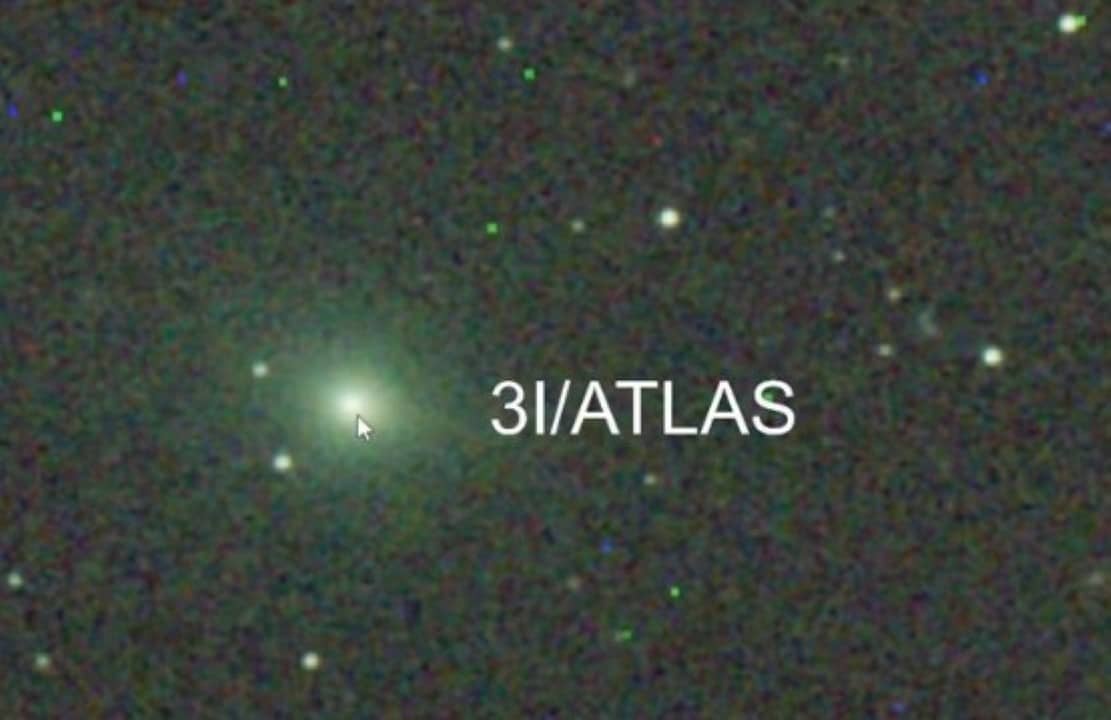
The comet3I/ATLAS, the third confirmed object coming from outside Sistema Solar, reached this Friday, December 19, 2025, the point of closest proximity to Terra, at around 270 million kilometers. Essa distance is equivalent to approximately 1.8 astronomical units, without any risk of collision or impact on the planet. Independent Observações carried out by ground-based and space telescopes confirmed that the object follows the predicted trajectory, remaining intact and now moving away towards deep space.
Discovered on July 1, 2025 by the ATLAS system on Chile, the3I/ATLAS(formally designated as C/2025 N1) follows a hyperbolic orbit, characteristic of bodies that are not gravitationally bound to Sol. Ele passed through perihelion, the closest point to Sol, on October 29, 2025, at 1.36 astronomical units. Desde then, the comet has been decreasing its activity, with a reduction in the release of gases and dust.

Several instruments captured images and data during the passage. Telescópios, as well as Hubble and James Webb, analyzed its composition, revealing the presence of a diffuse coma and a weak tail, with tones ranging from green to gold due to the evolution of ice sublimation.
Current trajectory
O 3I/ATLAScontinues its journey away from Sistema Solar after land approach. Ele is now heading for a close encounter with Júpiter in March 2026, when it will pass within about 0.36 astronomical units of the giant planet.
- This pass may allow additional observations by the Juno probe, which orbits Júpiter.
- After the flyby, the comet will accelerate into interstellar space, definitively abandoning Sistema Solar in the 2030s.
The object’s current speed exceeds 200,000 kilometers per hour, driven by solar gravity. Recent Observações indicate that the external coma is more diffuse, facilitating studies of the internal structure, although the nucleus remains invisible directly from Terra.
Recent observations
Amateur and professional astronomers recorded the3I/ATLASin real time during the approach. Imagens renders show a reddish, dust-rich coma similar to that of the previous interstellar comet 2I/Borisov.
- The apparent magnitude varies between 11 and 13 → requiring medium to large telescopes for viewing.
- Locations with low light pollution offered the best conditions, especially in the southern hemisphere.
Spectroscopic data collected by observatories such as Gemini North reveal constant activity, with no significant flare-ups in recent months. The core rotation, estimated to take about 16 hours, was confirmed by variations in the antitail.
Chemical composition
Preliminary analyzes indicate that the3I/ATLASIt has a composition rich in water and dust → with variations that suggest origin in a star system different from ours.
- Instruments such as SPHEREx have detected gas emissions → including possible traces of nickel in unusual proportions compared to local comets.
- The coma evolved from green tones, indicative of cyanide → to golden tones, signaling a reduction in gaseous activity.
Studies indicate that the object may be billions of years old, potentially older than Sistema Solar itself. Dust ejection, estimated at tens of kilograms per second in July, has decreased substantially.
Interstellar origin
O 3I/ATLASrepresents the third confirmed visitor from outside the central Via Láctea, after ‘Oumuamua and Borisov. Sua hyperbolic trajectory confirms that it was ejected from another star system, possibly by gravitational interactions with giant planets.
- Pre-discoveries date back to June 2025 → when the object passed through the dense galactic center.
- Cometary activity began at greater distances than usual → suggesting preserved primitive composition.
Research indicates that the comet may carry pristine material from interstellar clouds. Sua safe passage reinforces the rarity of these events, with only three detected in decades of monitoring.
Next steps
After leaving the terrestrial neighborhood, the3I/ATLASwill cross the orbits of outer planets in the coming years. The Juno probe may record data during the Jovian approach in March 2026.
- Observations remain a priority → to map the tail of debris and sodium emissions.
- Models predict that the object will reach full interstellar space in the 2030s → with an orbital period exceeding hundreds of thousands of years.
The scientific community has mobilized global networks of telescopes to collect unique data. Esses records contribute to understanding the formation of distant planetary systems.
Current visibility
The comet remains visible only with advanced equipment, positioned in the constellations of Leão and Virgem in the early hours of the morning. Aplicativos of astronomy assist in precise location.
- The current magnitude does not allow observation with the naked eye → unlike recent bright comets.
- Ideal conditions include clear horizons and the absence of urban light.
Recent images show elongation of the tail, with dust ejected at varying speeds. The stabilized activity indicates that the nucleus survived the solar passage intact.
O 3I/ATLASIt now heads into the interstellar void, taking with it valuable data on cosmic origins. Sua passage marked 2025 as a year of rare discoveries in the sky.



