


The interstellar comet 3I/Atlas, a cosmic visitor, reaches its closest proximity to Terra on December 19, 2025. Este astronomical event, awaited by scientists, marks the passage of the third confirmed object coming from outside our Sistema Solar. The established minimum distance is approximately 270 million kilometers, equivalent to approximately 1.8 astronomical units.
Discovered in July 2025 by the ATLAS telescope system at Chile, the comet follows a hyperbolic trajectory, which will take it back to interstellar space after this passage. Recent Observações indicate that the object shows typical comet activity, forming a coma and a tail.
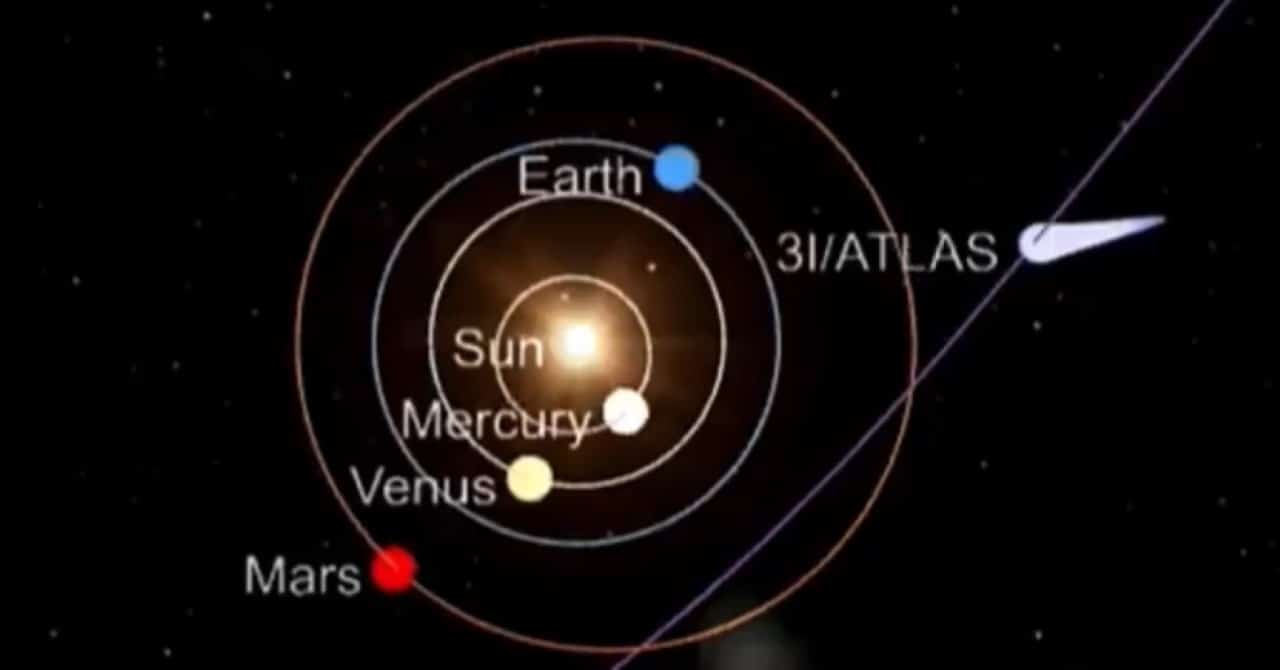
Despite its visibility and scientific importance, there is no threat to life on the planet, as reiterated by experts from NASA and international observatories. Rumores about a possible end of the world or climate change, which circulated on social networks, are categorically denied by the astronomical community.
The trajectory and size of the comet’s nucleus, estimated at between 440 meters and 5.6 kilometers, ensure that its gravitational influence on Terra will be insignificant, without any possibility of impact or significant change.
Historical approach and unique trajectory
The interstellar comet 3I/Atlas, a notable phenomenon for the scientific community, reaches its closest point to Terra on December 19, 2025. Este celestial body, which travels at speeds exceeding 200 thousand km/h, offers a rare opportunity to study the formation of objects in other stellar systems.
Its hyperbolic trajectory is a distinctive feature, confirming its origin external to Sistema Solar. Diferentemente of the comets that orbit Sol regularly, 3I/Atlas is just passing through, driven by an orbital eccentricity that will make it permanently escape solar gravity.
Recent studies indicate that the comet may preserve primordial material, dating back billions of years. Analyzing its composition can reveal crucial information about the initial conditions of other stellar systems and the chemistry of interstellar space.
Continuous discovery and monitoring
The detection of 3I/Atlas occurred in July 2025, thanks to the ATLAS telescope system, located at Chile. Desde then, a global network of observatories has been intensively monitoring its movement and characteristics, providing valuable data for astronomical research.
Observations of Telescópio Espacial Hubble, carried out in November 2025, captured detailed images of the comet when it was 286 million kilometers from Terra. Essas images revealed a reddish coma, indicating the presence of dust, and the emission of gases such as cyanide and atomic nickel, in concentrations similar to those of solar comets.
[[_0]
Myths and truths about the end of the world
The passage of comets often generates speculation and apocalyptic theories, and 3I/Atlas was no exception. Rumores disseminated on online platforms suggested that the approach could trigger catastrophic events or even the end of life in Terra. Contudo, science vehemently denies these claims.
World-renowned space agencies and astronomers, such as NASA, reiterate that the distance of 270 million kilometers between the comet and Terra is too great for any noticeable impact. The object remains well beyond the orbit of Marte throughout the period of its closest approach, eliminating risks of significant gravitational influence.
Experts emphasize that astronomical events like this are routinely studied and do not pose threats. Continuous Monitoramentos by ground and space telescopes, including the Virtual Telescope Project, allow real-time monitoring without any indication of danger. The scientific community seeks to enlighten the public, combating misinformation with concrete facts and verifiable data.
Chemical composition and cosmic enigmas
3I/Atlas has a chemical composition that intrigues scientists. Análises spectra confirmed the presence of carbon dioxide and atomic nickel, essential elements for understanding planetary formation processes in distant stellar environments. The elongated coma and the absence of large explosions indicate a relative stability of the comet during its passage through the inner Sistema Solar.
Comparisons with comets originating from our own solar system reveal similarities in some gas concentrations, but also notable differences in the proportion of volatiles. Essas variations suggest that 3I/Atlas may have formed at lower temperatures or in an environment with a different chemistry. Dados from the XMM-Newton X-ray observatory detected an X-ray glow extending hundreds of thousands of kilometers around the comet, a phenomenon that contributes to the study of the interaction between interstellar objects and the solar wind.
Scientific legacy and future discoveries
The visit of 3I/Atlas represents an important milestone in astronomy, reinforcing the rarity of interstellar objects detected to date. Sua in-depth analysis contributes significantly to theoretical models of comet ejection by distant stellar systems, helping to understand the dynamics of Via Láctea.
The event also highlights the global scientific community’s coordinated response capacity to cosmic visitors. Data collected during this passage, including observations of Gemini North that recorded greenish hues in the coma in November 2025, will allow refinements in age estimates and primordial composition. Futuras discoveries of similar objects will depend on the continuation of tracking programs like ATLAS, which are crucial for planetary defense and the advancement of astronomical knowledge.
Looking to the future of interstellar research
After its closest approach to Terra on December 19, 3I/Atlas’s brightness will gradually dim as it moves away on its return journey to interstellar space. Astrônomos will continue to monitor the comet as much as possible, with the object still visible in pre-dawn skies to amateur equipment until spring 2026. Este extended tracking is vital to capturing all the nuances of its behavior.
Preliminary studies already point to cryovolcanism as a possible explanation for the jets observed on the comet’s surface. The ability to study an object so distant and so ancient offers an unprecedented perspective on the diversity of celestial bodies in our galaxy and beyond. Cada new data is a step towards unraveling the mysteries of the universe and better understanding the vastness of the cosmos.



