

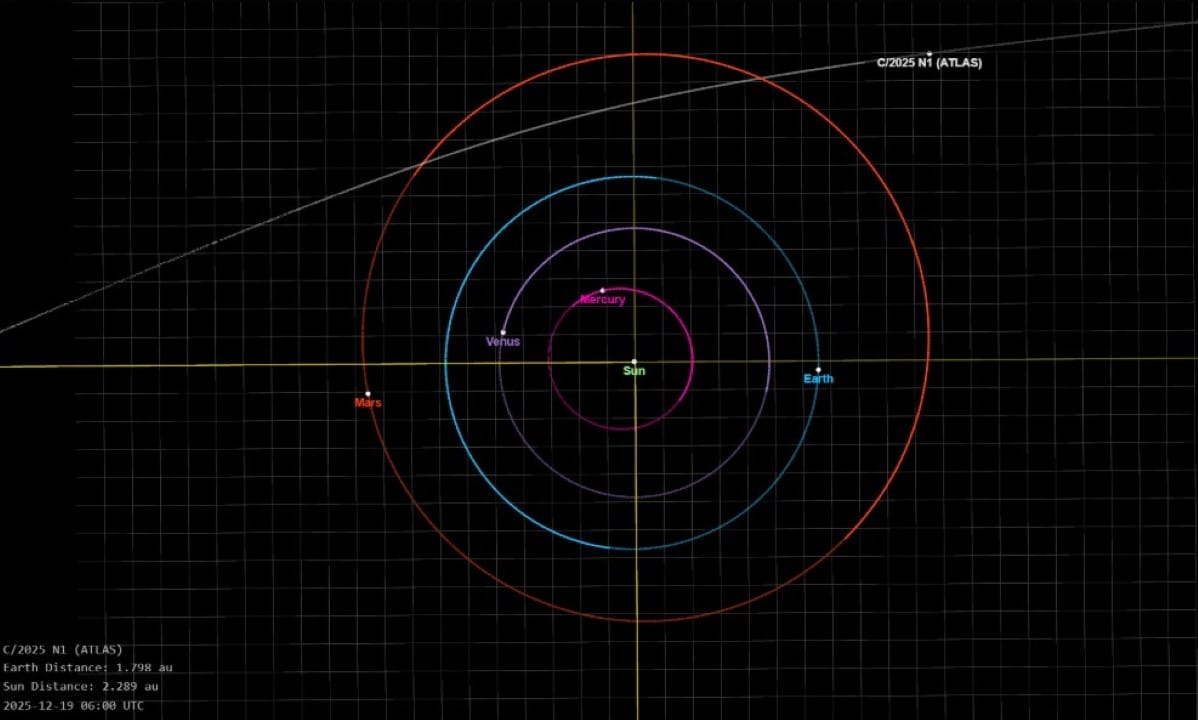
A celestial phenomenon, comet 3I Atlas, continues to captivate the scientific community, with NASA preparing for intensified observation campaigns in 2025. This distant icy body, formally designated C/2019 Y4 (ATLAS), was first detected by the Asteroid Terrestrial-impact Last Alert System (ATLAS) in Hawaii. Its journey through the solar system has presented unique opportunities for researchers to study cometary evolution and composition, offering critical insights into the early history of our cosmic neighborhood. The anticipated close approach, though not precisely a “close shave” with Earth, positions it favorably for advanced telescopic and spectroscopic analyses, promising a treasure trove of new data.
Astronomers globally are keenly awaiting the next phase of observations, focusing on its potential for outgassing and fragmentation, behaviors that have historically made comets both fascinating and unpredictable. The comet’s trajectory and intrinsic brightness variations have made it a subject of continuous study since its initial discovery.
Key aspects under scrutiny include:
- Its volatile material composition.
- The mechanisms driving its coma and tail formation.
- Potential for future fragmentation events.
A cosmic visitor’s journey through fragmentation
The journey of comet 3I Atlas through the inner solar system has been marked by both spectacular outbursts and unexpected dimming events. Initially, scientists predicted it could become a naked-eye object in 2020, but a significant fragmentation event in April of that year led to its rapid disintegration and a dramatic decrease in brightness. This event, observed by multiple ground-based and space telescopes, provided invaluable data on the structural integrity and volatile content of comets originating from the Oort Cloud.
Despite its initial fragmentation, residual pieces of the comet continue on their orbital path, offering a unique case study in cometary dynamics. Researchers are now leveraging advanced computational models to predict the behavior of these remnants and their interaction with solar radiation and particle streams. The ongoing observation of these fragments into 2025 aims to clarify whether further disintegration is imminent or if stable, smaller cometary bodies will persist.
Nasa’s pivotal role in tracking celestial objects
NASA’s involvement in tracking comet 3I Atlas has been comprehensive, utilizing a suite of instruments and telescopes to gather data across various wavelengths. The Hubble Space Telescope provided crucial high-resolution imagery of the comet’s fragmentation, revealing dozens of distinct pieces drifting away from the primary nucleus. Beyond visible light, observations from infrared and radio telescopes have allowed scientists to analyze the chemical composition of the comet’s gases and dust, identifying molecular species like water, carbon monoxide, and various organic compounds. This multi-messenger approach is essential for building a complete picture of cometary interiors and the processes that govern their activity as they approach the sun, contributing significantly to our understanding of the delivery of volatiles to early Earth.
Unveiling cometary secrets from the Oort Cloud
Unveiling cometary secrets from 3I Atlas has pushed the boundaries of planetary science. The comet’s initial brightness spike indicated a rapid release of frozen volatiles, a common characteristic of “new” comets making their first pass near the Sun.
Subsequent observations, however, revealed a more complex picture, suggesting a layered structure within the nucleus. This layering could imply different formation environments or evolutionary paths for various cometary materials.
Scientists are particularly interested in the ratio of water ice to other frozen gases, which provides clues about the temperature and pressure conditions in the distant Oort Cloud where 3I Atlas originated. Understanding these ratios helps refine models of the solar system’s formation.
The data collected has also contributed to ongoing debates about the source of Earth’s oceans and the building blocks of life. Comets are thought to have played a significant role in delivering water and organic molecules to our planet billions of years ago.
Preparing for 2025 observations and data analysis
Preparations for intensified observations of 3I Atlas in 2025 are well underway, involving a global network of observatories. Ground-based telescopes equipped with advanced adaptive optics will attempt to resolve finer details of any surviving fragments, while space-based assets will provide an unobstructed view free from atmospheric interference.
These coordinated efforts aim to capture any renewed activity or further fragmentation, providing real-time data to refine cometary models. The scientific community is eager to apply new analytical techniques to the expected influx of information, ensuring maximum scientific return from this unique celestial event.
Public viewing prospects and challenges
Public viewing prospects for comet 3I Atlas in 2025 remain limited due to its diminished state and distant trajectory. While dedicated amateur astronomers with powerful telescopes may catch glimpses of its remnants, it is not expected to be a prominent object for casual stargazers.
Broader implications for science and planetary defense
The study of comets like 3I Atlas has broader implications for planetary defense and astrobiology. Understanding their composition and orbital dynamics is crucial for developing strategies to mitigate potential impacts from similar objects in the future.
Furthermore, these icy wanderers are considered pristine time capsules, preserving material from the solar system’s birth. Analyzing their volatile content helps scientists trace the origins of water and organic molecules crucial for life.
The continuous monitoring by NASA and international partners ensures that every celestial visitor, even those that fragment, contributes valuable knowledge to humanity’s quest to understand the cosmos.