


New research, released on December 19, 2025, details the most recent observations of the interstellar comet 3I/ATLAS taken in November. The data reveals persistent anomalies that challenge conventional comet models based on nuclear activity.
Astronomers have identified unique features such as an unusually stable jet and sustained non-gravitational acceleration over several months. Esses findings indicate an activity mechanism distinct from typical ice sublimation processes.
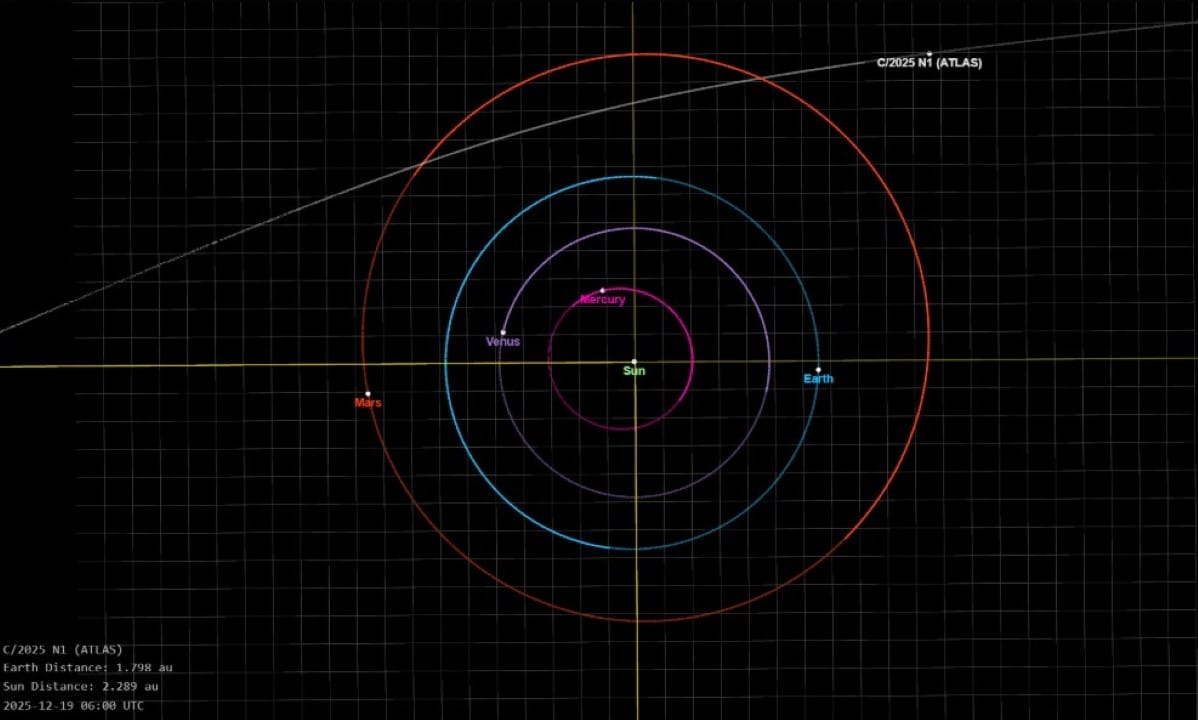
Designated as the third interstellar object ever catalogued, comet 3I/ATLAS surpassed its perihelion in October and has been monitored by ground- and space-based telescopes, providing unprecedented insight into its enigmatic nature.
Anomalous coma and jet behavior
Research has established that the rotation period of the comet’s coma is approximately 16 hours. Contudo, current models cannot explain the lack of significant rotation in the jet of material and gas emanating from the nucleus.
The comet’s jet remains largely stable and maintains a consistent direction for several consecutive hours. Essa constant directionality is an unusual feature for comets in our solar system, where jets often exhibit dynamic variations.
The observed stability of the jet defies expectations based on typical comets, which often show spiral patterns or orientation changes due to nucleus rotation and irregular sublimation of volatiles.
These observations point to the possibility that gas emissions from 3I/ATLAS are driven by global internal factors rather than localized activity at the core’s surface, suggesting an atypical composition and structure.
This collective evidence suggests the possibility of gas emission driven by global internal factors, which contradicts the standard understanding of how comets behave as they approach Sol.
[[_0]
Details about the internal gas wrap
The internal coma of comet 3I/ATLAS has a dense envelope of gas that remains stable. Esta singular characteristic remains practically unchanged in relation to the rotation of the coma, indicating a cohesive structure.
This envelope demonstrates little change in rotational motion, suggesting a fixed position relative to the comet’s nucleus. Observations carried out in November confirmed the persistence of this formation.
The low intrinsic activity observed in this envelope is consistent with a coma that is not dominated by core sublimation. Isso implies a reduced abundance of dust and gas emission controlled by different mechanisms.
Prolonged non-gravitational acceleration
The comet’s A3 nongravitational acceleration exhibited a small decrease over approximately 180 days, a period of stability that exceeds predictions from traditional comet models. Essa constancy in acceleration is one of the most intriguing aspects of the 3I/ATLAS.
Revised trajectory data, provided by minor planet centers, reinforces the stability of this acceleration. The initial consistency of the observation was maintained, defying the expectation of a more pronounced reduction as the comet moved away from Sol, as occurs with objects in our system.
4.3 micrometer spectral signature
Spectral analysis of the comet reveals the presence of a 4.3 micrometer band, a signature that is generally associated with the presence of carbon dioxide or carbon monoxide. Esta detection is crucial to understanding the volatile composition of the object. The intensity and depth of this band, however, are inconsistent with typical gas emissions expected from a comet in its active phase, suggesting unusual chemical processes or an internal distribution of volatiles. Observações Additional external observations confirmed the existence of an as-yet-unidentified organic compound, which strengthens the hypothesis of complex internal chemical processes and the preservation of interstellar volatiles.
Implications for comet models
The particularities observed in comet 3I/ATLAS call into question existing models that describe the behavior of comets originating in the solar system. The jet’s stability and prolonged non-gravitational acceleration indicate that the physical and chemical processes that govern it are fundamentally different.
This interstellar object requires the development of new theoretical frameworks to explain its dynamics and composition. Current research suggests that the conditions for the formation and evolution of comets in other stellar systems may be significantly different from those we know.
Additional research and monitoring
This study points to a vast potential for future observations related to the comet’s coma and spectral bands. The expectation is that the uniform behavior of the jet will persist, offering more opportunities for detailed study.
It will be essential to continue examining the stability of the A3 parameter and confirming the signature of the 4.3 µm band. Essas investigations will help consolidate understanding of the mechanisms of comet activity.
Unique opportunity for planetary science
Comet 3I/ATLAS, with its unusual chemical signatures and origin outside the solar system, represents an unparalleled opportunity for scientific research. Sua trajectory offers a rare window to study comet formation.



