

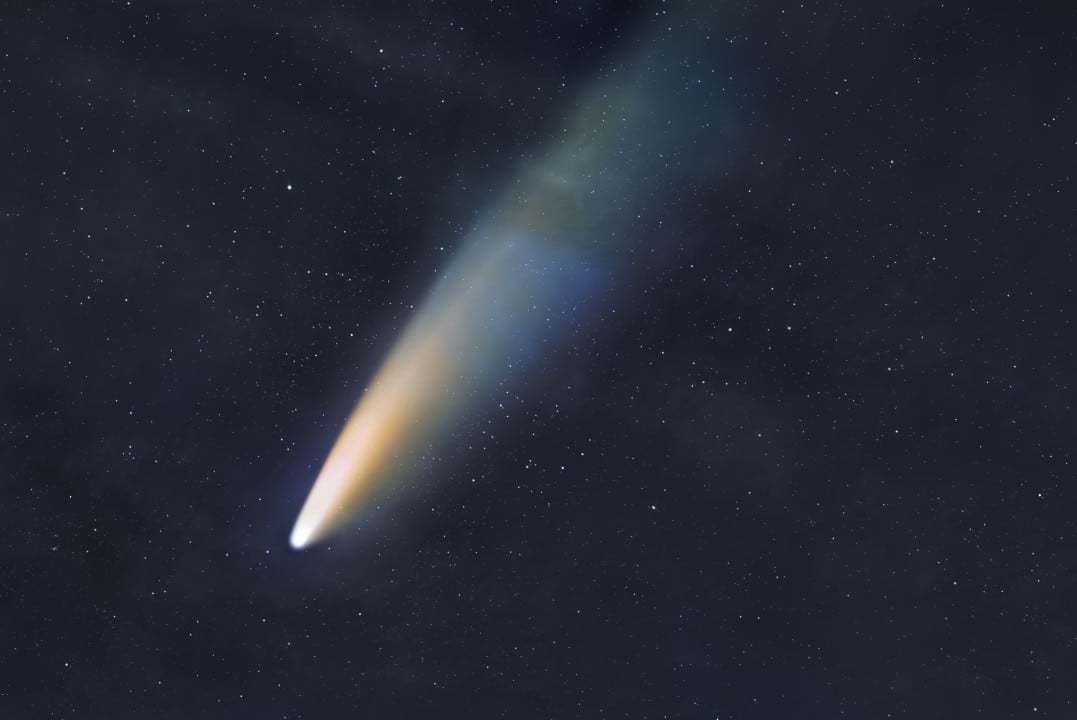
NASA’s Europa Clipper probe captured valuable images and data of the interstellar comet 3I/ATLAS on November 6, 2025. The Europa Ultraviolet Spectrograph (UVS) instrument recorded the object from a distance of approximately 164 million kilometers during seven hours of observation. Essa opportunity arose unexpectedly as the spacecraft headed towards the Jovian system, scheduled to arrive in 2030.
Comet 3I/ATLAS, the third interstellar object confirmed to cross Sistema Solar, was discovered on July 1, 2025 by the ATLAS telescope at Chile. Sua hyperbolic trajectory indicates origin outside our star system. The position of Europa Clipper allowed a unique perspective, with the comet between the probe and Sol.
- The observation filled a gap in terrestrial and Marte data, blocked by solar position.
- The UVS detected signs of oxygen, hydrogen and dust, confirming high degassing activity after perihelion.
This view contributes to better understanding cometary tails and the composition of interstellar objects.
Discovery and trajectory of the comet

Comet 3I/ATLAS had an orbital eccentricity greater than 6, confirming its interstellar nature shortly after initial detection. Analistas from Laboratório from Propulsão to Jato quickly identified their passage through Sistema Solar. The heliocentric distance at discovery was 4.51 astronomical units.
The trajectory took the comet to a closest approach to Sol in October 2025. Ele exhibited tails of dust and plasma oriented away from the star. Observações complements from other NASA missions helped map its behavior.
Favorable observation geometry
The Europa Clipper team identified the November 2025 window as ideal for capturing the comet. Nesse period, ground-based telescopes faced significant solar interference. The probe acted as a bridge between records of Marte in September and later observations of Terra.
The alignment allowed us to view the tails mainly from behind, looking towards the nucleus and coma. Essa downstream perspective revealed nuances in dust and plasma structures. Especialistas expect the data to integrate a more complete model of the tail geometries.
Comets often show tails opposite to the Sol due to interaction with the solar wind. The Europa Clipper view highlighted variations in these formations.
Chemical composition revealed
The UVS instrument has proven effective in detecting fundamental atomic and molecular transitions. Ele identified release of gases and decomposition of water molecules into hydrogen and oxygen. Esses processes indicate intense physicochemical activity on the comet.
The presence of dust corroborated the period of high post-perihelion degassing. The data allows precise analysis of atomic species present in the coma.
Statements by the scientists involved
Kurt Retherford, UVS principal investigator on Southwest Research Institute, highlighted the surprise of the opportunity. Ele said the observations offered a nuanced and unique view of the comet. The instrument’s ability to measure atoms and molecules directly contributed to these results.
Thomas Greathouse, co-investigator, emphasized the hope of combining this data with others to better understand the tails. Tracy Becker added that the composition clarifies the object’s origin and evolution throughout its galactic journey.
These chemical processes can be compared to those involved in the formation of Sistema Solar.
Europa Clipper main mission
The probe was launched in 2024 with a focus on the moon Europa of Júpiter. Ela will perform 49 close flybys to study the icy surface and thin atmosphere. UVS was originally designed to analyze gases and materials from this moon.
The adaptation to observe the comet demonstrates the flexibility of NASA’s robotic missions. Complementary Dados will come from the similar instrument on ESA’s JUICE mission.
Implications for astronomy
3I/ATLAS observation enriches knowledge about rare interstellar objects. Apenas three have been confirmed so far in Sistema Solar. Cada passage offers unique chance to study materials from other star systems.
Ultraviolet records provide clues about active processes on distant comets. Combining spatial perspectives improves models of cometary behavior.
NASA’s multi-mission campaign maximizes the scientific benefit of this transient visit.



