


The HANBIT-Nano rocket, developed by the South Korean company Innospace, suffered an anomaly minutes after liftoff from Centro from Lançamento from The mission, known as Operação Spaceward, represented the first commercial orbital launch from Brazilian territory and ended with the vehicle colliding with the ground, followed by an explosion. Não there were records of victims or damage beyond the predicted safety area.
Força Aérea Brasileira (FAB) confirmed that the vehicle began the vertical trajectory as planned, but detected the irregularity shortly afterwards. Equipes from FAB and Corpo from Bombeiros were mobilized immediately to analyze the wreckage in the controlled zone. Todas security, tracking and data collection measures were carried out within international space sector standards.
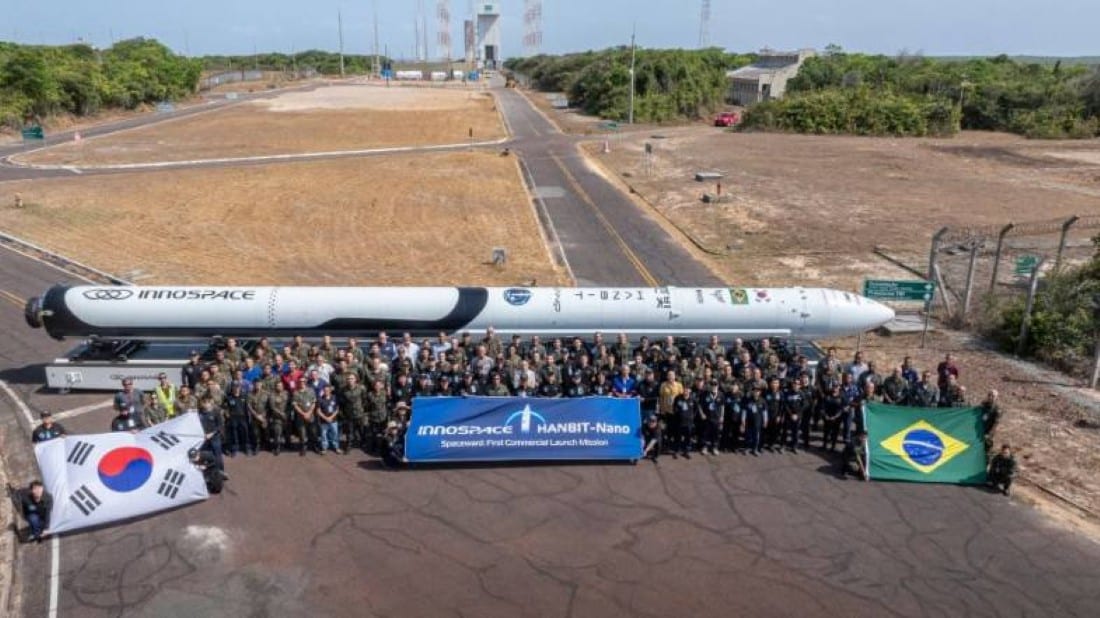
Innospace interrupted the live transmission shortly after the start of the flight, displaying a message about the detected anomaly. The two-stage rocket, approximately 21 meters high, used hybrid propulsion and carried eight payloads, including Brazilian and Indian experiments.
- Two Universidade Federal and Santa Catarina nanosatellites for low-power communication tests.
- Educational satellite with solar panel technologies and messages from students in local communities.
- Additional navigation experiments and integrated systems.
Spaceward operation details
Operação Spaceward involved around 400 professionals, 300 of whom were Brazilian military personnel. The partnership between FAB, Agência Espacial Brasileira (AEB) and Innospace aimed to position the Centro of Lançamento of Alcântara in the global small launcher market. The base in Maranhão offers geographical advantages due to its proximity to the Equador line, reducing the consumption of propellant necessary to reach orbit.
The launch has suffered previous postponements due to technical issues, such as valve problems and weather conditions. The window of opportunity closed on December 22, which led to the final attempt at night. Apesar of the failure, the safety protocols worked, containing the impact in the designated area.
innospace’s position after the incident
The CEO of Innospace, Kim Soo-jong, released a letter to shareholders expressing apologies for not completing the mission. Ele highlighted that, approximately 30 seconds after takeoff, the anomaly was identified, activating security measures to direct the vehicle to the protected land zone. The company collaborates with Brazilian authorities in the detailed investigation of the causes.
Kim Soo-jong emphasized obtaining valuable data during the initial flight. Esses records will serve to improve the technical reliability and design of HANBIT-Nano in future attempts.
Payloads onboard the hanbit-nano
The rocket carried five satellites and three non-separable experiments, focusing on national technologies. Instituições like Universidade Federal from Maranhão and Brazilian startups contributed with small devices, such as cubesats weighing up to three kilos.
- Communication system for Internet from Coisas with low energy consumption.
- Testing of advanced navigation instruments and solar panels.
- Indian cargo complementing scientific experiments.
The failure prevented insertion into low orbit at an altitude of 300 kilometers, the mission’s main objective.
Technical characteristics of the vehicle
The HANBIT-Nano measures 21.8 meters in height, with a diameter of 1.4 meters and a mass of approximately 20 tons at takeoff. Seu hybrid engine combines solid fuel and liquid oxidizer in the first stage, offering capacity for up to 90 kilograms of payload in synchronized orbit with the Sol.
Innospace has developed the technology internally since 2017, with previous tests of suborbital prototypes at Alcântara in 2023. The model represents progress for small launchers on the international market.
Investigation and next steps
Technical teams from Innospace and FAB analyze telemetry and debris to determine the origin of the anomaly. Cooperation includes regulatory bodies such as AEB, responsible for licensing the operation.
Despite the setback, the incident provides information for future corrections. The Alcântara base maintains operational infrastructure, ready for new commercial launch campaigns.
Strategic advantages of alcantara
The location 2.3 degrees south of Equador allows savings of up to 30% in propellant compared to bases at higher latitudes. Essa advantage attracts international companies interested in small satellite constellations.
The Centro of Lançamento of Alcântara has operated under FAB administration since the 1980s.
The Brazilian space program seeks greater autonomy through updates to policies such as Programa Nacional of Atividades Espaciais. Iniciativas public-private companies expand access to the sector, even with technical challenges inherent to inaugural flights.



