


The commercial dollar closed this Tuesday, December 23, 2025, down 0.95%, quoted at R$5.5313. Essa devaluation marked the interruption of a sequence of seven consecutive high sessions, influenced by factors such as the cancellation of an interview scheduled by former president Jair Bolsonaro and favorable economic data.
The market reacted positively to the absence of political statements that could generate additional volatility. Paralelamente, the preview of Brazilian inflation and international indicators contributed to the retreat of the American currency.
In the year 2025, the dollar will depreciate by around 10.5% against the real. The Ibovespa, the main index of the Brazilian Bolsa of Valores, advanced more than 1%, surpassing the 160 thousand points mark.
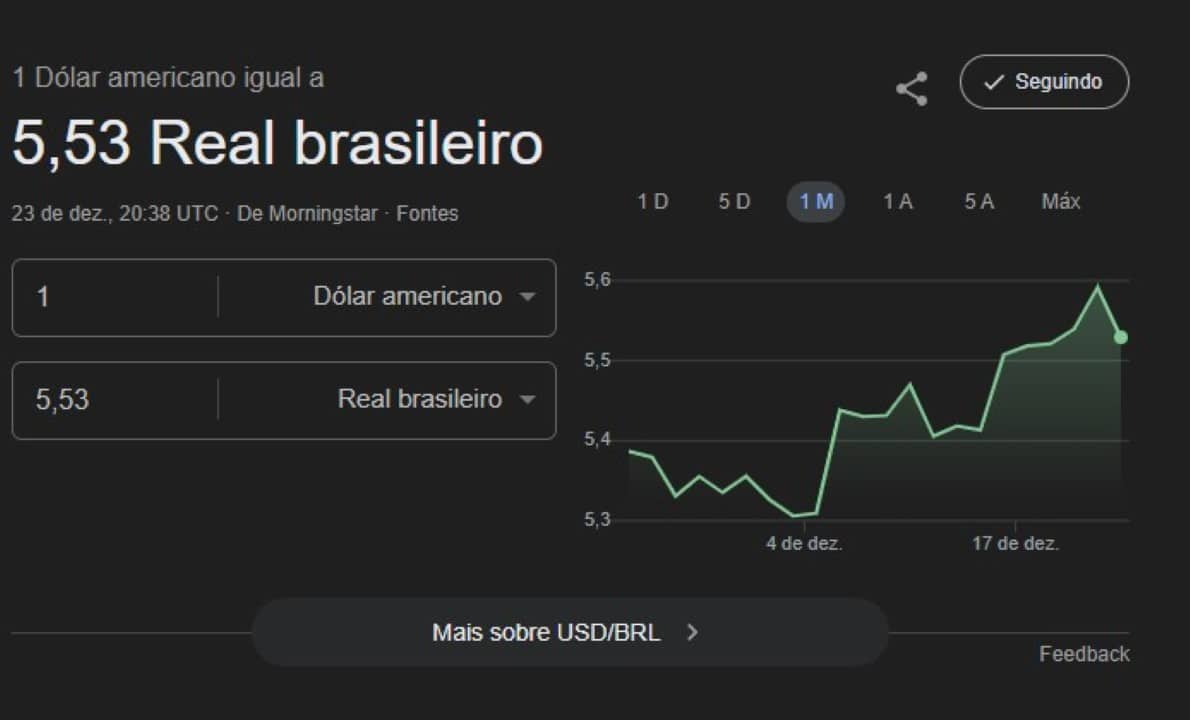
Intraday exchange rate movements
The spot dollar opened the day with moderate fluctuations, registering a maximum of R$5.596 and a minimum of R$5.530 in the first hours. The turn towards negative territory gained strength throughout the session, reflecting investors’ risk appetite.
The dollar futures contract for January, the most traded on B3, followed the movement and fell 1.08%, closing at R$5.5375. Essa synchrony between the spot and futures market demonstrated consistency in the perception of relief in exchange rate pressures.
Influence of the domestic political scenario
The cancellation of the interview that Jair Bolsonaro would give to the portal Metrópoles, citing health issues, reduced uncertainty in the financial market. Autorizada by Supremo Tribunal Federal, the statement was awaited as a possible signal about political support for 2026.
Operators reported that the absence of new declarations avoided potential electoral noise in an already sensitive period. Esse factor directly contributed to the improvement in investors’ mood throughout the day.
Banco Central intervention
Banco Central held two line auctions, with a total offer of US$2 billion in dollar sales with repurchase commitments. The monetary authority accepted proposals worth US$500 million, injecting partial liquidity into the market.
This operation aimed to meet seasonal demands at the end of the year, common during periods of external remittances. Apesar partial acceptance, the auction helped contain additional pressure on the price.
Brazilian inflation preview data
The IPCA-15 registered an increase of 0.25% in December, a result slightly below market projections, which expected 0.27%. Year-to-date, the indicator closed at 4.41%, within the established inflation target.
This number reinforced expectations of consolidation in the disinflation process in the country. Economistas highlight that the data leaves room for possible adjustments in monetary policy in 2026.
- Food and beverages: moderate high influenced by seasonal items.
- Transport: positive contribution with fuel adjustments.
- Housing: controlled variation despite energy pressures.
International economic indicators
Produto Interno Bruto of Estados Unidos grew 4.3% in the third quarter of 2025, an annualized rate above previous estimates. Esse robust performance supported consumer spending and business investment.
Abroad, the dollar showed general weakness against other currencies, benefiting emerging assets such as the real. Índices Americans traded with mixed variations, but optimism prevailed in global markets.
Performance of Ibovespa in the session
The main B3 index advanced around 1.3%, closing above 160 thousand points for the first time in weeks. Setores as banks and commodities led gains, reflecting renewed risk appetite.
Shares of large companies, such as Petrobras and Vale, registered significant appreciation. Trading volume remained high despite the proximity of the Natal holiday.
End-of-year seasonal factors
Remittances of profits and dividends by foreign companies intensify demand for dollars in December. Esse seasonal flow usually puts pressure on the exchange rate, but was mitigated by the combination of positive factors in this session.
Analysts point out that reduced liquidity in the coming days could amplify movements. The Brazilian market closes operations before Natal, resuming only after the holiday.
Projections for the exchange rate in 2026
Economists maintain dollar expectations at high levels at the beginning of next year, influenced by American interest rates. Boletim Focus slightly adjusted projections for the end of 2025, but signals relative stability.
Factors such as the Brazilian trade balance and fiscal policies will continue to be on the radar. The real demonstrated resilience throughout 2025, accumulating significant gains.
- Trade balance: surplus projected for December.
- International reserves: maintained at high levels.
- Interest rates Selic: debates on future cuts.
Reactions from economic analysts
Banco Inter experts highlight the consolidation of disinflation despite monthly variations. Eles project weaker inflation in the first quarter of 2026, paving the way for adjustments in the basic interest rate.
Other institutions reinforce that the favorable external scenario benefits emerging currencies. The real appreciated in line with peers such as the Mexican peso and other currencies in the region.
Annual context of the foreign exchange market
Throughout 2025, the dollar fluctuated between high levels in moments of global tension and declines in phases of optimism. The accumulated devaluation reflects capital inflows and robust exports.
Banco Central acted on several occasions to smooth volatility. International reserves remained comfortable, supporting interventions when necessary.
The Brazilian financial market ended the year with mixed indicators, but positive signs in the final stretch. The combination of internal and external data favored the real in this last full session before the holidays.



