NASA prepares for intensive 2025 study of unique interstellar visitor 3I Atlas, promising new cosmic insights

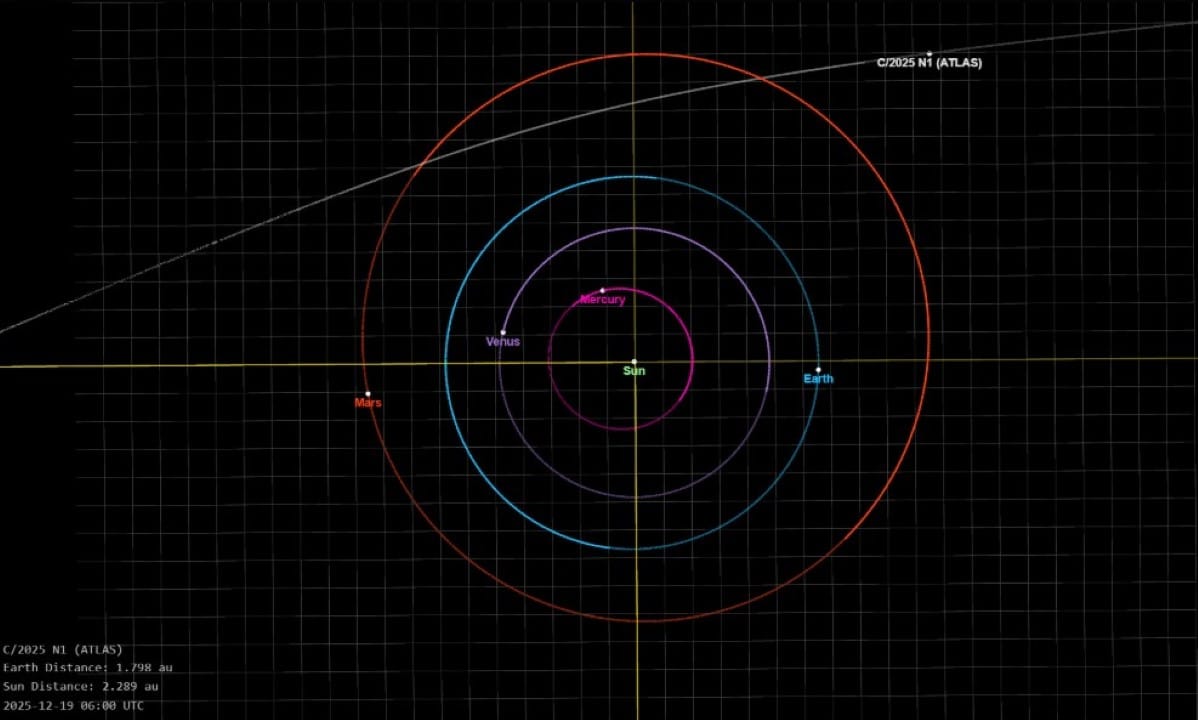
Scientists at NASA are making extensive preparations for a groundbreaking observational campaign in 2025, focusing on the enigmatic celestial body designated 3I Atlas. This object, believed to be the third confirmed interstellar visitor of its kind observed by humanity, has captured the attention of astronomers worldwide due to its unusual trajectory and potential to offer unprecedented insights into the composition of matter from beyond our solar system. Researchers anticipate that the close-up observations planned for the coming year will utilize an array of advanced instruments, providing a rare opportunity to analyze pristine material that has traveled vast cosmic distances, shedding light on the chemical makeup of other star systems and the processes that govern their formation. The scientific community is buzzing with anticipation, hoping to unlock secrets about the universe’s broader cosmic neighborhood.
Initial detections of 3I Atlas were made by the Asteroid Terrestrial-impact Last Alert System (ATLAS) in late 2024, which first flagged its distinctive hyperbolic orbit. This trajectory immediately indicated an origin outside the Sun’s gravitational influence, setting it apart from typical comets and asteroids. Its rapid approach and unique spectral signature have further fueled speculation about its truly alien nature.
Early data suggests 3I Atlas exhibits characteristics not commonly found in objects originating from the Oort Cloud or Kuiper Belt, prompting a reassessment of our understanding of solar system formation and evolution. Key preliminary findings include:
Unraveling 3I Atlas’s interstellar mystery
The designation “3I” signifies 3I Atlas as the third interstellar object identified, following ‘Oumuamua and Comet 2I/Borisov. Each discovery has progressively enhanced our ability to detect and characterize these cosmic wanderers, providing valuable data points on the prevalence and diversity of objects traveling through the Milky Way. Its peculiar characteristics are igniting new theories about planetary formation in distant star systems.
Astronomers are particularly keen to determine if 3I Atlas formed under conditions vastly different from those within our own protoplanetary disk. Its composition could reveal details about the elements and processes available in other stellar nurseries, offering a comparative study that was once only theoretical. This could potentially redefine our models of how planets and smaller bodies originate across the galaxy.
Advanced observational campaigns in 2025
For 2025, NASA and its international partners are mobilizing telescopes and instruments across the globe and in space to maximize data collection from 3I Atlas. The Hubble Space Telescope and the James Webb Space Telescope are slated for dedicated viewing windows, aiming to capture high-resolution images and spectroscopic data. These powerful observatories will be critical in discerning the object’s fine details and chemical makeup.
Ground-based observatories, including those in Hawaii and Chile, will contribute to the effort by tracking 3I Atlas’s precise trajectory and monitoring its activity as it passes through the inner solar system. The combined data from these diverse platforms will create a comprehensive picture of the object, from its macroscopic features to its molecular components. This multi-pronged approach ensures that no stone is left unturned in the pursuit of scientific understanding.
Furthermore, scientists are preparing for potential transient events, such as outbursts or fragmentation, which could provide additional clues about the object’s internal structure and stability. The readiness to respond to such dynamic phenomena is a testament to the meticulous planning involved in this ambitious observational campaign.
The ATLAS survey: A sentinel of the cosmos
The Asteroid Terrestrial-impact Last Alert System (ATLAS), a robotic astronomical survey system developed by the University of Hawaii and funded by NASA, has once again proven its invaluable role in celestial discovery. ATLAS operates a network of telescopes designed to detect near-Earth objects (NEOs) that might pose an impact threat. Its wide-field search capabilities also make it highly effective at spotting unusual comets and asteroids far from Earth.
The system continuously scans the night sky, identifying moving objects against the backdrop of fixed stars. Its automated detection algorithms are adept at flagging anomalies, which then trigger follow-up observations by other telescopes. The rapid response capability of ATLAS is crucial for objects like 3I Atlas, which appear suddenly and move quickly through our cosmic neighborhood.
Beyond its primary mission of planetary defense, ATLAS has become a prolific discoverer of comets, supernovae, and now, interstellar objects. Its sustained operation provides a vital early warning system for both potential hazards and scientific opportunities, demonstrating the broad utility of dedicated sky surveys. The continuous improvement of its hardware and software ensures that ATLAS remains at the forefront of astronomical discovery.
Unprecedented data collection and analysis
The 2025 observational period for 3I Atlas promises to yield an unprecedented volume of data, far exceeding what was collected for previous interstellar visitors. Advances in astronomical instrumentation and data processing techniques will allow scientists to extract maximum information from every observation. This includes detailed spectroscopy to identify specific molecules and elements, as well as photometric studies to understand its rotation and surface properties.
Dedicated teams of researchers worldwide are preparing specialized analytical pipelines to handle the incoming flood of information. The goal is to rapidly process and interpret the data, allowing for quick adjustments to observation strategies based on real-time findings. This dynamic approach is essential for thoroughly characterizing an object that will only be visible for a limited window.
Understanding cosmic origins
Studying 3I Atlas offers a unique window into the processes of planet formation and chemical evolution in other star systems. Unlike meteorites or samples from our own solar system, interstellar objects carry direct evidence from alien environments. Their analysis could confirm or challenge current theories about how stars and planets assemble themselves across the galaxy.
Public engagement and future prospects
NASA plans to share updates on 3I Atlas regularly throughout 2025, engaging the public with this fascinating interstellar journey. The excitement generated by such discoveries helps foster a greater appreciation for space science and encourages future generations to pursue careers in astronomy and related fields.