

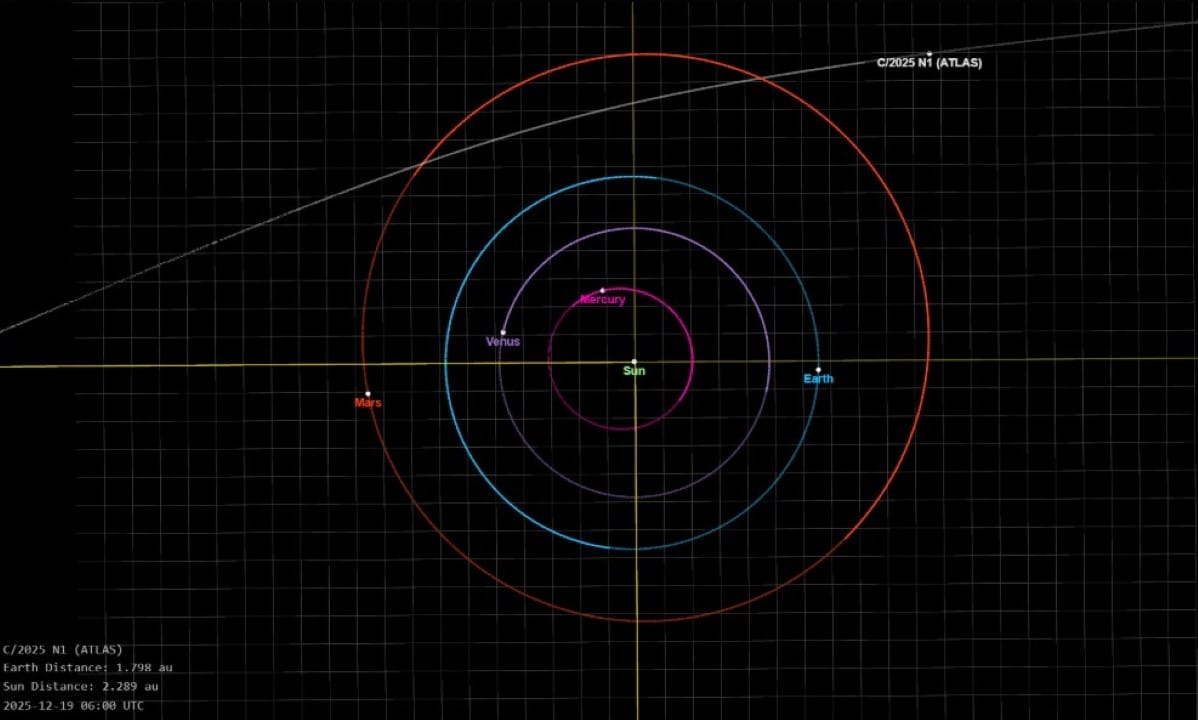
Scientists at NASA are continuing their extensive analysis of data collected from the fragmented Comet 3I Atlas (C/2019 Y4), a celestial event that captivated astronomers worldwide in 2020. The ongoing research in 2025 provides crucial insights into the volatile nature of comets and their intricate interactions within our solar system. This sustained investigation underscores the importance of monitoring these icy wanderers, particularly those exhibiting unusual behaviors.
The comet’s unexpected disintegration several years ago delivered an unprecedented opportunity for detailed observation, revealing critical information about cometary composition and structural integrity. Researchers are leveraging advanced computational models and refined observational techniques to piece together the events that led to its breakup. This long-term study is instrumental in validating theories about cometary evolution and the forces that shape these ancient remnants.
Observations from various space-based and ground-based telescopes, including the Hubble Space Telescope, contributed to a rich dataset that continues to yield discoveries. The detailed images and spectroscopic data from 2020 remain a cornerstone for understanding how comets, often described as “dirty snowballs,” respond to the increasing thermal and tidal stresses as they approach the Sun.
3I Atlas’s initial discovery and early promise
Comet 3I Atlas was initially discovered in December 2019 by the ATLAS (Asteroid Terrestrial-impact Last Alert System) robotic astronomical survey system in Hawaii. Its rapid brightening in the early months of 2020 quickly generated significant excitement within the astronomical community, leading to speculation that it might become a spectacular naked-eye comet.
The comet’s trajectory indicated a relatively close approach to both Earth and the Sun, making it a prime candidate for intensive study. Early observations suggested a large, active nucleus, fueling hopes for a celestial show that would engage both professional astronomers and the public.
The dramatic fragmentation of a celestial body
However, the comet’s behavior took an unexpected turn in March 2020 when it began to visibly fragment into multiple pieces. This dramatic disintegration was closely monitored by astronomers globally, including those at NASA, transforming the object from a potential spectacle into a unique scientific case study.
The fragmentation process provided a rare, real-time glimpse into the internal structure of a comet, an event seldom observed with such clarity. Scientists watched as the main nucleus broke apart, creating a trail of smaller icy debris that continued along the original orbital path, albeit with diminishing brightness.
NASA’s observational tools and data collection
NASA played a pivotal role in observing the fragmentation of Comet 3I Atlas, deploying some of its most powerful assets. The Hubble Space Telescope, with its unparalleled resolution, captured stunning images of the comet’s breakup, revealing dozens of distinct fragments drifting away from the primary nucleus.
These detailed observations allowed scientists to track the individual fragments, measure their sizes, and analyze their trajectories. Such precise data collection is crucial for understanding the forces at play during cometary disintegration, from thermal stresses to rotational forces.
Beyond Hubble, other NASA-supported instruments and ground-based telescopes provided complementary data, including spectroscopic analyses that shed light on the chemical composition of the comet’s interior. This multi-instrument approach has created a comprehensive record of the event, enabling ongoing research in 2025 to delve deeper into its implications.
Scientific significance of studying comet fragmentation
The fragmentation of comets like 3I Atlas offers invaluable scientific insights into several key areas of planetary science. Firstly, it provides direct evidence of the internal structure and composition of these ancient bodies, which are thought to be pristine remnants from the early solar system. Observing how they break apart reveals layers and materials that would otherwise remain hidden.
Furthermore, studying these events helps scientists understand the physical mechanisms responsible for cometary activity and evolution. The stresses imposed by solar heating and tidal forces from the Sun can cause rapid outgassing and structural failure, and 3I Atlas offered a clear example of these processes in action, enhancing our predictive models for other comets.
Ongoing analysis and new models in 2025
In 2025, scientists are still meticulously analyzing the vast trove of data from Comet 3I Atlas, employing advanced simulations to reconstruct the events of its fragmentation. New models are being developed that integrate thermal, rotational, and gravitational forces to better predict how similar comets might behave under stress.
The insights gained are contributing to a refined understanding of how cometary nuclei are held together and what factors lead to their demise. Researchers are particularly focused on identifying any patterns or precursors to fragmentation that could be observed in other comets currently being tracked.
This long-term analytical effort is also informing the design and objectives of future space missions aimed at studying comets up close. Understanding the resilience and fragility of these objects is paramount for missions that might attempt to sample or even deflect comets in the future.
The legacy of 3I Atlas continues to resonate within the scientific community, emphasizing the dynamic and unpredictable nature of celestial objects. The detailed records from its breakup serve as a critical reference point for all subsequent cometary observations and theoretical developments.
Implications for understanding cometary evolution
The detailed study of Comet 3I Atlas’s fragmentation provides crucial context for understanding the broader processes of cometary evolution. It offers tangible evidence for how comets lose mass, change their structure, and ultimately contribute to the dust and gas in the inner solar system, influencing planetary atmospheres over cosmic timescales.
Future research directions and related findings
The knowledge gleaned from 3I Atlas is directly influencing future research priorities at NASA and other space agencies. Scientists are now better equipped to identify and characterize potentially unstable comets, enhancing planetary defense strategies and improving our overall understanding of small body dynamics. Key areas of focus include:
- Developing more sophisticated computer models to simulate cometary fragmentation under various conditions.
- Enhancing observational techniques to detect subtle changes in cometary nuclei that might precede a breakup event.
- Prioritizing targets for future missions that could provide direct measurements of cometary interior structures.
The lessons from 3I Atlas continue to shape our approach to studying these enigmatic visitors from the outer reaches of our solar system, ensuring that each new cometary encounter builds upon a robust foundation of past observations and analyses.