
NASA readies for 2025 close study of mysterious 3I Atlas comet, promising new solar system revelations

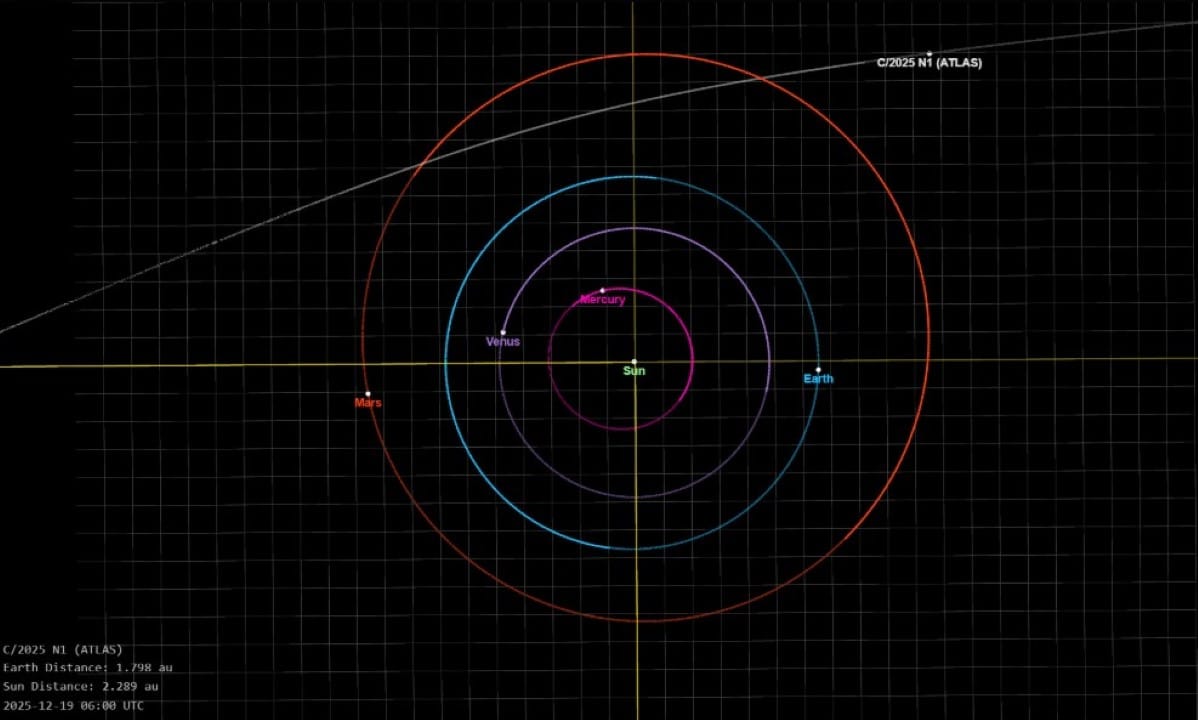
The scientific community is buzzing with anticipation as NASA prepares for an intensive observation campaign targeting comet 3I Atlas, expected to make a significant approach to Earth in 2025. This celestial visitor, unique in its composition and trajectory, offers an unparalleled opportunity for astronomers to gather critical data on the early solar system and the origins of cometary bodies. Its journey through the inner solar system provides a rare window into distant cosmic phenomena, captivating both researchers and the public alike.
Discovered initially as an interstellar object, 3I Atlas has since been reclassified based on refined orbital mechanics, confirming its unique characteristics that set it apart from typical comets originating from the Oort Cloud or Kuiper Belt. This reclassification has only intensified interest, suggesting it might harbor pristine material from beyond our immediate solar neighborhood. Such an object could hold clues about the formation processes of other star systems, offering comparative insights into our own.
NASA’s upcoming mission will leverage a suite of advanced telescopes and instruments, both terrestrial and space-based, to meticulously track and analyze the comet. The ambitious project aims to capture high-resolution images, spectroscopic data, and compositional analyses that could redefine our understanding of cometary science. Preparations are already underway, ensuring that every available resource is optimized for this fleeting astronomical event.
Unveiling the comet’s mysterious origins
Comet 3I Atlas presents a fascinating puzzle for planetary scientists due to its unusual orbital characteristics and presumed interstellar beginnings. Initial observations hinted at its extra-solar origin, sparking widespread excitement about studying material from another star system. While further analysis has placed it firmly within our solar system’s gravitational influence for now, its distinctive properties continue to suggest a complex and perhaps varied past.
The precise mechanisms by which 3I Atlas entered its current trajectory remain a subject of active research. Scientists hypothesize it may have been gravitationally captured during a close pass with a giant planet or experienced a series of subtle gravitational nudges over millennia. Understanding this trajectory is crucial for predicting its future path and ensuring optimal observation windows during its 2025 approach.
NASA’s advanced mission for 2025
NASA’s strategic planning for the 3I Atlas observation in 2025 involves a multi-pronged approach, integrating data from various global astronomical facilities. This collaborative effort ensures comprehensive coverage and diverse data acquisition, maximizing the scientific return from the comet’s close passage. Key observatories like the Hubble Space Telescope and the James Webb Space Telescope are expected to play pivotal roles.
Specialized instruments will focus on analyzing the comet’s coma and tail, seeking out volatile compounds, organic molecules, and isotopic ratios that can reveal its primordial composition. The goal is to detect signatures of materials that may have been present during the formation of our own solar system, offering a direct comparison with theories of planetary accretion. Ground-based telescopes, equipped with adaptive optics, will complement space observations by providing continuous tracking and broader contextual views.
Furthermore, a dedicated team of scientists and engineers is refining observation schedules and data processing protocols to handle the expected influx of information. This includes developing new algorithms to filter out atmospheric interference for ground-based observations and to reconstruct three-dimensional models of the comet’s nucleus. The sheer volume and complexity of the data demand a sophisticated analytical framework to extract meaningful insights.
The journey of 3I Atlas through our solar system
Comet 3I Atlas follows an elongated elliptical orbit, bringing it periodically close to the sun and Earth, before swinging back into the colder, more distant reaches of the solar system. Its current trajectory indicates a perihelion (closest approach to the sun) coinciding with its closest proximity to Earth in mid-2025, making it a prime target for detailed study. This timing is fortuitous, allowing researchers to observe the comet at its most active.
Its journey is not without historical context; astronomers have meticulously traced its path, noting subtle gravitational interactions with various planetary bodies. These interactions provide valuable data for refining orbital models and understanding the long-term dynamics of comets within our solar system. Such detailed tracking helps confirm its classification and provides a foundation for future predictions.
The comet’s current velocity and orbital inclination suggest it has spent a significant portion of its existence in the outer solar system, preserving much of its original volatile content. This makes it an ideal candidate for studying the conditions present during the solar system’s infancy, before significant alteration by solar radiation and planetary interactions. Scientists believe it acts as a time capsule, preserving clues from billions of years ago.
Understanding the full extent of 3I Atlas’s journey, from its hypothesized origin to its current path, is key to unlocking its secrets. Researchers are particularly interested in any past close encounters with gas giants, which could have influenced its composition or structure through tidal forces or impacts. These past events could explain some of its unique characteristics observed today.
Technological advancements enabling deeper insights
Recent advancements in astronomical instrumentation and data analysis techniques are poised to revolutionize the study of comet 3I Atlas. New spectrometer designs offer unprecedented sensitivity, allowing for the detection of trace elements and complex organic molecules in the comet’s coma that were previously beyond reach. These improvements are critical for understanding the building blocks of life potentially delivered by comets.
Additionally, enhanced adaptive optics systems on Earth-based telescopes can now compensate for atmospheric distortions with greater precision, yielding clearer images and more accurate spectroscopic data than ever before. This technological leap means that observations from the ground will complement space-based missions with near-comparable quality for certain analyses, expanding the scope of the 2025 campaign.
Potential scientific breakthroughs from cometary studies
The comprehensive study of comet 3I Atlas in 2025 holds the promise of significant scientific breakthroughs, potentially reshaping our understanding of planetary science and astrobiology. By analyzing its composition, astronomers hope to gain clearer insights into the distribution of water and organic compounds in the early solar system, which are crucial for the emergence of life. If 3I Atlas indeed carries material from outside our solar system, its study could offer the first direct chemical comparison between our protoplanetary disk and those around other stars, providing invaluable data for exoplanet research and the search for extraterrestrial life. This mission represents a pivotal moment in our ongoing quest to comprehend the vastness and complexity of the cosmos, pushing the boundaries of what is observable and knowable about our cosmic neighborhood and beyond.
Public engagement and viewing opportunities
While direct viewing of comet 3I Atlas may require specialized equipment, NASA and various astronomical organizations plan to offer extensive public outreach programs in 2025. These initiatives will include live streams from powerful telescopes, expert commentary, and educational resources, allowing a global audience to participate in this exciting astronomical event. Citizen science projects may also be launched, inviting enthusiasts to contribute to data analysis.


