


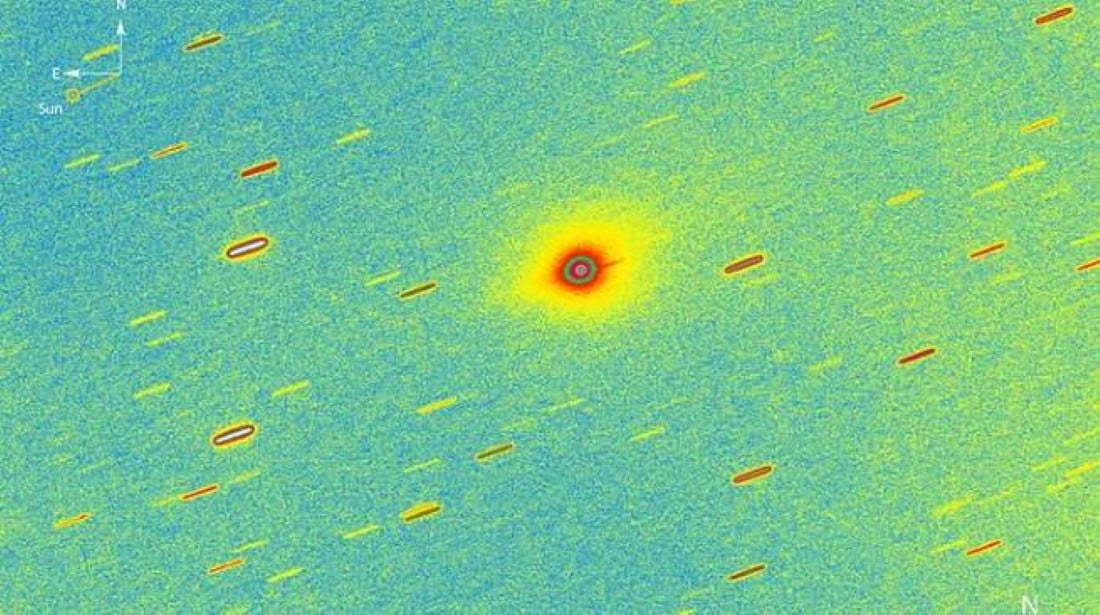
Interstellar object3I/ATLASrecords anti-tail jet with particles larger than common in recent observations. Imagens captured in December 2025 shows a collimated jet heading towards Sol, with a length of at least 400 thousand kilometers. Astrônomos analyze the phenomenon, which differs from typical comets from Sistema Solar. The brightness of the jet suggests the dominance of particles larger than the dust that scatters sunlight efficiently.
Filter-processed observations reveal narrow, long structure of the sunward jet. Dados indicate that particles need to overcome solar deceleration to reach such a length. Cálculos point to high initial velocities in larger grains. The object, the third confirmed interstellar, remains under monitoring after passing close to Sol.
- Submicron particles face strong solar radiation pressure.
- Larger grains resist deceleration better and maintain a sunward trajectory.
- Rate of mass loss estimated at hundreds of kg per second supports model.
Recent observations of the jet
Images from December 13 and 15, 2025 highlight collimated jet processed by amateur and professional astronomers. The jet appears in the opposite direction to the conventional tail, pointing towards Sol. Filtros and Larson-Sekanina enhance the gradient structure. Observadores in Itália, Tailândia and other locations record an extension of more than 400 thousand km.
This configuration persists after perihelion in October 2025. The object’s current Distância at Terra is around 270 million km. Projeções indicate minimum approach on December 19. Telescópios terrestrials capture details despite the distance.
Particle size in the jet
Calculations based on solar dynamics constrain particle radii between specific values. Grãos smaller than 1 micron suffer strong radiative repulsion and do not reach the observed length. Partículas larger than 100 microns face difficulty in acceleration due to gaseous drag. Intermediate Faixa explains collimation and jet extension.
Assumed solid density of 1 g/cm³ enters the models. Required initial Velocidade varies inversely with the square root of the radius. Comparação with solar comets shows typical dominance of fine dust. Aqui, larger grains contribute more to sunward glow.
This difference generates debate about the natural origin of the object. Modelos of ice sublimation predict standard behavior. Explicações alternatives consider exotic sources for arbitrary speeds. Dados future spectroscopic devices may measure Doppler displacement.
Sunward jet collimation
Jet has a narrow angular opening, around 8 degrees. Liberação occurs on a small fraction of the surface of the nucleus. Colimação suggests focusing on a limited region. Observações post-perihelic maintain characteristic.
Comparison with known comets reveals the rarity of this persistent configuration. Geometric Projeção excludes perspective effect. Imagens from multiple telescopes confirm real physical structure. Análise of pre-perihelic wobble indicates alignment with axis of rotation.
Upper and lower limits
Maximum particle radius is restricted by gaseous transport efficiency. Tempo of jet dilution imposes condition on distance from the nucleus. Núcleo greater than certain limits is incompatible with data from Hubble. Valores modest mass loss adjust restrictions.
Very large particles reduce surface area per mass and scatter less light. Equilíbrio explains brightness observed in long jet. Medições direct velocity measurements via spectroscopy refine estimates. Dados of space telescopes complement terrestrial observations.
Context of observations
Object discovered in July 2025 maintains continuous scientific attention. Hyperbolic Trajetória confirms interstellar origin. Cometary Atividade includes coma and varied tails. Imagens recent focus on sunward anomaly.
Monitoring continues with global telescopes. Distância increasing after terrestrial approach reduces future brightness. Accumulated Dados allows comparisons with previous objects. Dynamic Estudos improve evolution models.
Implications for dynamic models
Solar radiative pressure dominates deceleration in small grains. Vento solar contributes less to dust. Equações of movement derive minimum required speeds. Resultados are incompatible with perfect drag in a natural comet.
Post-perihelic mass loss rate estimated at 500 kg/s. Densidade of the jet declines with the square of the distance. Tempo of drag must overcome dilution for effective acceleration. Restrições imposed favor a specific size range.



