


The interstellar object 3I/ATLAS, the third confirmed visitor from outside Sistema Solar, passed through the closest point to Terra on December 19, 2025, at a distance of approximately 269 million kilometers. Descoberto on July 1, 2025 by the ATLAS system in Chile, the exocomet has attracted attention due to the presence of an anti-tail directed at Sol, with a length of at least 400 thousand kilometers. Astrophysicist Avi Loeb, from Harvard, highlighted that the particles responsible for the brightness of this jet are larger than those common in natural comets.
Recent processed images show the anti-tail highly collimated, with particles that do not follow the pattern expected for fine dust entrained by sublimation gases. Loeb argues that the observed speed and length are only possible with grains with a radius greater than 1 micron and less than 100 microns. The Essa feature differentiates 3I/ATLAS comets from the Sistema Solar, where smaller particles dominate the brightness.
- The anti-tail appears in observations from December 2025, even after perihelion in October.
- The narrow collimation suggests release of material from a small fraction of the core surface.
- Comparisons with 1I/’Oumuamua and 2I/Borisov show differences in composition and behavior.
Discovery and trajectory of 3I/ATLAS
3I/ATLAS was initially identified as a hyperbolic object, confirming an interstellar origin shortly after detection by the ATLAS telescope at Chile. Preliminary Observações indicated cometary activity, with a coma and tail, leading to the additional designation as a comet. Sua retrograde trajectory and aligned with the ecliptic plane contributed to immediate scientific interest.
The object reached perihelion on October 29, 2025, at about 1.4 astronomical units from Sol. Após this passage continued to display tail and anti-tail structures in images from ground-based and space telescopes. The approach to Terra in December allowed detailed observations, without risk of impact.
Features of anti-tail
The anti-tail of 3I/ATLAS extends toward Sol, contrary to the typical pattern of cometary tails pushed by solar radiation pressure. Imagens processed with filters reveals a narrow and long jet, longer than the Terra-Moon distance. Essa structure persists in observations from November and December 2025.
Tight collimation indicates that particles are released in a targeted manner, possibly from specific regions of the nucleus. Estudos Complementary spectroscopy has detected gases such as cyanide, but the focus remains on the solid particles that dominate the visible glow.
Analysis of ejected particles
Avi In the case of 3I/ATLAS, the long anti-tail requires larger grains, with greater inertia against deceleration. Essa property prevents ordinary fine dust from explaining the observation.
The grains must be entrained by outflowing gases to reach observed velocities, while maintaining sufficient size to resist solar pressure. Faixas of radius between 1 and 100 microns meet these criteria, differing from solar comets where submicron particles prevail.
Recent observations of the collimated jet
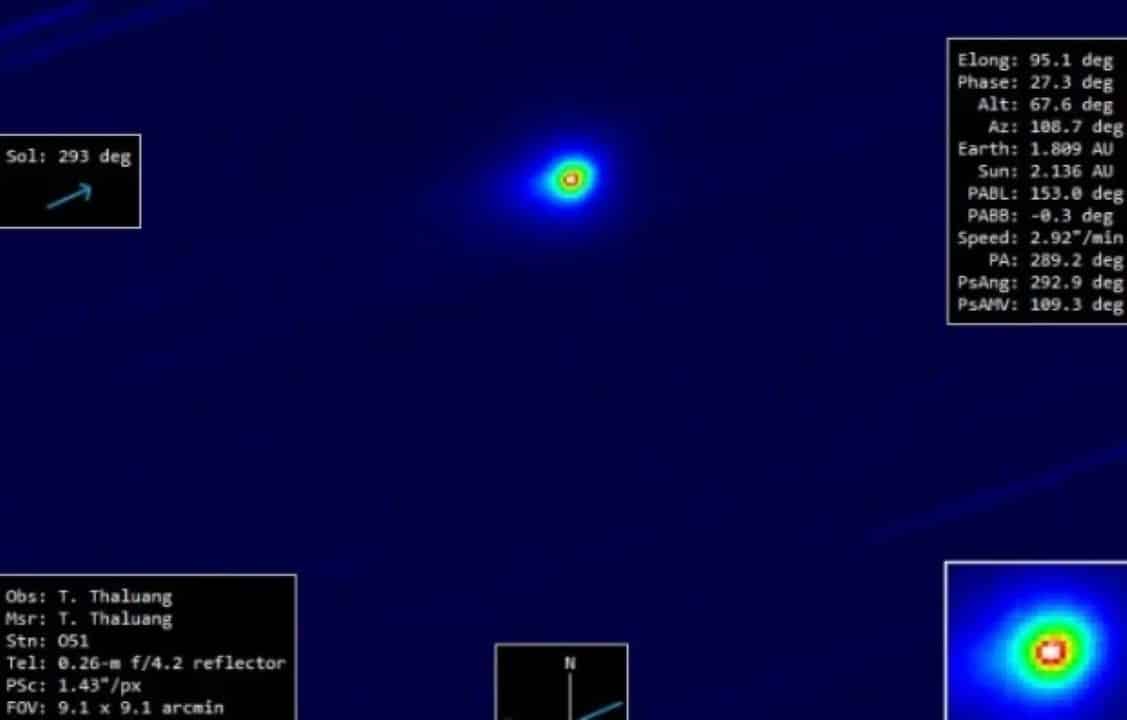
Images from mid-December 2025, captured by amateur and professional observers, show the sunward jet ten times smaller in width than its length. Processamentos with gradient filters highlights the linear and narrow structure. Essa extreme collimation persists at distances of hundreds of thousands of kilometers.
Telescopes like Gemini and remote observations confirm the persistence of the post-perihelion phenomenon. The stability of the jet suggests concentrated ejection mechanisms, possibly from active areas in the rotational core.
Comparison with known comets
Unlike comets of Sistema Solar, where anti-tails are perspective illusions, that of 3I/ATLAS is a real physical jet. Comparações with 2I/Borisov shows less collimation and dominant smaller particles. The absence of water in high proportions in the gas plume adds layers to the analysis.
Other interstellar objects, such as ‘Oumuamua, have not exhibited visible tails, making 3I/ATLAS unique in observed activity. Dados of Hubble and Parker Solar Probe assist in characterizing the nucleus and ejections.
Implications for interstellar studies
The presence of larger particles expands the understanding of the composition of objects outside Sistema Solar. Observações continued until definitive retirement in 2026 will provide more data on the rate of mass loss. Projetos like Galileo, led by Loeb, seek to distinguish natural origins from alternative hypotheses based on evidence.
Future spectroscopy could clarify jet velocities and composition, refining models of sublimation or other processes.



